
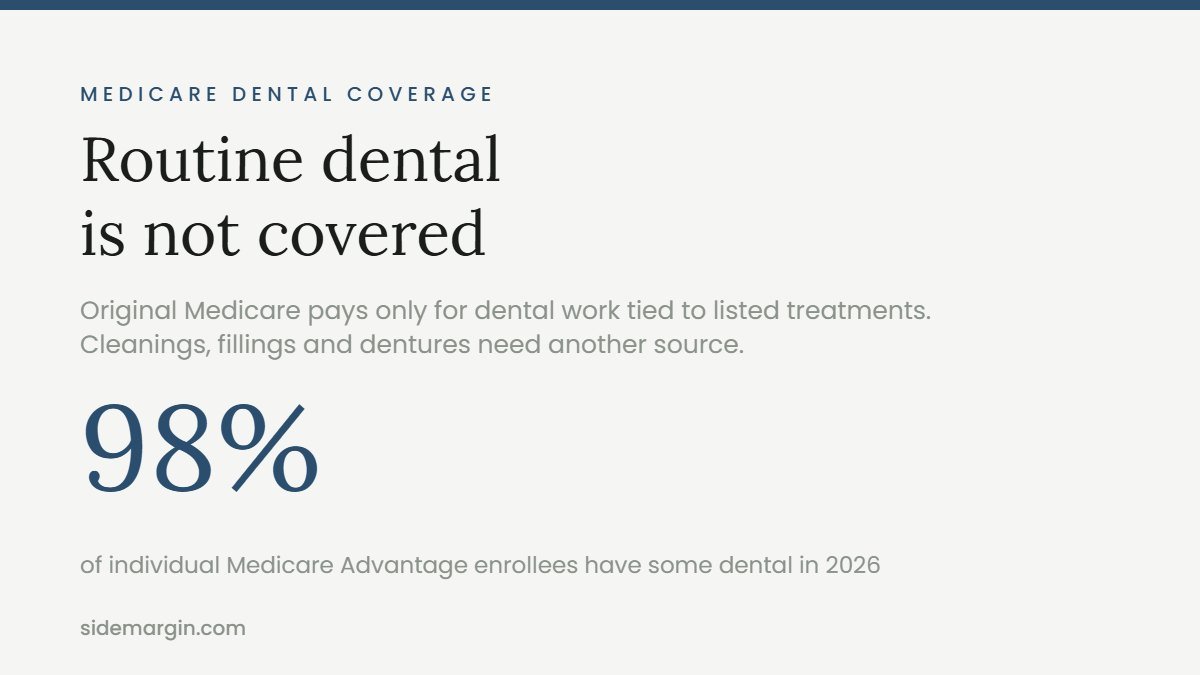
Mostly, no. Original Medicare’s Medicare dental coverage is limited by law to a short list of situations where dental work is tied to a covered medical treatment, such as an exam before a heart valve replacement or an organ transplant. Routine cleanings, fillings, extractions, dentures and implants are not covered. If you want coverage for those, it has to come from a Medicare Advantage plan, a separate dental policy, Medicaid, or PACE.
Open Enrollment for 2027 coverage runs October 15 to December 7, 2026, and dental is one of the main reasons people pick one Medicare Advantage plan over another. This piece covers what Original Medicare actually pays for, how Medicare Advantage dental plans work in practice, and what to check in the plan documents before you choose.
Key takeaways
- The exclusion is in the statute. Section 1862(a)(12) of the Social Security Act bars payment for routine care of the teeth. CMS rules since 2023 carve out only dental work tied to specific covered treatments.
- The exceptions list is now settled. CMS said it completed the list in its 2025 rule by adding dialysis for kidney failure, and made no changes for 2026.
- Almost every Medicare Advantage plan advertises dental. KFF counts 98% of enrollees in individual plans with some dental benefit in 2026. The question is how much it pays.
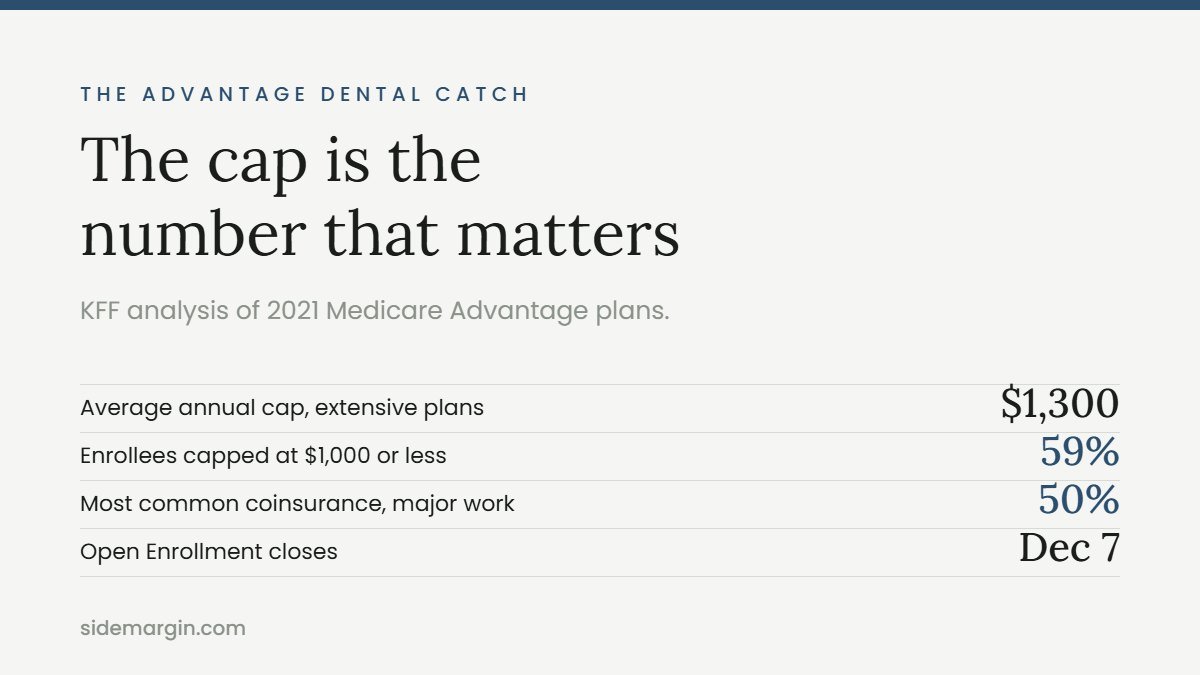
- Caps are the catch. In KFF’s analysis of 2021 plans, 59% of enrollees with extensive dental coverage had a yearly maximum of $1,000 or less, and 50% coinsurance was the most common charge for bigger work.
- Medigap does not cover dental. Neither does Part D.
- Leaving Medicare Advantage later can be hard. Outside protected windows, a Medigap insurer can refuse to sell you a policy.
Medicare dental coverage under Original Medicare: the rule
Original Medicare (Parts A and B) does not pay for ordinary dental care, and CMS cannot change that alone. It is in federal law. Section 1862(a)(12) of the Social Security Act excludes “items and services in connection with the care, treatment, filling, removal, or replacement of teeth or structures directly supporting the teeth.”
Medicare.gov says that in most cases Medicare does not cover cleanings, fillings, extractions, dentures or implants. The 2027 Medicare & You handbook lists “most dental care” among what Original Medicare leaves out.
What changed in recent years is the reading of that exclusion. Starting with its 2023 Physician Fee Schedule, CMS said that dental services which are inextricably linked to the clinical success of a covered medical service are not excluded. So if a mouth infection could wreck a transplant or cancer treatment Medicare already pays for, Medicare can pay to treat it. Your six-month cleaning is still out.
When Original Medicare pays for dental work
CMS built the list over three years of rulemaking. Here is the current set of clinical situations, as listed on CMS’s dental coverage page (last updated March 10, 2026), with the rule that added each one.
| Covered medical treatment | Dental services Medicare may pay for | Added or codified |
|---|---|---|
| Organ transplant, including bone marrow and stem cell transplant | Dental exam and needed treatment before the transplant | 2023 rule |
| Heart valve replacement or valvuloplasty | Dental exam and needed treatment before the procedure | 2023 rule |
| Jaw fracture repair; dislocated jaw joint treatment | Tooth stabilization and dental splints as part of that treatment | Long-standing |
| Head and neck cancer treatment (radiation, chemotherapy, surgery or a mix) | Dental exam and treatment before, and care for complications during | Announced 2023, codified 2024 |
| Chemotherapy, CAR T-cell therapy, or high-dose bone-modifying (antiresorptive) drugs for cancer | Dental exam and treatment to clear infection before or alongside treatment | 2024 rule |
| Dialysis for end-stage renal disease | Dental or oral exam, and diagnosis and treatment to eliminate an oral or dental infection, before or during dialysis | 2025 rule |
| Hospital stay needed because of a medical condition or the severity of the procedure | Part A covers the hospital care; the dentist’s work itself follows the rules above | Long-standing |
CMS described the 2025 dialysis addition as “completing the list” of scenarios. For 2026 it declined to add more, saying it would keep public suggestions in mind for the future. The 2026 final rule made no changes to how these services are paid. The 2027 Physician Fee Schedule proposal, released in July 2026, does not mention dental services in CMS’s fact sheet. As of today, then, the list above is the list.
The work has to be connected to the covered treatment: being on dialysis does not make an unrelated crown covered. Billing is also fiddly. Since July 1, 2025, these claims must carry a specific modifier and diagnosis codes. Ask your medical team for a written referral, and ask the dentist before treatment whether they can bill Medicare.
What you pay when Medicare dental coverage applies
When a dental service qualifies under Part B, you pay the usual Part B share: 20% of the Medicare-approved amount after the Part B deductible, which is $283 in 2026. If the work happens during a hospital admission covered by Part A, the Part A inpatient deductible applies instead, which is $1,736 per benefit period in 2026.
For anything not on the list, you pay 100%. Medigap will not help, because it only fills gaps in services Medicare covers.
How Medicare Advantage dental plans really work
Medicare Advantage (Part C) plans are run by private insurers. They must cover everything Original Medicare covers, and they can add extras. Dental is the most common extra. KFF found that 98% of enrollees in individual Medicare Advantage plans in 2026 are in a plan that offers some dental benefit, the same share as in 2025. Dental is also where plans spend the most of their extra money: MedPAC reports that dental made up 41% of conventional plans’ spending on non-Medicare benefits in 2025.
Plans usually split the benefit in two.
- Preventive: exams, cleanings and X-rays. Milliman found nearly all enrollees in 2024 plans with dental had coverage for these, often with no cost sharing.
- Comprehensive: fillings, extractions, root canals, gum treatment, crowns, dentures and sometimes implants. This is less universal and has been trimmed. Between 2023 and 2024, Milliman found the share of zero-premium plan enrollees with extraction coverage fell from 95% to 91%, and dentures and other prosthodontics from 88% to 86%.
Some plans also sell “optional supplemental” dental as a rider for an extra monthly premium. In KFF’s analysis of 2021 plans, about 10% of enrollees in plans with dental had to pay a separate premium to get any dental at all.
The annual maximum is the number that matters
Almost every plan limits how much it pays each year. MedPAC found nearly 90% of 2024 plans with dental used spending limits. Once you hit the cap, you pay the rest. That makes it work more like a yearly allowance than protection against a big bill.
A worked example, using made-up figures to show the mechanics rather than a real price: say your dentist quotes $3,000 for a mix of extractions and a partial denture. Your plan covers comprehensive care at 50% coinsurance with a $1,000 annual maximum. The plan’s 50% share would be $1,500, but it stops at $1,000. You pay $2,000. The same work under a plan with a $2,500 cap costs you $1,500. Same coinsurance; the cap is the difference.
The numbers on Medicare Advantage dental plans
Good data is thin. MedPAC notes CMS’s encounter data system could not accept dental records until 2024, so most figures come from plan filings and surveys.
| Measure | Figure | Source and year |
|---|---|---|
| Enrollees in individual MA plans with some dental benefit | 98% | KFF, 2026 |
| Enrollees with extensive coverage who face an annual dollar cap | 78% | KFF, 2021 plans |
| Average annual cap among those enrollees | $1,300 | KFF, 2021 plans |
| Enrollees with a cap of $1,000 or less | 59% | KFF, 2021 plans |
| Most common coinsurance for extensive services | 50% | KFF, 2021 plans |
| Enrollees with a shared preventive and comprehensive limit | 71% (up from 65% in 2023) | Milliman, 2024 |
| Plan rebate dollars spent on dental, conventional plans | About $19 per member per month | MedPAC, 2025 |
| Enrollees with MA dental who saw a dentist in the year | Just over half | MedPAC, 2017 to 2022 |
| MA enrollees who reported using dental benefits | 42% | Commonwealth Fund survey, late 2023 |
My read: the typical plan pays for checkups and a filling or two, and falls well short of a major restoration. About $19 a month is roughly $228 a year per member (my arithmetic on MedPAC’s figure), which fits a benefit sized for routine use, not dentures.
How to read a plan’s Medicare dental coverage before you enroll
The ad on television will say “dental included.” The documents tell you what that means. Three matter.
- Summary of Benefits. A short overview. Look for the dental rows: preventive copays, the comprehensive coinsurance, and the annual maximum. If the maximum is shared between preventive and comprehensive care, your cleanings eat into the money left for a crown.
- Evidence of Coverage (EOC). The full contract. Medicare.gov says plans send it each year, usually in the fall. Search it for “dental” and read the benefit chart for frequency limits (how many cleanings, how often X-rays), which services need prior authorization, and any exclusions such as implants.
- Annual Notice of Change. If you already have a plan, this lists changes to coverage, costs and networks that take effect in January. Check it for a lower dental cap or dropped services before you let the plan renew.
Then check the network. Medicare.gov notes you may need to use providers in the plan’s network. Your dentist may not be in it. In KFF’s review of ten sample plans, three paid nothing out of network. Ask your dentist’s office whether they take that exact plan for 2027, rather than the insurer in general.
Medigap, standalone dental insurance and discount plans
If you stay with Original Medicare, dental has to come from somewhere else.
Medigap does not help. Medicare.gov’s Medigap guide (March 2026 edition) lists vision and dental care, hearing aids, glasses, long-term care and private-duty nursing among the things Medigap policies generally do not cover.
Standalone dental insurance is the usual route. It works like any individual dental policy: a monthly premium, an annual maximum, and often waiting periods. Delta Dental describes 6 to 12 months as typical before fillings are covered and 12 months as often standard for crowns or dentures, with no wait for cleanings and exams. If you already know you need major work, a new policy may not pay for it in year one. Our guide to whether dental insurance is worth it walks through the premium versus benefit math.
Dental discount plans charge a membership fee for reduced prices at participating dentists. They are not insurance. The FTC warns that savings “typically are a lot less than promised,” and suggests calling the dentists on the list before paying and checking with your state insurance department that the program is licensed.
Medicaid, dual eligibility and PACE
If your income and savings are low enough to qualify for Medicaid as well as Medicare, your dental options depend heavily on your state. Medicaid.gov is blunt: states decide what dental benefits adults get, and “There are no minimum requirements for adult dental coverage.” CareQuest Institute counted 11 states plus DC with an extensive adult dental benefit as of December 31, 2024. Others cover only limited or emergency care, and states do cut benefits, so check your state’s current rules.
People with both Medicare and Medicaid can also join special needs plans for dual eligibles, which are Medicare Advantage plans built around that group; KFF reports that a similarly high share of special needs plan enrollees have dental benefits. If you do not qualify for full Medicaid, check the Medicare Savings Program, which can pay your Part B premium and free up money for dental bills, and Extra Help for drug costs.
PACE (Programs of All-Inclusive Care for the Elderly) lists dentistry among its covered services. It is for people 55 and older who live in a PACE service area, need a nursing home level of care as certified by the state, and can live safely in the community with PACE’s help. With Medicaid, there is no PACE premium and no cost sharing for care the PACE team approves.
Comparing your Medicare dental coverage options
| Option | Routine dental? | Main limits | Best fit |
|---|---|---|---|
| Original Medicare (A and B) | No | Only work tied to listed treatments; 20% after the Part B deductible | Anyone in a listed treatment group |
| Medigap | No | Covers Medicare cost sharing only | Pair with a separate dental policy |
| Medicare Advantage with dental | Usually | Annual caps, 50% coinsurance common for major work, network rules | People needing mostly checkups and minor work |
| Standalone dental insurance | Yes | Premiums, annual maximum, waiting periods for major work | Original Medicare users wanting routine coverage |
| Dental discount plan | Discounts only | Not insurance; savings vary | A known procedure at a participating dentist |
| Medicaid (dual eligible) | Depends on state | From emergency only to extensive | People with low income and assets |
| PACE | Yes, as approved by the care team | Age 55+, nursing home level of care, service area | Frail older adults living at home |
What changes for 2027 Medicare Advantage dental plans
Nothing in CMS’s 2027 rules targets dental directly. Three things still matter.
- Payments to plans are up. CMS’s April 6, 2026 rate announcement projects an average increase of 2.48%, over $13 billion, in payments to Medicare Advantage plans for 2027. Plans decide how much goes to extras.
- The mid-year reminder is gone. The 2027 final rule rescinded the requirement that plans send a mid-year notice of supplemental benefits you have not used. If you leave dental benefits unused in 2027, nobody has to remind you.
- Debit card rules tightened. Plans that deliver extras through a debit card must link the card to plan-covered items at the point of sale and limit it to the plan year.
Separately, KFF found 2026 plans held dental steady while cutting other extras such as over-the-counter allowances, meals and transportation. Whether that holds for 2027 will only show in this fall’s plan documents. Our Medicare Open Enrollment 2027 guide covers the dates and the rest of the comparison.
Questions to ask before choosing a plan for its dental benefit
- What is the annual maximum, and is it shared between preventive and comprehensive care?
- What coinsurance applies to fillings, extractions, root canals, crowns and dentures?
- Are dentures and implants covered at all, and how often can they be replaced?
- Is my dentist in network for this exact plan in 2027? What happens if I go out of network?
- Is there a waiting period or a separate premium for the dental rider?
- Which dental services need prior authorization?
- Does unused benefit money roll over, or does it expire December 31?
- Apart from dental, are my doctors, hospitals and drugs covered? A few hundred dollars of dental should not decide your medical plan.
That last point deserves weight. Switching from Original Medicare to Medicare Advantage for the dental extras can be hard to undo. Medicare.gov’s Medigap guide says that outside protected windows an insurer can deny you a policy based on medical underwriting. There is a trial right if you joined Medicare Advantage when first eligible at 65 and switch back within the first year, but after that the protection may be gone. We explain the risk in why Medicare Advantage can be a one-way door.
What to do before December 7
- If you are facing a transplant, heart valve surgery, head and neck cancer treatment, chemotherapy, CAR T-cell therapy or dialysis, ask your medical team now about a Medicare-covered dental exam. That coverage exists whatever plan you pick.
- Get a written cost estimate from your dentist for work you expect in 2027.
- If you have Medicare Advantage, find your Annual Notice of Change and compare the 2027 dental cap and coinsurance with 2026.
- For each plan on your shortlist, pull the 2027 Summary of Benefits and Evidence of Coverage and run your dentist’s estimate against the cap and coinsurance.
- If you are staying with Original Medicare, price a standalone dental policy and note the waiting periods before any major work.
- If money is tight, check your state’s Medicaid adult dental benefit and apply for the Medicare Savings Program.
- Make the change between October 15 and December 7, 2026. Medicare Advantage members get a second chance to switch plans from January 1 to March 31, 2027.
Sources
- Medicare.gov, dental services coverage
- CMS, Medicare dental coverage and the Section 1862(a)(12) exclusion
- CMS, CY 2024 Physician Fee Schedule final rule fact sheet
- CMS, Medicare Physician Fee Schedule final rule summary for CY 2025
- Center for Medicare Advocacy, CMS final rule includes important oral health clarification
- Center for Medicare Advocacy, Medicare will not expand on dental payment examples in 2026
- ADA News, CMS highlights medical and dental integration in 2026 Physician Fee Schedule
- CMS, CY 2027 Physician Fee Schedule proposed rule fact sheet
- CMS, 2026 Medicare Parts A and B premiums and deductibles
- Medicare.gov, Medicare & You 2027 handbook
- Medicare.gov, Understanding Medicare Advantage Plans (April 2026)
- Medicare.gov, Evidence of Coverage
- Medicare.gov, what Medigap covers
- Medicare.gov, Choosing a Medigap Policy (March 2026)
- Medicare.gov, PACE
- Medicaid.gov, dental care
- CareQuest Institute, Medicaid adult dental benefits by state
- KFF, Medicare and dental coverage: a closer look
- KFF, Medicare Advantage in 2026: premiums, out-of-pocket limits, supplemental benefits and prior authorization
- KFF, changes to the Medicare Advantage program for 2027
- MedPAC, June 2025 report, supplemental benefits in Medicare Advantage
- Milliman, dental coverage in Medicare Advantage plans, 2024 update
- Commonwealth Fund, how much do Medicare Advantage enrollees value and use their supplemental benefits
- CMS, Contract Year 2027 Medicare Advantage and Part D final rule fact sheet
- CMS, 2027 Medicare Advantage and Part D rate announcement
- Delta Dental, dental insurance waiting periods
- FTC, discount plan or health insurance