
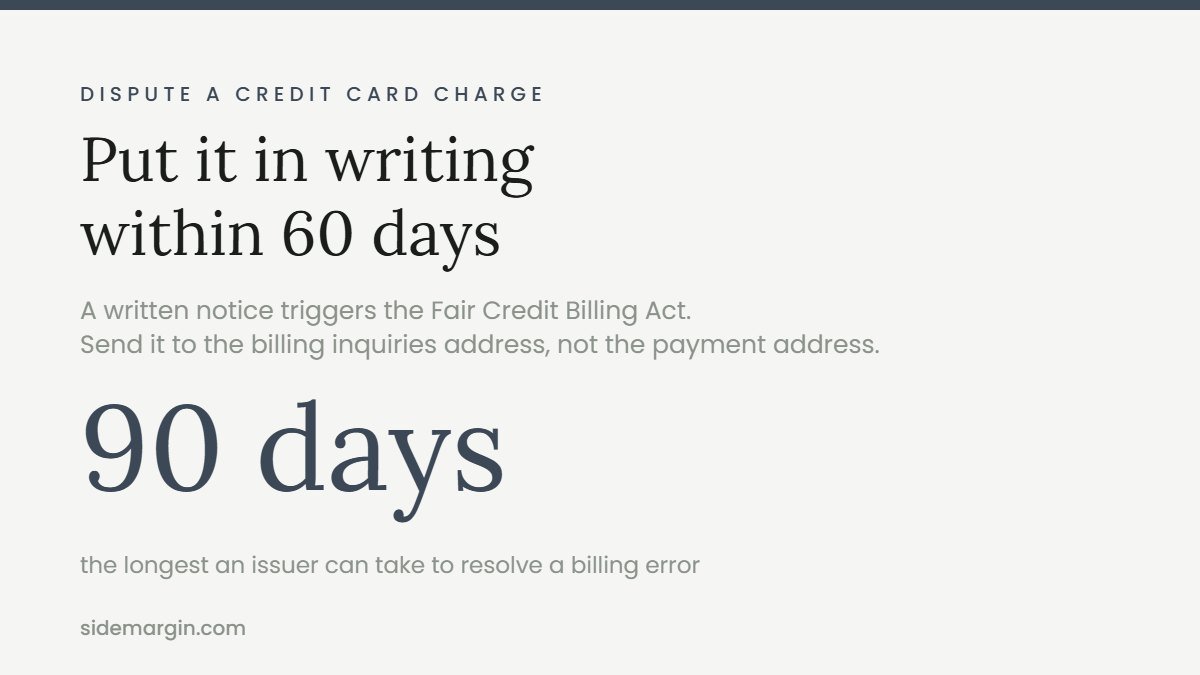
Here is how to dispute a credit card charge with your federal rights intact: ask the merchant to fix it first, then call or click “dispute” with your card issuer, and also mail a written billing error notice to the issuer’s billing inquiries address within 60 days of the statement that first showed the charge. That written notice triggers the Fair Credit Billing Act, which lets you withhold the disputed amount and puts the issuer on deadlines.
Most people only tap the button in the app. That often works, but it leaves the strongest protections unclaimed if the dispute goes badly. This is general information, not legal advice.
Key takeaways
- The 60 day clock starts with the statement, not the purchase.
- Write to the billing inquiries address, not the payment address. An app dispute alone may not preserve your rights.
- The issuer has deadlines too. It must acknowledge in writing within 30 days and resolve within two billing cycles, and never later than 90 days.
- You can hold back the disputed amount while it investigates, and it cannot report that amount as late.
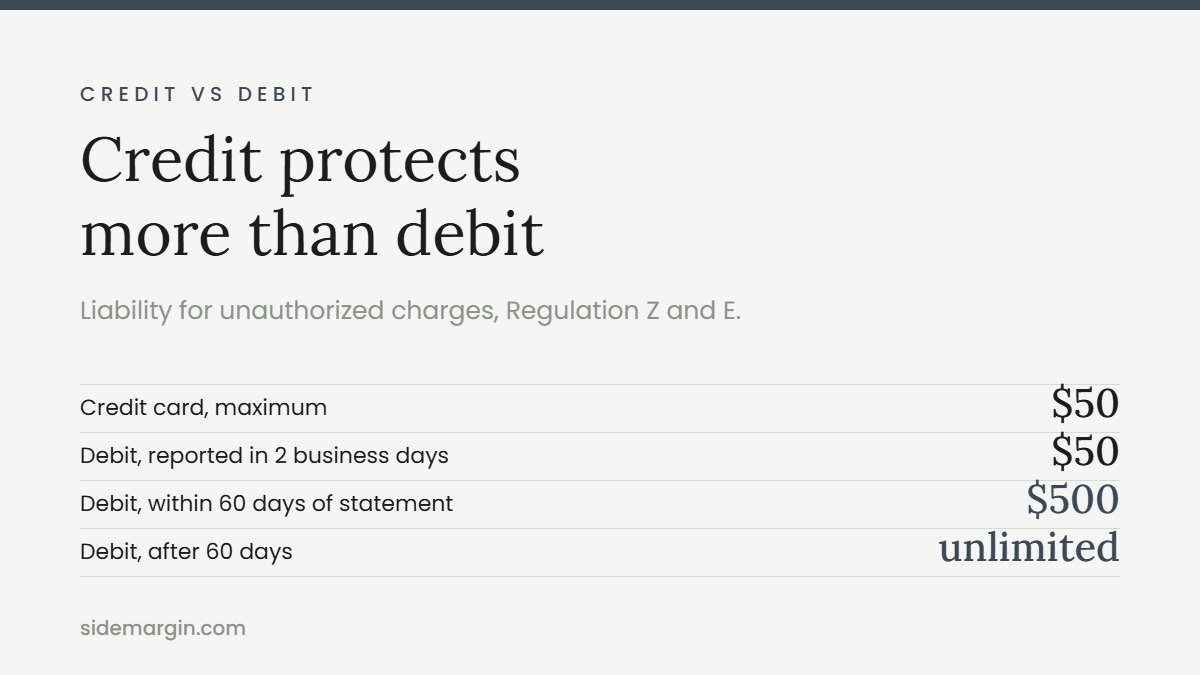
- Unauthorized credit card charges are capped at $50 by law, and $0 if only your number was stolen.
- Debit cards are weaker. Your liability grows the longer you wait, and a “bad product” complaint is not an error under the debit card rules at all.
Chargeback vs billing error: two systems, one button
A chargeback is the card network’s process. Your issuer pulls the money back from the merchant’s bank under Visa, Mastercard, American Express or Discover rules. These are private rules between banks, with deadlines set by the networks, not by Congress.
A billing error dispute is your legal right under the Fair Credit Billing Act (15 U.S.C. 1666) and Regulation Z (12 CFR 1026.13). It applies to credit cards and revolving charge accounts. The FTC notes it does not cover installment loans like car or appliance financing.
The CFPB describes disputing the charge and reporting a billing error as two options that can both get your money back. The difference shows up when things go wrong. If you only called, you rely on the issuer’s goodwill and the network’s rules. If you also sent the written notice, the issuer is bound by federal law.
What counts as a billing error you can dispute
Regulation Z lists seven kinds of billing error. In plain terms:
- A charge you, or someone you authorized, did not make.
- A charge that is not identified clearly enough for you to recognize it.
- A charge for goods or services you did not accept, or that were not delivered as agreed.
- A payment or credit the issuer failed to post properly.
- A math or bookkeeping mistake by the issuer.
- A charge you are asking the issuer to explain or document.
- The issuer’s failure to send your statement to your current address.
Notice what is and is not there. Double charges, wrong amounts and undelivered orders fit. So does a recurring charge that kept coming after you canceled properly, which is why the paper trail from canceling a subscription the right way matters so much later. Gyms are the classic case. If you are fighting one, the steps in how to cancel a Planet Fitness membership are the evidence you will need here.
“The product was bad” is not on the list. That falls under a different rule, below.
The deadlines that apply when you dispute a credit card charge
| Step | Deadline | Who |
|---|---|---|
| Written billing error notice received by the issuer | Within 60 days after the issuer sent the first statement showing the error | You |
| Written acknowledgment | Within 30 days of receiving your notice (unless it resolves the dispute sooner) | Issuer |
| Correct the error, or explain in writing why there was none | Within two complete billing cycles, and never later than 90 days | Issuer |
| Pay any amount found to be owed | At least the grace period, or 10 days if there is no grace period, before it can report you late | You |
| Tell the issuer you still dispute its decision | Within the time allowed to pay | You |
The 60 days runs to when the issuer receives the letter, not when you mail it. Send it tracked.
If the issuer skips these steps, the statute says it forfeits the right to collect the disputed amount and related finance charges, capped at $50. The real value of the deadlines is having something concrete to cite when you escalate.
Your rights while the dispute is open
Under 1026.13(d), once your written notice is in, you need not pay the part of your bill tied to the disputed amount, and the issuer may not try to collect it. You still have to pay the rest of the bill on time.
During the investigation the issuer also cannot:
- Report the disputed amount as delinquent, or threaten to.
- Try to collect the disputed amount.
- Restrict or close your account solely because you did not pay the disputed amount (15 U.S.C. 1666(d)).
If you already paid the charge, the CFPB says you can still dispute it, but “you probably won’t get the money back until the credit card company has decided that you were right.”
Quality problems: disputing a charge when the product was bad
If you got the item but it was defective, or the service was badly done, the right you are using is the “claims and defenses” rule in 12 CFR 1026.12(c). It lets you withhold payment of what is still unpaid, as if the issuer were the merchant. The conditions are tighter:
- You must have made a good faith attempt to resolve it with the merchant first.
- The purchase must be over $50.
- It must have been made in your home state or within 100 miles of your current address.
- You can only withhold what is still unpaid on that purchase, plus related finance charges, at the time you notify the issuer.
The $50 and 100 mile limits do not apply when the seller is the card issuer itself, is controlled by or controls the issuer, is a franchisee of the issuer, or when you bought through a mail solicitation from the issuer.
The 100 mile rule was written for in-person shopping. My read: for online and out-of-state purchases, the network chargeback process does most of the work. Dispute anyway, but do not count on this particular right if you already paid in full or bought far from home.
Fraud and unauthorized charges on a credit card
For a credit card, federal law caps your liability for unauthorized use at the lesser of $50 or the amount charged before you notify the issuer (12 CFR 1026.12(b)). The FTC adds that if only your account number is used, and the card itself was not lost or stolen, you owe nothing for charges you did not authorize.
In practice the $50 rarely comes up. Visa’s Zero Liability policy covers unauthorized charges on lost, stolen or fraudulently used Visa cards, and Mastercard’s covers unauthorized transactions in stores, online, by phone and at ATMs. Both have conditions: you must take reasonable care of the card and report problems promptly. Both exclude certain commercial and unregistered or anonymous prepaid cards.
For fraud, call the issuer first so it can lock the card. Then send the written notice for anything already on a statement.
Debit cards: why disputing a debit charge is harder
Debit cards run under Regulation E (12 CFR 1005), not the Fair Credit Billing Act. Three things differ.
Your money is already gone. With debit, the cash left your checking account and you are asking for it back.
Liability for fraud grows with delay. Under 12 CFR 1005.6, if your card is lost or stolen:
- $0 if you report before any unauthorized use.
- Up to $50 if you report within 2 business days of learning about it.
- Up to $500 if you report after 2 business days but within 60 days after your statement is sent.
- After 60 days, the FTC warns you could lose all the money taken, and possibly more.
If only your card number was stolen, the FTC says you are not responsible for unauthorized transactions reported within 60 calendar days after the statement is sent. Banks must extend these deadlines for extenuating circumstances.
Quality disputes are not covered by federal law. Regulation E’s list of “errors” includes unauthorized transfers, incorrect amounts, and bank bookkeeping mistakes. It does not include a defective product or a merchant who did not deliver what was promised. Your bank may still file a network chargeback, but that depends on the bank and network rules, not a federal right.
Where Regulation E does apply, the bank must investigate within 10 business days. It can take up to 45 days if it provisionally credits your account within 10 business days. That becomes 90 days for point-of-sale debit card purchases, transfers initiated outside the US, and transfers within 30 days of the account’s first deposit.
| Protection | Credit card (Regulation Z) | Debit card (Regulation E) |
|---|---|---|
| Unauthorized use liability | Up to $50; $0 if only the number was used | $0, $50, $500 or unlimited, depending on how fast you report |
| Deadline to report | Written notice received within 60 days of the statement | 2 business days for the lowest tier; 60 days after the statement for the rest |
| Defective or not as promised | Covered if over $50, in state or within 100 miles, merchant tried first | Not a Regulation E error; up to the bank and network |
| Your money during the dispute | You can withhold the disputed amount | Already withdrawn; provisional credit if the bank takes more than 10 business days |
| Issuer’s time limit | Two billing cycles, no more than 90 days | 10 business days, or 45 days (90 for POS debit) with provisional credit |
| Credit reporting during the dispute | No adverse report on the disputed amount | Not usually relevant; no credit line involved |
For online shopping, travel, and anything prepaid far ahead, a credit card paid in full each month is the stronger choice.
How to dispute a credit card charge, step by step
1. Contact the merchant first (unless it is fraud). The CFPB’s first step is to go to the seller. Ask in writing, by email or chat, so there is a record. For quality claims this is required.
2. Give the merchant a short, fair deadline. A week is reasonable. Watch your own 60 day clock.
3. Open the dispute with your issuer. Use the app or the number on the card, and note any case number.
4. Send the written billing error notice. Find the billing inquiries address on your statement or in your card agreement. The FTC is specific: “Use the address given for billing inquiries, not the address for sending your payments.” Include your name, address, account number, the charge, and why it is wrong. Send copies, never originals.
5. Pay the undisputed part of the bill on time.
6. Keep a file. Log every call date, as the CFPB suggests.
7. Answer requests fast. A missed document request is an easy way to lose.
Evidence that helps, depending on the case:
- The receipt or order confirmation, with the price you agreed to.
- Cancellation confirmation or return tracking.
- Emails or chat transcripts showing you asked the merchant to fix it.
- Photos of a damaged or wrong item, taken as soon as it arrived.
- A dated screenshot of the merchant’s refund policy.
A medical charge you paid by card is a special case. If the problem is the bill itself, work through disputing the medical bill with the provider and insurer first, since a card dispute cannot fix a coding error.
A sample credit card dispute letter
Keep it short and factual. Replace the brackets.
[Your name], [your address], [date]. To: [Card issuer], Billing Inquiries, [billing inquiries address from your statement].
Re: Billing error notice, account ending [last four digits].
I am writing to dispute a billing error on my statement dated [statement date]. The charge is from [merchant name] on [transaction date] for [$ amount].
This charge is in error because [one or two sentences: for example, I canceled this service on (date) and received confirmation number (number), or the order was never delivered, or I was charged twice for one purchase]. I contacted the merchant on [date(s)] and asked for a refund, and the problem has not been resolved.
I am asking you to credit [$ amount] and any related finance charges and fees to my account, and to send me an accurate statement. Copies of [receipt, cancellation confirmation, emails] are enclosed. I understand I do not have to pay the disputed amount while you investigate.
Sincerely, [your name and signature]. Enclosures: [list].
What happens if you lose a credit card dispute
If the issuer decides there was no error, Regulation Z says it must explain why in writing, and send you the documentary evidence if you ask for it. It must also tell you the amount owed and the due date.
You then get the normal grace period, or at least 10 days, to pay before the issuer can report the amount as delinquent. Two things matter here:
- If you tell the issuer in writing, within that payment window, that you still dispute the amount, it may report you but must also report that the amount is in dispute, tell you who received that report, and later report the outcome to them too.
- The issuer does not have to reinvestigate if you simply send the same billing error again.
After a loss, you can file a complaint with the CFPB about the issuer’s handling, especially if it missed a deadline. You can also take the merchant to small claims court.
Chargeback abuse, “friendly fraud” and merchant retaliation
Visa defines friendly fraud as a cardholder disputing a legitimate purchase that they or someone in their household made. Examples include a family member using a saved card and disputing after missing a return window. Visa cites industry research putting friendly fraud at around 20% of fraud disputes globally.
Merchants can fight back. Under Visa’s Compelling Evidence 3.0 rules, in effect since April 2023, a merchant facing a fraud claim can point to two earlier undisputed purchases, made 120 to 365 days before the dispute, sharing data such as the same device, IP address or login. If that evidence shows you took part in the transaction, the dispute can be invalidated.
What this means for you:
- Before claiming fraud, search your email for the merchant name and ask your household.
- Do not claim fraud when your real complaint is quality or a refund. Describe the actual problem.
- The FCBA protects your card account from the issuer. It does not govern the merchant. A store that sees you as a chargeback risk can close your account with it under its own terms.
- The federal rule only bars your issuer from closing or restricting the card solely because you did not pay a disputed amount before it sends its written answer.
PayPal and buy now, pay later disputes
PayPal. Its Purchase Protection covers items not received and items significantly not as described. Open a dispute within 180 days of paying for an item not received. For an item not as described, it is 30 days from delivery or 180 days from payment, whichever is sooner. You then have 20 days to escalate to a claim if you and the seller cannot agree. PayPal says that if you also file a chargeback with your card issuer, it will close its case. You cannot run both at once.
Buy now, pay later. In 2024 the CFPB issued an interpretive rule treating pay-in-four lenders like credit card issuers for dispute and refund purposes. That no longer stands. The CFPB said in May 2025 it would not prioritize enforcing it, and on May 12, 2025, it withdrew the rule along with other guidance documents. As of September 2026, BNPL disputes run mainly on each lender’s own policy. Klarna, for example, says to select “Report a problem” on the purchase in its app, that it pauses your payment until the issue is solved, and that claims for goods not received or significantly different must be raised within 120 days of purchase.
What to do today
- Find the statement that first showed the charge and write its date on a note. Count 60 days forward. That is your deadline for the issuer to receive your letter.
- If it is fraud, call the issuer now to lock the card. If it is a debit card, today matters more: your liability goes up after 2 business days.
- If it is a merchant problem, send one written request for a refund today and save a copy.
- Open the dispute in your card app, then mail the written notice to the billing inquiries address the same week.
- Set reminders at 30 and 90 days for the issuer’s answers.
Sources
- Cornell LII, 15 U.S.C. 1666, correction of billing errors
- CFPB, Regulation Z 12 CFR 1026.13, billing error resolution
- Cornell LII, 12 CFR 1026.13
- Cornell LII, 12 CFR 1026.12, unauthorized use and claims and defenses
- Cornell LII, Regulation E 12 CFR 1005.6, liability for unauthorized transfers
- CFPB, Regulation E 12 CFR 1005.11, error resolution
- Cornell LII, 12 CFR 1005.11
- CFPB, How do I dispute a charge on my credit card bill?
- CFPB, How can I get a refund on a product or service I purchased with my credit card?
- FTC, Using credit cards and disputing charges
- FTC, Lost or stolen credit, ATM and debit cards
- Visa, Zero Liability policy
- Mastercard, Zero Liability protection
- Visa, Friendly fraud explained
- Visa, Evolution of Compelling Evidence merchant FAQs
- PayPal, Purchase Protection program
- CFPB, Buy now, pay later products (withdrawal of the 2024 interpretive rule)
- CFPB, Announcement regarding enforcement actions related to BNPL loans, May 2025
- Klarna, Buyer Protection