
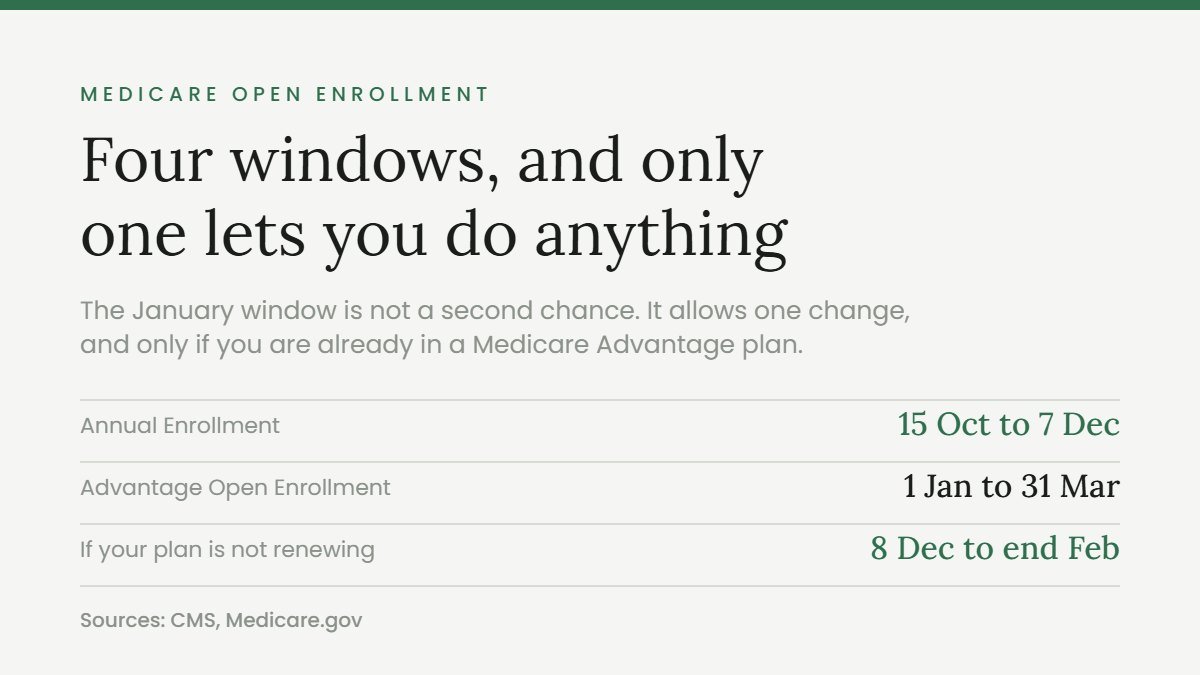
Medicare open enrollment runs from 15 October to 7 December 2026 for coverage that starts on 1 January. Most guidance stops there, which is why so many people use the window badly. Medicare does not have one enrolment period. It has four, they allow different things, and the one change that is hardest to undo is not covered by any of them.
This is a guide to what each window actually permits, and to the asymmetry that makes one decision in October very difficult to reverse in March.
Key takeaways
- The Annual Enrollment Period is 15 October to 7 December 2026. It is the only window in which anyone can move freely between Original Medicare and Medicare Advantage, or change a standalone drug plan.
- The January to March window is not a second bite. It allows one change, and only if you are already in a Medicare Advantage plan.
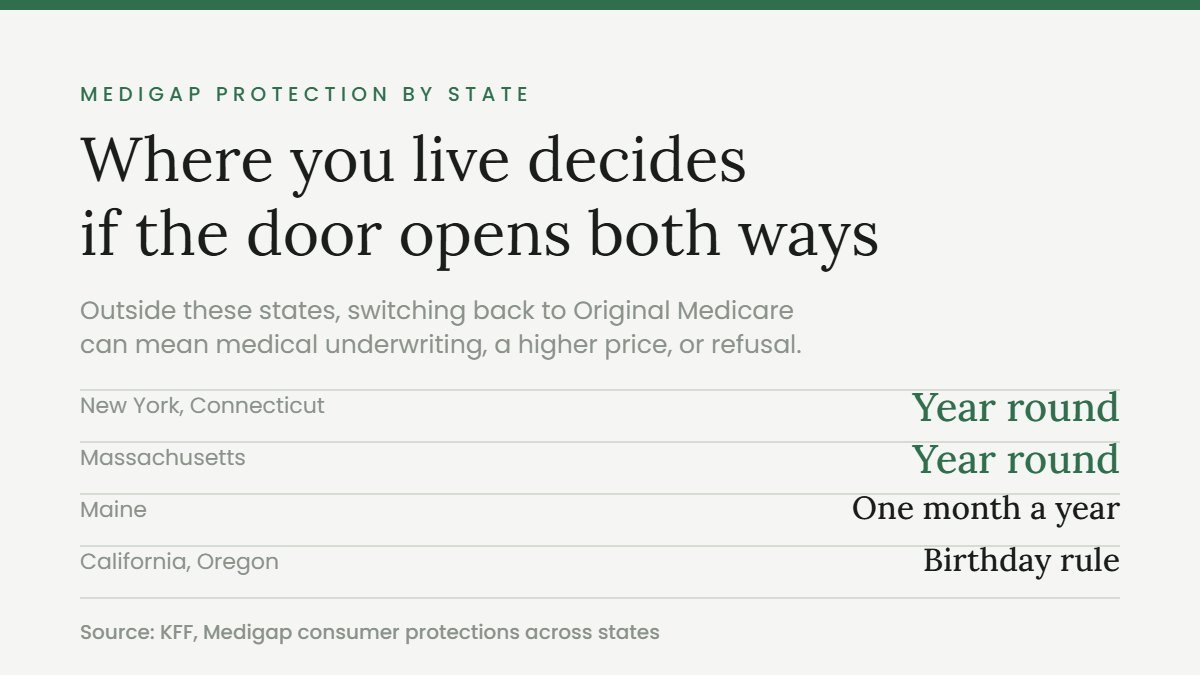
- Medigap has no open enrollment. Outside narrow windows an insurer can medically underwrite you, charge more, or decline you. This is the one-way door.
- Four states protect you year round or annually. Everywhere else, KFF puts it bluntly: people switching back to traditional Medicare “may be denied a Medigap policy due to a pre-existing condition.”
- If your plan is not renewing, you get a longer window, running from 8 December to the last day of February, plus a guaranteed right to buy certain Medigap policies.
- The 2027 Part B premium is not out yet. CMS usually announces in mid-November, which is after enrolment opens and three weeks before it closes.
The four windows, and what each one actually allows
| Window | Dates | What it allows |
|---|---|---|
| Annual Enrollment | 15 Oct to 7 Dec 2026 | Anything: Original Medicare to Medicare Advantage and back, switch Advantage plans, join, switch or drop a drug plan |
| Medicare Advantage Open Enrollment | 1 Jan to 31 Mar 2027 | One change, and only if already in Advantage |
| General Enrollment | 1 Jan to 31 Mar | Sign up for Part A or B if you missed your initial window |
| Special Enrollment | Event-driven | Varies by trigger, day counts are precise |
The January window is the one people misread. It is not a general do-over. If you are in Original Medicare on 1 January, you cannot use it at all. If you are in a Medicare Advantage plan, you may switch to a different Advantage plan or return to Original Medicare, once.
There is a further trap inside it. Someone in a Medicare Advantage plan who gets drug coverage through a separate standalone plan can only move to an Advantage plan without drug coverage, or to Original Medicare. They cannot change their standalone drug plan in this window. For drug plan changes the deadline really is 7 December, which is why the Medicare Part D plans comparison should happen before the autumn ends rather than in January.
One piece of good news that has not filtered through. The General Enrollment Period used to carry a punishing gap, with coverage not starting until 1 July. That ended. Coverage now begins the month after you sign up.
Medigap is the door that only opens one way
Here is the asymmetry that governs the whole decision, and it is not mentioned in most open enrolment checklists.
Moving from Original Medicare into Medicare Advantage is easy. Moving back is easy too. What is not guaranteed is getting a Medigap policy once you return, and without one, Original Medicare leaves you exposed to 20% coinsurance with no annual cap.
Medicare’s own guide states the rule without softening it: “There’s no guarantee that an insurance company will sell you a Medigap policy if you don’t meet their medical underwriting requirements.”
Guaranteed issue rights exist, but the same guide defines them narrowly: “Guaranteed issue rights or ‘Medigap protections’ are your rights to buy certain Medigap policies in limited situations outside of your Medigap Open Enrollment Period.”
Those limited situations are real and worth knowing, because each is time-boxed to 60 days before and no more than 63 days after the relevant coverage ends:
- You joined Medicare Advantage when you first became eligible at 65 and want Original Medicare back within the first year.
- You dropped a Medigap policy to try Medicare Advantage for the first time, have been in it less than a year, and want your old policy back.
- Your plan leaves Medicare, stops serving your area, you move out of its service area, or it makes a significant network change.
- Your employer group coverage alongside Original Medicare ends.
Read what is absent. Someone in year three of a Medicare Advantage plan who simply decides they do not like it, and switches during open enrolment, has no federal guaranteed issue right at all. They can be underwritten, surcharged, or refused. The deeper mechanics of that trade sit in the Medicare Part C one-way door guide.
Where you live decides how reversible your choice is
State law can be more generous than federal law, and a handful of states are.
| State | Protection |
|---|---|
| New York | Continuous, year-round guaranteed issue |
| Connecticut | Continuous, year-round guaranteed issue |
| Massachusetts | Continuous, and pre-existing condition waiting periods are prohibited |
| Maine | Guaranteed issue for one month a year, set by the insurer |
| California, Oregon | Birthday rule: 30 days to switch to an equal or lesser plan |
| Missouri | 30 days around your policy anniversary to switch to an equivalent plan |
KFF states the consequence for everyone else directly: “In all other states and D.C., people who switch from a Medicare Advantage plan to traditional Medicare may be denied a Medigap policy due to a pre-existing condition.”
If you live outside those states and you are weighing Medicare Advantage, the honest way to frame the decision is that you are choosing it for as long as your health holds. That is not an argument against it. It is an argument for making the choice deliberately.
If your plan is not being renewed, you have more rights, not fewer
Insurers withdraw plans and exit counties every year, and the letters land in the autumn. This feels like bad news and is partly good news, because a non-renewal triggers protections a voluntary switch does not.
- A longer enrolment window. Where a plan’s contract is not renewed, the special enrolment period runs from 8 December to the last day of February of the following year, well past the 7 December deadline everyone else faces.
- If Medicare terminates the contract or the plan leaves your area, the window starts one month before the contract ends and runs two full months after.
- If the plan itself initiates the non-renewal, it starts two months before and ends one full month after.
- A Medigap guaranteed issue right, under the 60 days before and 63 days after rule above.
Do not let the Medigap clock run out while you shop for an Advantage replacement. The 63 day limit is the binding one, and it is the only chance many people get to buy a supplement without underwriting.
Two smaller windows worth knowing
The low-performing plan escape hatch. If your plan has been rated under three stars for three consecutive years, you can leave at any time while you are in it, not only during open enrolment.
The five-star switch. If a five-star plan is available where you live, you can move to it once between 8 December and 30 November the following year. Star ratings for 2027 are published in early October, just before enrolment opens, so this is worth a look before you commit.
Ratings matter beyond the badge. Plans at four stars and above receive bonus payments, and those payments are frequently what funds the dental, vision and over-the-counter extras. A plan that slips can trim those benefits the following year.
The letter that arrives before the window opens
Your Annual Notice of Change should reach you by 30 September. It is the single most useful document in this process and the most ignored.
Check six things: the premium, the out-of-pocket maximum, the copays for the doctors you actually see, whether your drugs moved tier, whether your providers and pharmacies are still in network, and whether the extra benefits changed.
If you do nothing, you are re-enrolled in the same plan on 1 January with whatever those changes are. A plan that suited you in 2026 is not automatically the right plan for 2027, and the comparison only takes an afternoon once a year.
What is not known yet, and when it will be
As of the middle of September 2026, CMS has not announced the 2027 Part B premium, the Part B deductible, or the income-related adjustment brackets. The pattern is a mid-November announcement: the 2026 figures were published on 19 November 2025.
That means enrolment opens, and nearly runs out, before the number lands. Figures circulating now are actuarial projections from the Trustees Report, not decisions. Treat any article presenting a confident 2027 Part B premium as having got ahead of the evidence, and check the CMS newsroom in November before you finalise a budget.
What to do, in order
- Read the Annual Notice of Change. If it has not arrived, ring the plan.
- If it says the plan is not renewing, note the 8 December to end of February window and start the Medigap conversation immediately.
- Look at the 2027 star ratings in early October.
- Compare properly between 15 October and 7 December, with your real drug list and your real doctors.
- If you are leaving Medicare Advantage without a qualifying trigger, get underwritten Medigap quotes before you drop anything. Do not cancel and then shop.
- Check whether you qualify for help paying for any of it. Medicare Extra Help covers drug costs, and the Medicare Savings Programs cover premiums.
Figures current as of 16 September 2026. The 2027 Part B premium, deductible and income-related adjustment brackets had not been announced at that date. State Medigap rules change, so confirm with your own state insurance department before relying on one.
Sources
- CMS, Medicare Open Enrollment partner resources
- Medicare.gov, Choosing a Medigap Policy (publication 02110)
- Medicare.gov, Special Enrollment Periods
- KFF, Medigap Enrollment and Consumer Protections Vary Across States
- Medicare.gov, When does Medicare coverage start
- NCOA, What is a Medicare Annual Notice of Change
- CMS Newsroom, for the 2027 Part B announcement