
Medicare Part C is the official name for Medicare Advantage, and switching into it is easy. Open enrollment runs October 15 to December 7, the plans are heavily advertised, and many carry a $0 premium. What almost nobody explains at that moment is that the door mostly swings one way.
If you later want to go back to Original Medicare with a Medigap policy, the insurer is usually allowed to look at your health first, and to say no. This article is about that asymmetry, because it is the single most consequential thing about Medicare Part C and it is buried in almost every comparison you will read this autumn.
Key takeaways
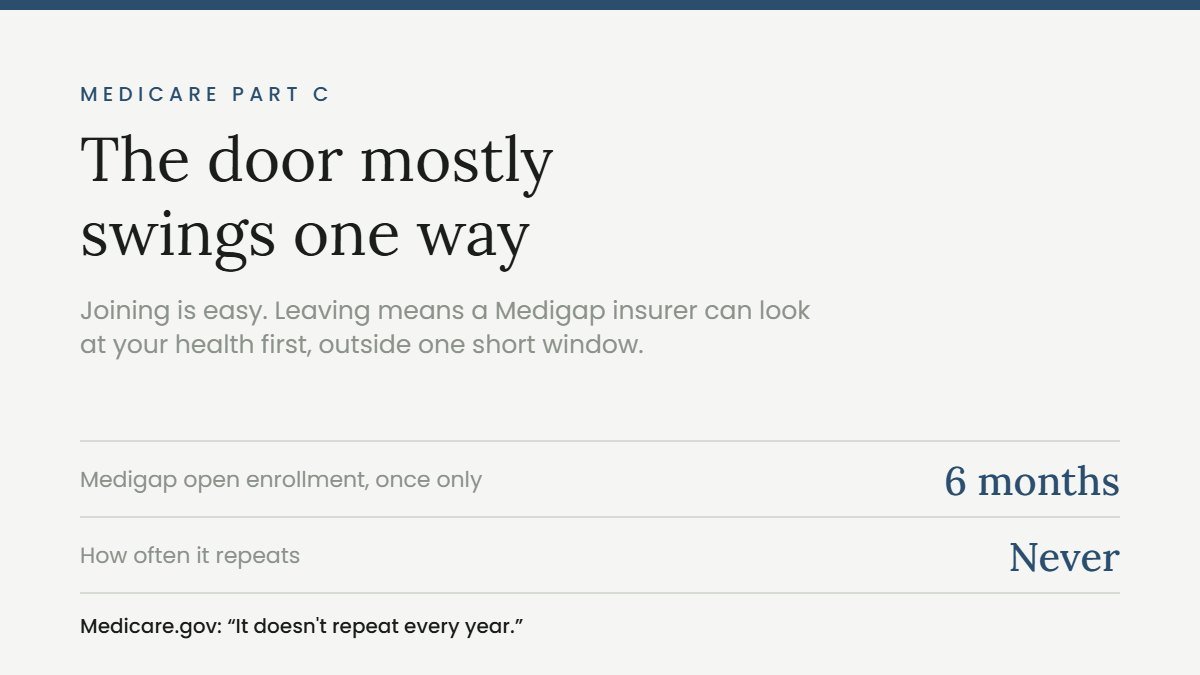
- Your Medigap Open Enrollment Period lasts six months and never comes back. Medicare.gov says so directly: “It doesn’t repeat every year.”
- Outside that window and a short list of exceptions, a Medigap insurer can deny you a policy based on your health.
- There are two trial rights, and they are not the same right. One gets you any policy in your state. The other gets you your old policy back from your old company, if they still sell it.
- The January to March switching window is a trap. You can drop Medicare Part C and return to Original Medicare, but that return is not on Medicare’s guaranteed-issue list.
- Only four states require insurers to sell Medigap regardless of health on a continuous or annual basis.
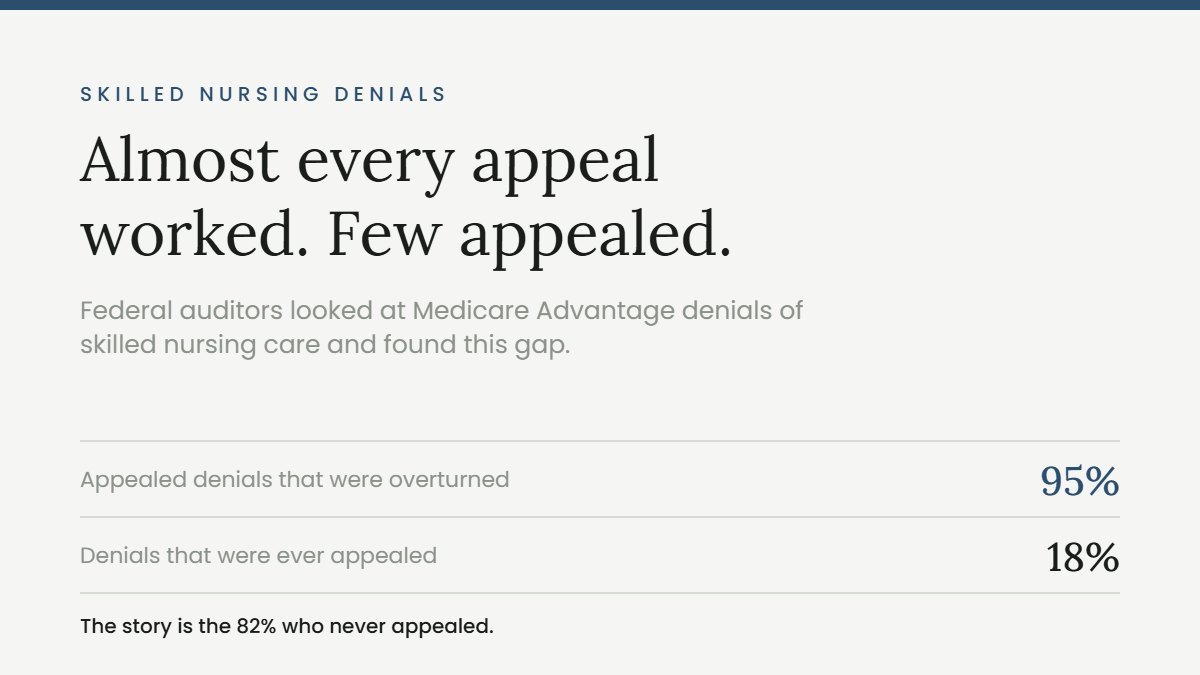
- When skilled nursing denials were appealed, plans overturned 95% of them. Only 18% were ever appealed.
What Medicare Part C actually is
Medicare Part C is Parts A and B delivered by a private insurer instead of by the government, usually with Part D drug coverage bundled in. The plan takes a fixed payment per enrollee and manages the care.
That structure produces the differences that matter. From Medicare’s own guide to these plans:
“You may need to use doctors in its network and get approval for certain drugs or services.”
And the genuine upside, from the same guide:
“Plans have a yearly limit on what you pay for covered Part A and Part B services… Once you reach your plan’s limit, you’ll pay nothing for covered services for the rest of the year.”
Original Medicare has no such cap. That is a real and important advantage, and it is why more than half of eligible beneficiaries now choose Medicare Part C.
The Medicare Part C one-way door, in plain terms
Medigap is the supplemental insurance that fills the gaps in Original Medicare. There is exactly one period in your life when a Medigap insurer must sell to you regardless of your health.
It starts the first month you are both 65 or older and enrolled in Part B. It lasts six months. And Medicare.gov is blunt about what happens next:
“Your Medigap Open Enrollment Period is a one-time enrollment period. It doesn’t repeat every year.”
During those six months, insurers “can’t use medical underwriting to decide whether to accept your application or deny you coverage due to pre-existing health problems.” After it ends:
“the insurance company is allowed to deny you a policy if you don’t meet their medical underwriting requirements.”
So the sequence that causes the problem is ordinary and reasonable at every step. You turn 65, you pick a Medicare Advantage plan because the premium is low and the dental benefit is nice, your six-month Medigap window quietly expires, and five years later a diagnosis makes you want the freedom of Original Medicare. At that point the Medigap insurer gets to review your health.
Medicare’s own guide to switching says it about as plainly as a government page can:
“In most cases you won’t be able to get it back, so pay attention to the timing.”
The two trial rights are not the same right
Most articles compress this into “you get 12 months to change your mind.” There are actually two distinct trial rights and they buy you different things.
| Situation | What you can buy |
|---|---|
| You joined Medicare Part C when first eligible at 65, and within the first year you want to switch to Original Medicare | Any Medigap policy sold in your state |
| You dropped a Medigap policy to try Medicare Part C for the first time, have been in the plan under a year, and want the policy back | The policy you had before, if that same company still sells it |
The second one is narrower than it sounds. You get your old policy from your old insurer. Only if that company no longer sells it do you fall back to Plans A, B, C, D, F or G from another insurer, and Plans C and F are closed to anyone who became eligible for Medicare on or after January 1, 2020.
Both have the same deadline: you can apply as early as 60 days before your coverage ends, and no more than 63 days after it ends. Miss that and the right is gone.
The January to March Medicare Part C trap
There is a second switching window every year, the Medicare Advantage Open Enrollment Period, running January 1 to March 31. It lets you switch to a different Medicare Part C plan, or drop Medicare Part C and go back to Original Medicare. You can only make one change during it.
Here is the trap. Returning to Original Medicare during that window is not among the situations Medicare.gov lists as giving you a guaranteed issue right for Medigap. Unless one of the trial rights above applies to you, you land in Original Medicare with no supplemental coverage and a Medigap application that can be underwritten.
Original Medicare with no Medigap means no annual out-of-pocket cap at all. That is a worse financial position than the Medicare Part C plan you just left. This is the specific mistake worth avoiding, and the window’s existence actively encourages it.
If cost is the reason Medicare Part C looked attractive, check the two programmes that cut Original Medicare’s costs directly before you switch: the Medicare Savings Program for premiums and cost sharing, and Extra Help for prescriptions.
The other doors back
Guaranteed issue rights do exist outside the trial rights. The common ones:
- Your plan leaves Medicare, or stops serving your area
- You move out of the plan’s service area
- Your employer or union group coverage ends
- The plan misled you or broke its own rules
- You lose Medigap coverage through the company’s fault
The standard window is 60 days before to 63 days after the coverage ends. Medicare.gov also notes that “Your rights may last an extra 12 months in certain circumstances” and points people to their State Insurance Department, which is the right place to ask about your specific situation.
Four states where the door stays open
Where you live changes this materially. According to KFF, Connecticut, Maine, Massachusetts and New York require Medigap insurers to sell to all beneficiaries aged 65 and over either continuously or for at least one month a year. Connecticut, Massachusetts and New York are continuous. Maine runs an annual one-month window for Plan A, plus year-round switching to equal or lesser benefits where there is less than a 90-day gap.
Several other states have “birthday rules” that let you switch policies each year without underwriting. Sourced to the state regulators themselves:
| State | Window | Limit |
|---|---|---|
| California | 60 days following your birthday | Same or lesser benefits |
| Oregon | 30 days before to 30 days after your birthday | Guaranteed “regardless of your health” |
| Nevada | First day of your birthday month, at least 60 days | Same or lesser benefits, no underwriting |
| Missouri | 30 days either side of your policy anniversary | Equivalent plan |
One correction worth making, because it propagates. KFF’s widely-copied state table says California’s window is 30 days. The California Department of Insurance says you have 60 days of open enrollment following your birthday each year. Articles that copied the older table are wrong on this.
A handful of other states have added similar rules. The KFF state comparison dates from 2018, so confirm anything here with your own state insurance department before relying on it.
The honest case for Medicare Part C
This article is not an argument against Medicare Advantage, and more than half the market is not making a mistake.
KFF reports that 55% of eligible Medicare beneficiaries are enrolled in Medicare Advantage in 2026, about 35.2 million of 64.2 million people, up roughly 1.1 million on the year. The Congressional Budget Office projects 63% by 2034.
The reasons are real:
- An out-of-pocket maximum. Original Medicare has none. For someone without Medigap, this is the difference between a bad year and a ruinous one.
- Lower cost up front. Many plans have a $0 premium, against a Medigap premium that can run well over $100 a month and rises with age.
- Drug coverage bundled in, instead of a separate Part D plan to choose and manage.
- Extras like dental, vision and hearing that Original Medicare does not cover.
If your budget cannot absorb a Medigap premium, Medicare Part C is not a compromise. It is the option that caps your downside.
The honest case against, with numbers
The trade-off is prior authorization and networks, and there is federal audit data rather than opinion.
The HHS Office of Inspector General examined denials in 2022 and found that “among the prior authorization requests that MAOs denied, 13 percent met Medicare coverage rules”. Those are requests that would have been covered under Original Medicare.
A June 2026 OIG report looked at skilled nursing facility admissions and produced the number that should change how you think about this:
“When SNF denials were appealed, MAOs overturned 95 percent in favor of the enrollee.”
And the number that makes it matter:
“Enrollees and their providers appealed 18 percent of SNF denials.”
Read those together. Almost every appealed denial was reversed, and fewer than one in five was ever appealed. The story is not the denial rate. It is the 82% who accepted a decision that would probably have been overturned.
The practical instruction is short: if your plan denies something your doctor says you need, appeal it. The odds are far better than the process suggests.
A separate June 2026 OIG report found that in a single month, 19 plans denied roughly two-thirds of requests for long-term care hospital admission and more than half of requests for inpatient rehabilitation facility admission.
Two things that changed in 2026
Plans now have to publish their own denial numbers. Under CMS rule 0057-F, from January 1, 2026 Medicare Advantage organizations must “publicly report certain prior authorization metrics annually by posting them on their website,” and must give “a specific reason for denied prior authorization decisions.” Decisions are due within 72 hours for urgent requests and seven calendar days for standard ones.
That is genuinely actionable. Before you enroll, you can look up the plan’s own published numbers.
Prior authorization is no longer a Medicare Advantage-only feature. CMS is running a model called WISeR “for six performance years from January 1, 2026 to December 31, 2031 in six states: New Jersey, Ohio, Oklahoma, Texas, Arizona, and Washington,” applying prior authorization to Original Medicare for a list of services including skin substitutes, nerve stimulator implants and knee arthroscopy for osteoarthritis. It does not apply to Medicare Advantage.
If you live in one of those six states, the clean “Original Medicare has no prior authorization” comparison no longer holds for those specific services.
The dates themselves, and what you can and cannot change inside each window, are set out in the Medicare open enrollment guide.
What is confirmed for Medicare Part C in 2027
Open enrollment runs October 15 to December 7, 2026, for coverage starting January 1, 2027. Your plan must receive the enrollment request by December 7.
CMS published the 2027 out-of-pocket limits in April 2026. These are ranges that plans must set their limits within, not a single number:
| Plan type | Mandatory limit range |
|---|---|
| HMO and HMO-POS, in-network | $7,151 to $9,850 |
| PPO, in- and out-of-network combined | $7,151 to $14,800 |
Plans can choose lower limits, and many do. Check the actual number on the plan you are considering rather than assuming.
The 2027 Part B premium and deductible are not published yet. CMS normally announces in November. Any figure circulating now is a projection.
The bottom line
There is no universally right answer here, and anyone who gives you one is selling something. What there is, is an asymmetry worth understanding before you choose.
Enrolling in Medicare Part C is reversible on paper and often not in practice. Staying on Original Medicare with Medigap is more expensive every month and keeps every door open. If you are inside your six-month Medigap window right now, that is the one moment when the choice is genuinely free, and it is worth knowing that is what you are spending.
Sources
- Medicare.gov — When to get a Medigap policy
- CMS — Choosing a Medigap Policy (publication 02110)
- CMS — Understanding Medicare Advantage Plans (publication 12026)
- Medicare.gov — Switching or dropping a Medigap policy
- Medicare.gov — Open Enrollment
- HHS OIG — OEI-09-18-00260, denials of prior authorization requests
- HHS OIG — OEI-09-24-00331, skilled nursing facility denials
- KFF — Medicare Advantage in 2026
- KFF — Medigap enrollment and consumer protections vary across states
- California Department of Insurance
- Oregon SHIBA — Medigap birthday rule
- CMS — WISeR Model
Fact-checked against these sources on 11 September 2026. Medigap rules vary by state and plan terms vary by plan. This is general information, not advice about your own coverage. Confirm anything here with Medicare, your plan, or your State Health Insurance Assistance Program before acting on it.