
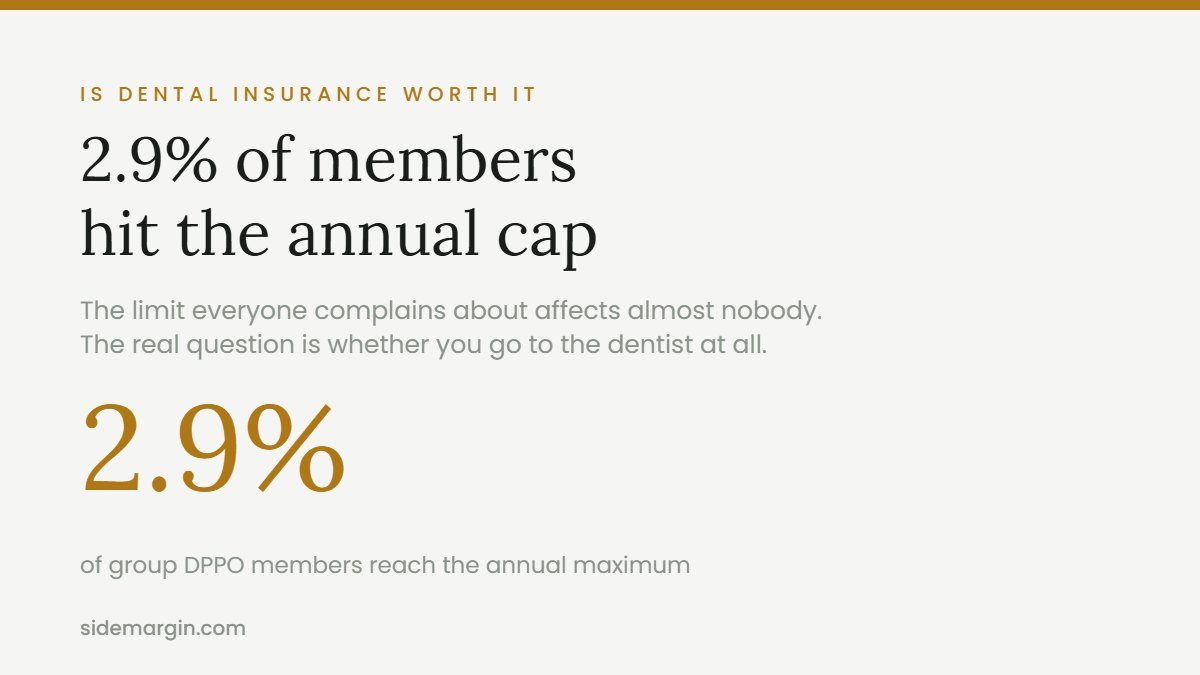
The usual complaint about dental insurance is that the annual maximum is too low. Industry data says the opposite is the problem: only 2.9% of people in employer dental PPOs ever reach their annual maximum. For the other 97%, the cap is irrelevant and the real question about whether dental insurance is worth it is much simpler. Does the premium beat the cost of two cleanings and the occasional filling?
So is dental insurance worth it? For a lot of people the honest answer is no, and for a smaller group it is emphatically yes. Which one you are depends on facts you already know about yourself.
Key takeaways
- 2.9% of group DPPO members hit their annual maximum. The cap almost everyone complains about affects almost nobody.
- The annual maximum has barely moved in decades. The American Dental Association says many plans’ maximums “have not increased in 50 years” and that carriers still promote the $1,000 level “established some 40 years ago”.
- The standard structure is 100/80/50: preventive fully covered, basic restorative at 80%, major work at 50%, usually with a $50 deductible that does not apply to preventive care.
- Waiting periods are where the plan protects itself. None for cleanings, 6 to 12 months for fillings, typically 12 months for crowns and dentures.
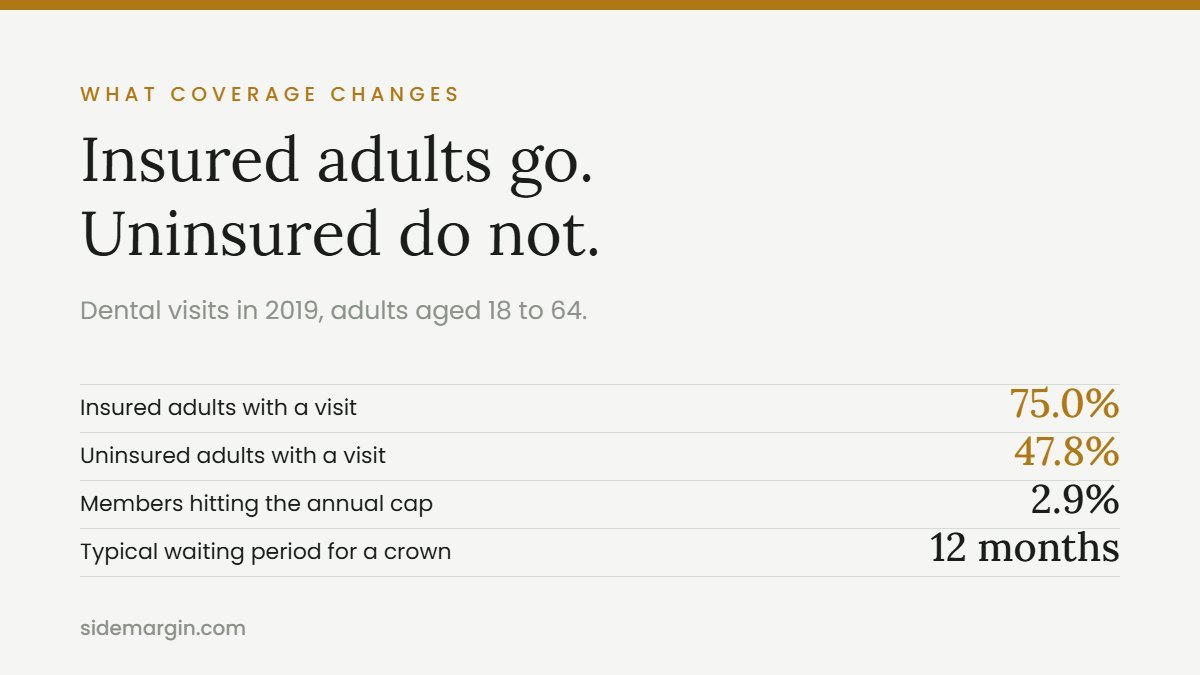
- The coverage effect on behaviour is large and well measured. 75.0% of insured adults aged 18 to 64 had a dental visit in 2019, against 47.8% of the uninsured.
- Dental savings plans are not insurance. They are discount memberships with no waiting period, and the insurer explaining them warns you “could end up spending more in a year”.
- There is no free national fee table. The ADA’s fee survey is a paid product, which is itself worth knowing before you trust a number you read online.
What a typical plan actually does
Dental plans are unusually standardised, which makes them easy to compare once you know the shape. The ADA and the National Association of Dental Plans describe the common design as “100% coverage for preventive and diagnostic services, 80% coverage for basic restorative services, 50% coverage for major restorative services”.
| Tier | Typically covers | Plan pays | Waiting period |
|---|---|---|---|
| Preventive and diagnostic | Cleanings, exams, x-rays | 100% | Usually none |
| Basic restorative | Fillings, simple extractions | 80% | 6 to 12 months |
| Major restorative | Crowns, bridges, dentures, root canals | 50% | Often 12 months |
A $50 annual deductible usually applies “to all services except preventive and orthodontic”. Annual maximums cluster between $1,000 and $2,500: NADP data for 2024 shows 73% of consumers in dental PPOs have a maximum of $1,500 or more, up from 67%.
Waiting periods deserve more attention than they get, because they defeat the obvious strategy. You cannot sign up in January, get a crown in February and cancel in March. Delta Dental describes 12 months as “often standard” for major services, with employer plans running “from a few days to a full year”. One useful exception: waiting periods are frequently waived if comparable coverage terminated 30 to 60 days before the new plan starts, which matters if you are changing jobs.
The annual maximum, and why the complaint is misdirected
The cap is genuinely absurd as a piece of product design. The ADA notes that many plans’ annual maximums “have not increased in 50 years” and that many carriers “still are promoting the long-standing $1,000 level that was established some 40 years ago”. In 2024 the Association adopted a policy position that it “does not support annual or lifetime maximums in any dental benefit program”.
A $1,000 cap set in the mid 1980s would need to be several times that today to buy the same dentistry. That is a real and well-founded criticism of the industry.
But it is not, for most people, the thing that determines whether their own policy is worth buying. Only 2.9% of group DPPO members actually reached the maximum in 2024, up from 1.7% the year before. If you are not in that 2.9%, the cap never touches you. What touches you is the premium against the value of the preventive care you would have had anyway.
That reframes the decision. Dental insurance is not catastrophic cover. It is a prepayment plan for routine care with a partial subsidy on repairs, and it should be evaluated like one.
Is dental insurance worth it? The arithmetic, done honestly
Here is an uncomfortable thing about this subject. I could not find a free, methodologically sound national table of dental fees. The ADA’s Survey of Dental Fees is a paid product. Almost every “average cost of a crown” figure circulating online comes from content marketing by dental practices or insurers with an interest in the number.
So rather than repeat a number I cannot stand behind, here is the arithmetic with the inputs left as variables. Fill in your own from your dentist’s fee schedule, which they will give you if you ask, and from your plan’s premium, which is on your enrollment portal.
The quiet year test. Two cleanings, one exam, one set of x-rays, nothing else. Call the cash price for that package P. Your annual premium is M multiplied by 12. Insurance wins the quiet year only if 12M is less than P. On most employer plans it is close, and on individual plans bought outside work it usually is not, because preventive care is the cheapest thing a dentist does and you are paying an insurer to pass it through.
The one filling year. Add a filling at cash price F. Insured you pay the $50 deductible plus 20% of the negotiated rate. The negotiated rate is the hidden variable and it matters more than the coinsurance: in-network fees are frequently well below list, so 80% of a discounted fee can beat 100% of a cash fee even before the coinsurance.
The bad year. This is where insurance earns its keep, and where the cap bites. Delta Dental’s own 2025 data puts an out-of-network root canal at roughly $1,200 for a front tooth, $1,300 for a premolar and $1,500 for a molar, and notes that plans commonly cover 50% to 80% after the deductible. A root canal plus the crown that follows it will clear a $1,500 annual maximum on its own. At that point the plan has paid its cap and you pay the rest.
The pattern that falls out of this is the useful conclusion: dental insurance is good value in the middle of the distribution and poor value at both ends. If you need nothing, you are subsidising other people’s fillings. If you need a lot, you hit the cap and are on your own anyway. If you need one or two moderate things a year, it works.
The argument for buying it anyway
There is a serious counter-argument to pure arithmetic, and the data behind it is strong.
| Adults 18 to 64 with a dental visit in the past 12 months | 2019 | 2020 |
|---|---|---|
| With dental insurance | 75.0% | 72.0% |
| Without dental insurance | 47.8% | 45.4% |
| Overall | 65.5% | 62.7% |
That is National Health Interview Survey data reported by the CDC. Use the 2019 column, since 2020 is distorted by the pandemic. A 27 point gap in whether people go to the dentist at all is not a small behavioural effect.
Some of that is selection: people who expect to need dentistry buy dental plans. But the direction of the commitment effect is real, and it is the same reason gym memberships and standing orders work. Having paid for something in advance makes people use it. If you are the sort of person who will otherwise let four years go by, a plan that gets you into a chair twice a year may be worth more than its expected value, because untreated small problems become the expensive ones.
Coverage overall is widespread and slipping. NADP reported about 284 million Americans with dental benefits in 2024, roughly 83% of the population, a 2.3% decline year over year. Access at work varies enormously by employer size: 30% of workers at firms under 100 employees have dental coverage available, against 70% at firms with 500 or more.
Who it clearly suits, and who it clearly does not
Stripping out the hedging, the decision sorts people into three groups fairly cleanly.
Buy it if your employer subsidises it. This is the single biggest factor and it usually settles the question on its own. An employer-paid or heavily subsidised dental plan is close to free money, and the arithmetic above is about plans you buy yourself. Group rates are also materially better than individual ones because the risk pool is not self-selected.
Buy it if you have children in the orthodontic window, or a known history. Orthodontics is usually a separate lifetime maximum rather than part of the annual one, and it is the one category where the numbers are large and predictable. The same goes if you have had multiple crowns, gum disease or a history of decay. Past dentistry is the best available predictor of future dentistry.
Think hard if you are buying an individual policy with no subsidy and no history. Here the premium frequently exceeds the value of the preventive care, the waiting periods block the only scenario where the plan would pay out meaningfully, and the annual maximum caps it anyway if something serious happens. Paying cash and asking your dentist about a prompt-payment discount is a legitimate alternative, and many practices offer their own in-house membership at a lower cost than an insurer’s.
One group falls between the cracks and is worth naming: people on Medicare. Original Medicare does not cover routine dental care. Medicare Advantage plans often bundle a dental benefit, though NADP recorded Medicare Advantage dental enrollment at 22.6 million in 2024, down 11.4% year over year, which suggests those benefits are being trimmed. If dental is part of why you chose a particular plan, check that it is still there before you renew.
Dental savings plans, and what they are not
These get marketed alongside insurance and they are a different product entirely. Cigna describes them as “annual, fee-based plans you buy outright”. You pay a membership fee, you get a discounted rate at participating dentists, and you pay for every service yourself at that rate.
| Dental insurance | Dental savings plan | |
|---|---|---|
| What you pay | Monthly premium | Annual membership fee |
| Waiting period | Up to 12 months for major work | None, usable immediately |
| Annual maximum | Yes, typically $1,000 to $2,500 | None |
| Who pays the dentist | Plan pays a share | You pay all of it, at a discount |
| Claims paperwork | Yes | Usually none |
The no waiting period and no annual maximum features are genuinely useful in one specific situation: you need significant work now and you do not currently have coverage. Cigna’s own warning is the honest summary, and it is unusual to see a vendor print it: with a savings plan “you could end up spending more in a year than you would with a traditional dental plan”.
Typical discount percentages and membership fees are not published by any source I would trust. Treat any specific figure you see as marketing until you have the actual fee schedule in front of you.
Is dental insurance worth it for you? How to decide
- Get your dentist’s fee schedule for the routine package. Two cleanings, an exam and x-rays, at their cash price. Ask at reception. This takes one phone call and it is the number the whole decision turns on.
- Multiply your monthly premium by twelve. If it exceeds the routine package and you have no known work coming, the plan is an insurance product you do not need rather than a discount you are getting.
- Check the waiting periods before you count on major coverage. If you need a crown in March and the plan has a 12 month major services wait, the plan does nothing for you this year.
- Check whether a prior plan waives the wait. Coverage that ended within 30 to 60 days often does.
- If you are on a high deductible health plan, ask about a limited-purpose FSA. It lets you pay dental costs with pre-tax money without touching your HSA eligibility, which is frequently better than buying a dental plan. The mechanics are in FSA versus HSA.
- If you are self-employed or your employer does not offer it, price a savings plan against insurance on the specific work you actually expect, not in the abstract.
One thing that is true regardless of which way you go. Ask for a written treatment plan with the procedure codes on it before any significant work, and send it to the plan for a pre-treatment estimate. That single habit prevents most dental billing disputes, and if one happens anyway, the process is the same as any other medical bill: get the itemised version first.
The rest of the enrollment decisions, ranked by what they are worth, are in the open enrollment checklist.
Data current as of 17 September 2026. Plan design and utilisation figures are 2024 data from NADP’s 2025 reports. Dental visit rates are 2019 and 2020 National Health Interview Survey data. Cost figures are Delta Dental’s own 2025 data for out-of-network root canals. This is general information, not dental or financial advice.
Sources
- NADP, 2025 Dental Benefits Report: Plan Design, including the 2.9% who reach the annual maximum
- NADP, 2025 Dental Benefits Report: Enrollment
- ADA News, on frozen annual maximums and ADA policy
- ADA and NADP, Dental Benefits: An Introduction (the 100/80/50 structure)
- CDC MMWR, dental visits by insurance status, National Health Interview Survey
- Delta Dental, root canal treatment costs
- Delta Dental, dental insurance waiting periods
- Cigna, discount dental programs compared with insurance
- BLS, Employee Benefits in the United States, March 2025
- IRS Publication 969, on limited-purpose FSAs