
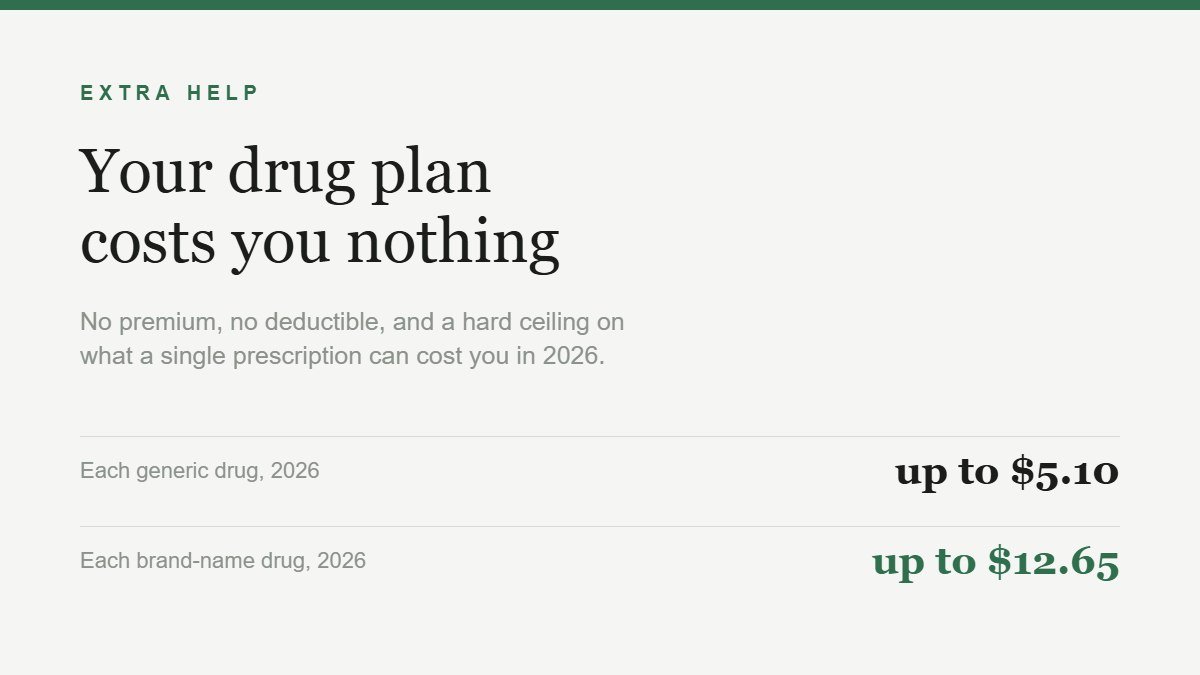
Extra Help Medicare, officially the Low Income Subsidy, is the federal program that pays your Medicare Part D premium and deductible and caps what you hand over at the pharmacy counter. In 2026 that means $0 premium, $0 deductible, up to $5.10 for a generic and up to $12.65 for a brand name, and once your total drug costs reach $2,100 you pay nothing at all for the rest of the year.
The Extra Help Medicare income and resource limits are far more generous than people assume, and there is one number in particular that changes who should bother applying.
The 2026 Extra Help Medicare limits
| Annual income limit | Resource limit | |
|---|---|---|
| Single person | $23,940 | $18,090 |
| Married couple | $32,460 | $36,100 |
Read the resource column again. $18,090 for a single person. That is nearly double the $9,950 limit that applies to Medicare Savings Programs, the sister benefit that pays your Part B premium.
This is the single most useful thing to know about Extra Help, and almost nobody says it out loud: you can have too much in savings for a Medicare Savings Program and still qualify comfortably for Extra Help. Being turned down for one tells you nothing about the other.
What Extra Help Medicare actually pays
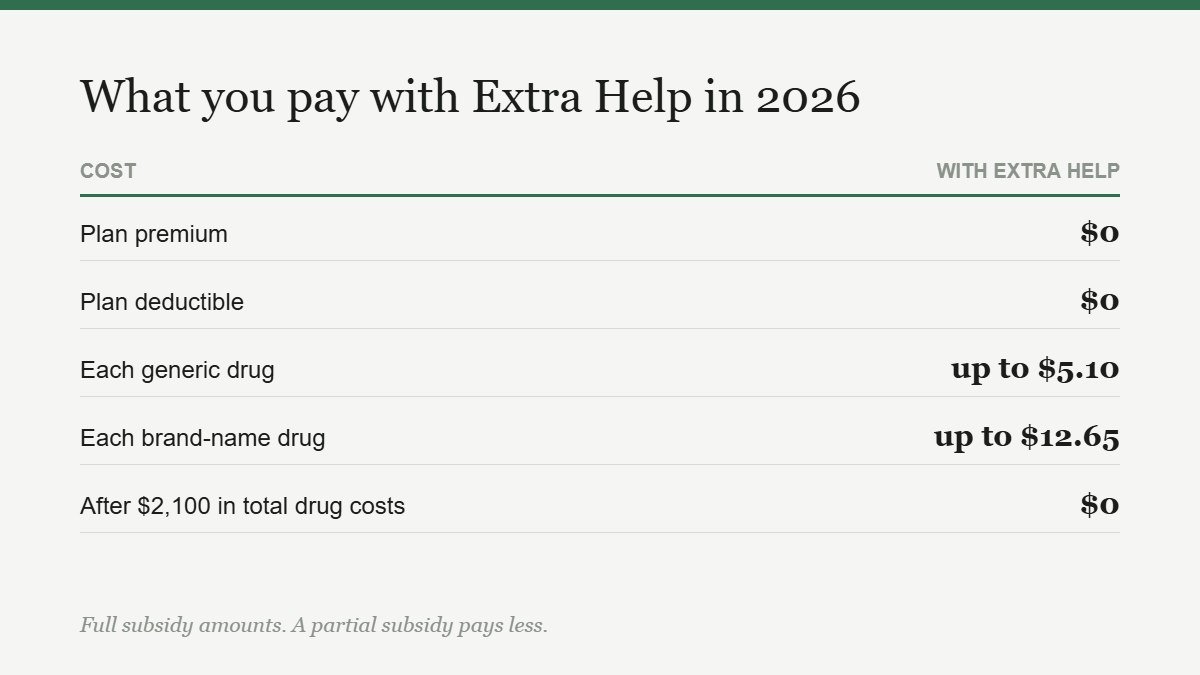
| Cost | With Extra Help in 2026 |
|---|---|
| Plan premium | $0 |
| Plan deductible | $0 |
| Each generic drug | Up to $5.10 |
| Each brand-name drug | Up to $12.65 |
| After total drug costs reach $2,100 | $0 for each covered drug |
That last row is the one worth dwelling on. Medicare’s wording is “Once your total drug costs reach $2,100, you’ll pay $0 for each covered drug.” Not a reduced amount. Nothing.
For anyone on a specialty drug or several brand-name prescriptions, that is not a discount program. It is the difference between filling the prescription and not filling it.
What it is worth in a year, with numbers
Take someone on four brand-name prescriptions filled monthly, on a plan with a $50 premium and the standard $615 deductible for 2026.
| Without Extra Help | With Extra Help | |
|---|---|---|
| Premium for the year | $600 | $0 |
| Deductible | $615 | $0 |
| Per brand-name fill | Plan cost sharing, often tens of dollars | Up to $12.65 |
| Ceiling for the year | $2,100 out of pocket, then $0 | Copays stop entirely once total drug costs reach $2,100 |
The premium and deductible alone are $1,215 in that example before a single prescription is counted. Add four brand-name fills a month capped at $12.65 instead of plan cost sharing and the gap widens quickly.
We have deliberately not invented a total. What your plan charges without Extra Help depends on your plan and your drugs, and any article quoting you a single national saving figure is guessing. The three rows that are fixed are the ones above.
Extra Help and Medicare Savings Programs, side by side
These two are constantly confused, and the confusion costs people money because they assume being over on one means being over on both.
| Extra Help | Medicare Savings Program (QMB) | |
|---|---|---|
| What it pays | Part D drug costs | Part B premium, deductibles, coinsurance |
| Who runs it | Social Security | Your state Medicaid agency |
| Resource limit, single | $18,090 | $9,950 |
| Income limit, single | $23,940 a year | $1,350 a month |
Apply for both. They are different agencies, different tests and different money.
You might already have it without knowing
Three groups of people get Extra Help automatically, with no application at all. Medicare lists them as anyone receiving:
- “Full-benefit Medicaid coverage”
- “Help from your state paying your Part B premiums”, meaning a Medicare Savings Program
- “Supplemental Security Income (SSI) payments from Social Security”
If any of those describe you, check what you are being charged at the pharmacy before you pay it. People in this group are sometimes charged the full amount because the pharmacy’s system has not been updated, and they pay it because they do not know they should not be.
Applying for Extra Help Medicare now starts a second application
This is new and it is genuinely useful. A CMS rule with a compliance date of 1 April 2026 requires states to treat your Extra Help data as the start of a Medicare Savings Program application, and to “accept LIS leads data as verified without additional confirmation from the individual.”
In plain terms: one application to Social Security should now put you in the queue for two benefits. Extra Help covers your drugs. A Medicare Savings Program covers your Part B premium, worth $202.90 a month in 2026, and in the case of QMB your deductibles and coinsurance as well.
It does not always happen smoothly. If you applied for Extra Help months ago and have heard nothing from your state Medicaid office, that is worth a phone call rather than a shrug.
How to apply for Extra Help Medicare
- Apply through Social Security. Extra Help is a Social Security application even though it pays a Medicare benefit. Online, by phone, or at an office.
- Ask SHIP to help. Medicare’s own advice is to contact your State Health Insurance Assistance Program (SHIP) to get free help applying. They do this daily and they do not sell anything.
- Apply even if you think you are over. The resource limit is $18,090 for one person, and your home and one car do not count toward it.
- Ask about the Medicare Savings Program in the same conversation. Different agency, different limits, and since April your Extra Help application should already have started it.
Frequently asked questions
Is Extra Help Medicare the same as a Medicare Savings Program?
No, and the difference matters. Extra Help pays for prescription drugs under Part D and is run by Social Security. A Medicare Savings Program pays your Part B premium and is run by your state Medicaid agency. The income and resource limits are different, and the Extra Help resource limit is far higher.
Do I have to apply during Medicare Open Enrollment?
No. Extra Help applications are accepted all year, and Medicare Open Enrollment decides which drug plan you are in, not whether you qualify for Extra Help. Getting Extra Help also opens a special enrollment period, so you can change drug plans outside the autumn window.
Does my house count against the resource limit?
Generally no. The home you live in is excluded, and so is one vehicle. The resource test looks at bank accounts, stocks and bonds.
What if I was turned down before?
Apply again. The limits rise every year, and your circumstances change. A refusal in a previous year says nothing about this one.
The bottom line
If your income is under $23,940 as a single person or $32,460 as a couple, apply. The resource limit is high enough that a modest amount of savings will not disqualify you, the application also starts your Medicare Savings Program claim, and if you already get SSI or Medicaid you may have it already and be paying anyway.
This is general information, not professional advice. Confirm your own eligibility with Social Security, Medicare or a free SHIP counselor.
Sources
- Medicare.gov, help with drug costs, 2026 Extra Help limits and costs
- Medicare.gov, Medicare Savings Programs, 2026 limits for comparison
- Social Security Administration, Extra Help with Medicare prescription drug costs
- CMS, 2026 Medicare Parts A and B Premiums and Deductibles
- Justice in Aging, Final Rule to Streamline Enrollment in Medicare Savings Programs, April 2026 compliance dates
Fact-checked against these sources in September 2026.