
Nike closed at $35.78 on 16 September 2026, a fresh 52 week low and roughly 80% below its November 2021 peak of $179.10. On 21 September it drops out of the S&P 100 after almost eighteen years, replaced by Palo Alto Networks. If you are asking why is Nike stock down, the short answer is that revenue has gone sideways for two years while China collapsed and four smaller brands took the running category.
The longer answer matters more if you buy shoes than if you buy shares, because the turnaround is being funded partly by you. Nike products got more expensive while Nike got smaller, and that is not a coincidence.
Key takeaways
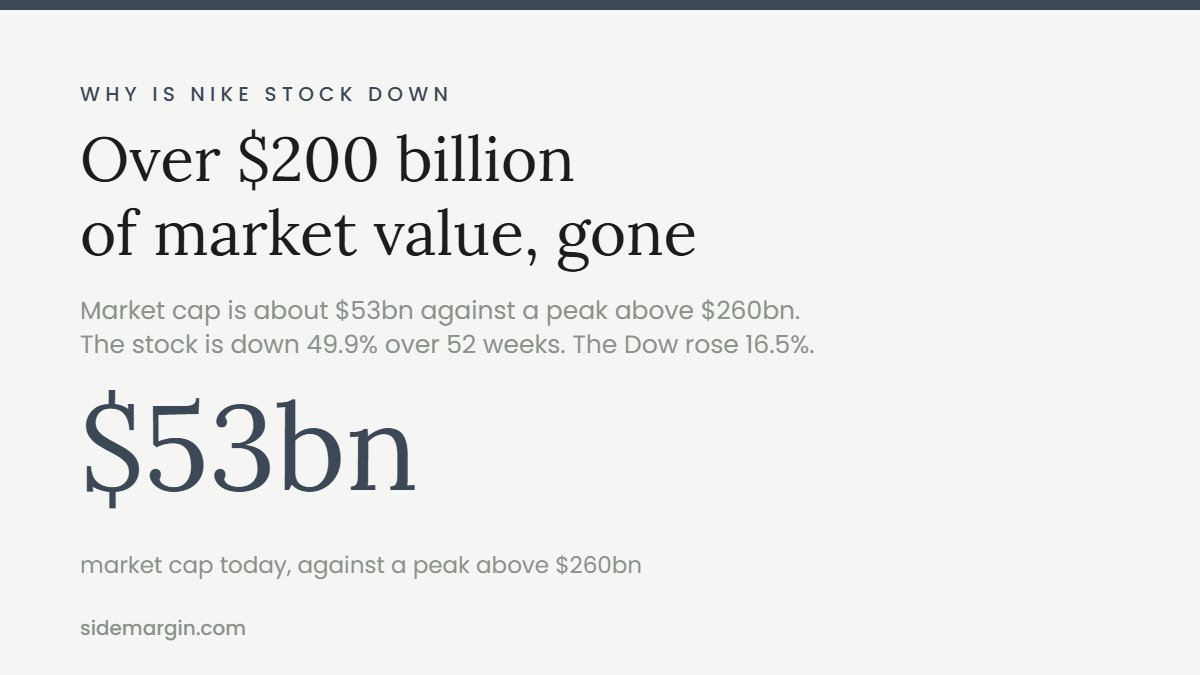
- More than $200 billion of market value is gone. Market cap is about $53bn against a peak above $260bn. The stock is down 49.9% over 52 weeks while the Dow rose 16.5%.
- The last quarter’s profit headline was not real operating performance. A $986 million tariff refund supplied roughly 900 basis points of gross margin and $0.52 of the $0.72 diluted EPS.
- Greater China is the wound. Full year revenue there fell 11%, and 13% currency neutral. Over five fiscal years it is down about 29% while Adidas grew 15% currency neutral in China last quarter.
- Nike deliberately sold fewer of its best sellers. Air Force 1, Dunk and Air Jordan 1 were cut by about 10 percentage points of the footwear mix on purpose, to restore scarcity.
- Online footwear prices rose about 17% in a year and apparel about 14%, while Nike pulled back on discounting. EMEA off-price digital sales fell 50%.
- Inventory is flat at $7.5bn. The 2023 and 2024 era of deep Nike clearance was a glut phenomenon. The glut is cleared, so expect fewer blowout discounts, not more.
- Nike has not called a bottom. Guidance is for revenue to fall again in the current quarter. The next report lands 1 October 2026.
The numbers, without the spin
One thing to get straight first, because almost every article gets it wrong: Nike’s fiscal year ends on 31 May. FY2026 covers June 2025 to May 2026 and closed on 31 May 2026. The June to August 2026 quarter is FY2027 Q1 and has not been reported yet.
| FY2026 (year to 31 May 2026) | Figure | Change |
|---|---|---|
| Revenue | $46,398m | +0.2% reported, -2% currency neutral |
| Net income | $3,108m | |
| Gross margin | 42.9% | +20 bps |
| Wholesale | $27.5bn | +6% |
| NIKE Direct | $17.7bn | -6% |
| Converse | $1.2bn | -31% |
| Greater China | $5,847m | -11% reported, -13% currency neutral |
| Inventory | $7.5bn | flat |
Read the currency neutral column, not the reported one. Revenue described as “flat” was down 2% once you take the weak dollar out. EMEA looks better still at +3% reported, until you notice it was -3% currency neutral. The exchange rate did the work, not the business.
The fourth quarter is where you have to be most careful. Nike reported gross margin of 49.2%, up 890 basis points, and net income up over 400%. That was almost entirely a $986 million refund of IEEPA tariffs. Strip it out and Q4 gross margin was roughly 40.2% and EPS roughly $0.20 rather than $0.72. Revenue in that quarter fell 1.1%.
Chief executive Elliott Hill’s own framing was not triumphant. He said Nike “took decisive actions to strengthen the foundation” and that “While we continue to face top-line headwinds, we’re encouraged by progress in performance product”. Chief financial officer Matthew Friend described “an increasingly challenging operating environment, where sell-through remains challenged.”
Why is Nike stock down: what actually went wrong
Ask why is Nike stock down and you get three decisions, taken over roughly seven years, that account for most of it.
The direct-to-consumer pivot. Announced in 2017 and accelerated under John Donahoe, Nike cut wholesale partners including Big 5, Dunham’s, Urban Outfitters, Dillard’s and Zappos, betting that selling directly through its own app and stores would be more profitable. For a while it was. DTC revenue grew 14% in FY2022, and Friend could point to “a return of more than $12 billion in incremental revenue.”
The pivot has now fully reversed, and the FY2026 numbers are the evidence. Wholesale grew 6% to $27.5bn. NIKE Direct, the strategy, shrank 6% to $17.7bn. Nike went back to DSW, Macy’s and Foot Locker, and returned to Amazon in autumn 2025 for the first time since 2019. The shelf space it gave up had been taken by someone else while it was gone.
Flooding the market with its own classics. This is the part that is easiest to see as a shopper. Nike leaned on Air Force 1, Dunk and Air Jordan 1 until they were everywhere, and a sneaker that is everywhere is no longer worth queuing for. Friend told investors those three franchises would be “down by 10 percentage points as a percent of its footwear mix” by the fourth quarter. Hill was careful to say Nike is not abandoning them, calling them “beloved silhouettes” with “strong fandoms” and saying Nike is “building a supporting cast.”
That is a company deliberately selling fewer of the shoes people were actually buying, because it had destroyed their scarcity. It is the right call and it costs revenue for years.
Cost cutting into a demand problem. In December 2023 Nike announced $2bn of cumulative savings over three years with $400m to $450m of restructuring charges. About 1,600 people, 2% of the workforce, went in April 2024. Donahoe said it was “making a huge difference in our focus and ability to execute”. Nine months later he was gone and Elliott Hill, a Nike veteran who had retired in 2020, came back to run it.
Who took the share
This is the table that explains the stock price better than anything Nike has said.
| Brand | Most recent reported period | Growth |
|---|---|---|
| Asics | H1 2026 | +32.7% (+22.0% ex currency), operating margin 22.5% |
| HOKA (Deckers) | FY2026 to 31 Mar 2026 | +15.9% |
| Adidas | Q2 2026 | +14% currency neutral, record quarter |
| On | Q2 2026 | +13.5% (+21.6% currency neutral), gross margin 65.4% |
| Nike | FY2026 to 31 May 2026 | -2% currency neutral |
| Lululemon | Q2 FY2026 | -4%, Americas comparable sales -12% |
Two things in that table are worth sitting with. On’s gross margin of 65.4% is about 22 points above Nike’s, which tells you people will pay full price for a running shoe when they want it badly enough. And Lululemon is shrinking faster than Nike in the Americas, which tells you this is not purely a Nike problem. US discretionary athletic spending is soft. The winners are specifically the running brands.
China is the single biggest hole
| Fiscal year | Greater China revenue | Share of total |
|---|---|---|
| FY2021 | $8.290bn | 18.6% |
| FY2025 | $6.586bn | 14.2% |
| FY2026 | $5.847bn | 12.6% |
That is a fall of roughly 29% in five years, in a market that grew. In the same quarter Nike’s Greater China revenue fell 17% currency neutral, Adidas grew 15% currency neutral there. A 32 point gap is not a macro story. It is a competitive one.
The local comparison is starker. Anta reported RMB 43.51bn of revenue for the first half of 2026 alone, up 12.9%, with a 63.9% gross margin. Nike’s Greater China revenue for the entire fiscal year was $5.85bn. Anta now sells roughly twice as much in China in six months as Nike does there in twelve.
One useful nuance against the easy narrative: Li-Ning, the other big Chinese brand, grew only 2.8%. It is not that every domestic brand is surging. It is Anta specifically, plus Adidas recovering and Asics running hot.
The tariff story, which is where your money comes in
Follow this sequence, because it is the clearest consumer finding in the whole picture.
- June 2025. Friend tells investors Nike faces “$1 billion in additional costs due to current U.S. tariffs”, and announces a “surgical price increase in the U.S. beginning in the fall of 2025.”
- May 2025, already in motion. Footwear priced $100 to $150 goes up by as much as $5. Footwear above $150 goes up by as much as $10. Apparel and equipment rise $2 to $10. Air Force 1, children’s shoes and anything under $100 are excluded.
- October 2025. The tariff estimate is revised up to $1.5 billion for fiscal 2026, because of “new reciprocal tariff rates that have taken effect since the last quarter.”
- By October 2025. Online footwear prices are up about 17% over the year and apparel about 14%, while Nike raises prices “where its brand power is strongest” and cuts discounting.
- June 2026. Nike books a $986 million refund when the IEEPA tariffs are unwound.
I have found no report of Nike reversing the price increases after the refund, and no report affirmatively confirming they stayed up either. What is documented is that the increases happened, the refund happened, and discounting was reduced rather than restored. The same pattern shows up across consumer goods this year, and it is the mechanism behind the iPhone 18 price increase too: a tariff arrives, the price rises, the tariff eases, the price stays.
Friend has said Nike plans to cut footwear imports from China from “roughly 16% today to the high single-digit range by the end of fiscal 2026”, with most production in Vietnam and Indonesia.
What this means if you just buy shoes
Four practical consequences, all of which follow from facts above rather than from forecasting.
- The deep-discount era is over for now. Inventory is flat at $7.5bn rather than bloated. The 2023 and 2024 clearance prices existed because Nike had too much stock, not because Nike is generous. EMEA off-price digital sales fell 50% as Nike deliberately repositioned digital “to be a premium business”.
- The classics get rarer and hold value better. Cutting Air Force 1, Dunk and Air Jordan 1 by 10 points of mix is the whole point of the exercise. If you like those shoes, buying them is less urgent than it was and finding a specific colourway will get harder.
- Wholesale is back, so shop wider. Nike is on Amazon, back at Foot Locker, DSW and Macy’s. Price dispersion across channels is wider than it was during the DTC years.
- The running brands are where the product investment is. On, Hoka and Asics grew 13% to 33% while Nike shrank, and Nike’s own turnaround is explicitly a running push.
Worth noting where the fitness money went instead. Mass participation racing is growing fast enough that private equity bought control of one format this month, which is part of the backdrop to the HYROX Beijing story. People did not stop spending on sport. They stopped spending it on sneakers as fashion.
What this means if you own an index fund
Most people reading this own Nike and do not know it, through a workplace retirement plan holding an S&P 500 or total market fund. Here is what actually happened to that position, factually.
A cap weighted index fund holds each company in proportion to its market value. As Nike fell roughly 80%, its weight in the fund fell roughly in proportion. Nobody had to decide anything and nobody had to be right about sneakers. That mechanical shrinking is the entire argument for indexing, illustrated by a single name, and it is the reason a 80% drawdown in one Dow component is a rounding error in a diversified fund rather than a disaster.
The S&P 100 removal on 21 September changes almost nothing in practice. Nike stays in the S&P 500, stays in the Dow, and stays in every total market fund. Only funds tracking the S&P 100 specifically will sell. It matters as a signal, not as a mechanism.
For context on the current state: 40 analysts carry a Hold consensus with an average target of $49.87 and a range from $23 to $94. Morgan Stanley initiated at Sell with a $31 target on 10 September 2026. The dividend yield is about 4.5%, which is unusually high for Nike and is a function of the price falling rather than the payout rising. None of that is a recommendation, and I am not a financial adviser. It is the state of the record as of today.
If you are trying to work out what a single position should be doing inside a portfolio at all, the mechanics of how leverage and concentration behave are worth understanding first, and the leveraged ETF explainer covers the version of that mistake that costs people the most.
Why is Nike stock down, and what to watch on 1 October
Nike reports FY2027 Q1, covering June to August 2026, on Thursday 1 October 2026 at about 1:15pm Pacific. The company has already guided to revenue down low to mid single digits in that quarter, and to a further sequential deceleration in Q2. Three lines will tell you whether anything has turned.
- Greater China currency neutral growth. It was -17% last quarter. Anything better than -10% is a genuine change.
- Gross margin excluding tariff effects. Nike guided to margin expansion beginning this quarter. Check whether it is operational or another one-off.
- NIKE Direct versus wholesale. Wholesale growing while Direct shrinks is the pivot unwinding. Both growing would be the first real evidence of a floor.
The honest bottom line: Nike is not in financial distress. It made $3.1bn last year, carries a 4.5% dividend and has cleaned up its inventory. What it does not have is growth, and it has now guided to two more quarters without it.
Share price and market data as of the close on 16 September 2026. Financial figures from Nike’s FY2026 fourth quarter and full year results, reported 30 June 2026. This is general information, not investment advice, and I am not a licensed financial adviser.
Sources
- Nike, FY2026 fourth quarter and full year results, 30 June 2026
- Nike, FY2026 third quarter results, 31 March 2026
- Nike, FY2027 first quarter earnings date
- Stock Analysis, NKE price, market cap and 52 week range
- Stock Analysis, NKE analyst consensus and price targets
- Yahoo Finance, Nike versus the Dow over 52 weeks
- Fortune, Nike’s market value decline and S&P 100 removal
- Seeking Alpha, Nike removed from the S&P 100
- Retail Insight Network, on the $986m IEEPA tariff recovery
- Supply Chain Dive, Nike’s $1bn tariff estimate and sourcing shift
- CFO Dive, Nike raises the tariff estimate to $1.5bn
- CBS News, Nike’s May 2025 price increases by tier
- Hypebeast, online footwear prices up 17% and apparel up 14%
- Retail Dive, Nike cutting Air Force 1, Dunk and Air Jordan 1 as a share of mix
- Modern Retail, why Nike’s direct-to-consumer pivot did not pan out
- Retail Dive, Nike’s $2bn cost savings plan
- HR Dive, Nike’s 2024 layoffs
- Retail TouchPoints, Nike earnings call commentary on EMEA off-price and consumer pressure
- Deckers Brands, FY2026 results including HOKA
- On Holding, Q2 2026 results
- adidas, Q2 2026 results
- lululemon, Q2 fiscal 2026 results
- ANTA Sports, 2026 interim results
- Li-Ning, 2026 interim results
- Modern Retail, Nike’s wholesale turnaround and Amazon return