
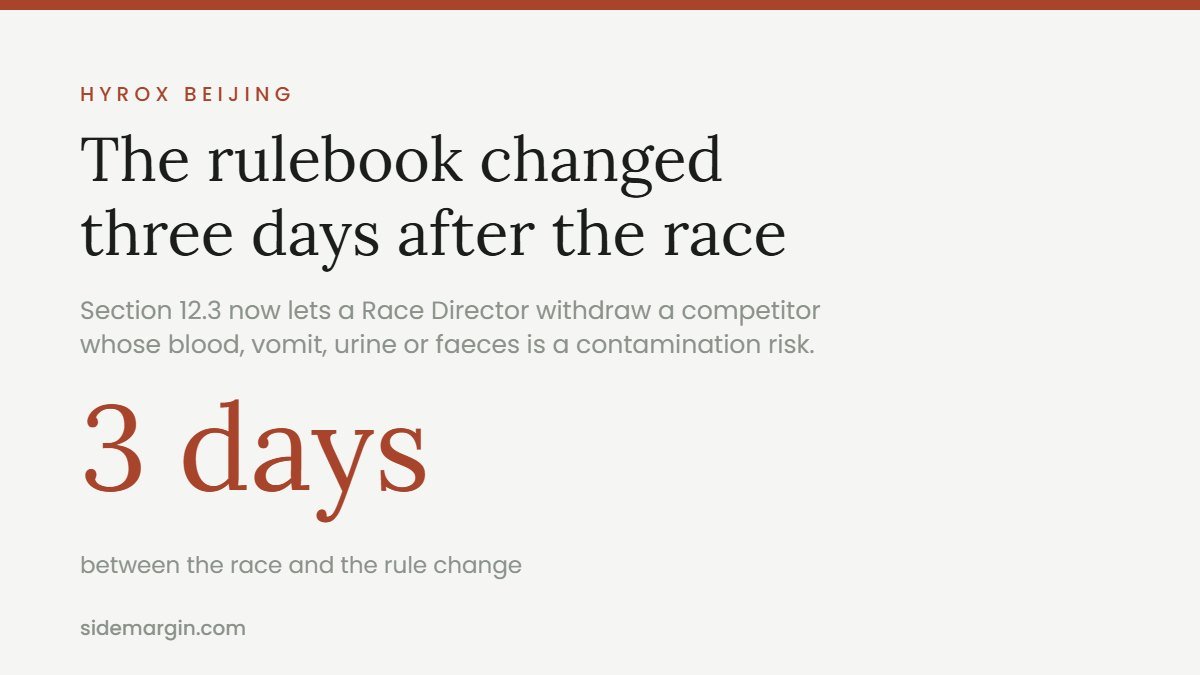
On 12 September 2026, an elite women’s race at HYROX Beijing was interrupted by something no rulebook in the sport covered. An athlete lost bowel control mid-race, was allowed to continue, used shared equipment while soiled, and won. Three days later HYROX quietly rewrote its rulebook. The interesting part is not the incident. It is what the incident exposed about how a sport that went from 570,000 competitors to roughly 1.4 million in a single season actually governs itself.
Most coverage of HYROX Beijing has been a joke at one competitor’s expense. That story is already written. This is the other one: what the rules said, what they say now, what comparable sports do instead, what the public health risk actually was, and what it means for the 2 million people HYROX expects to race this season.
Key takeaways
- The rulebook has already changed. Section 12.3 now lets a Race Director withdraw a competitor whose “blood, vomit, urine, or faeces poses a welfare or contamination risk”. That clause was added around 15 September, after the race.
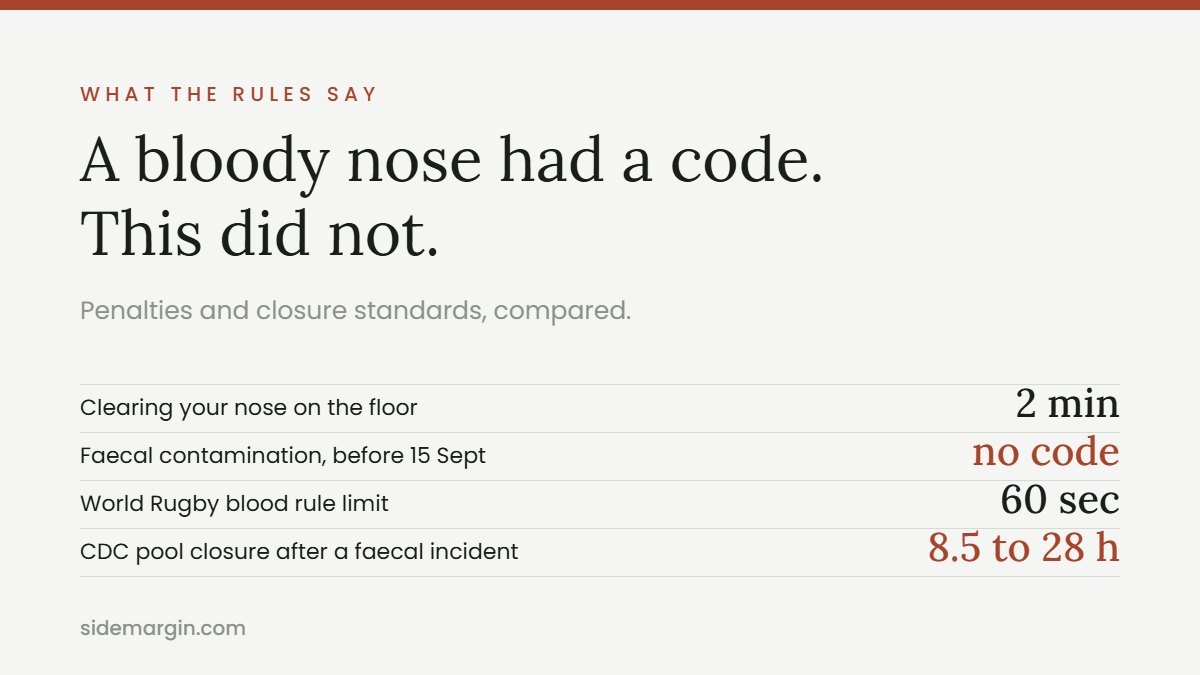
- Clearing your nose on the floor has been a numbered offence for years. Code 21 carries a 2 minute penalty. Faecal contamination of shared equipment had no code at all until three days ago.
- HYROX publishes one live rulebook with no version number, no date and no changelog. The rules were edited silently. That is a governance problem independent of this incident.
- The new rule is weaker than rugby’s. World Rugby gives a 60 second limit, mandatory removal, an independent match-day doctor and a specified bleach concentration. HYROX says a Race Director “may”.
- The closest real benchmark is brutal. CDC guidance closes a swimming pool for 8.5 to 28 hours of hyperchlorination after a diarrhoeal incident. HYROX closed a lane and kept racing.
- Nobody has reported getting sick. As of today the harm is hypothetical, and saying so is more accurate than implying an outbreak.
- Four days before the race, private equity bought control. An L Catterton led consortium acquired the majority stake on 8 September. The scaling pressure behind this is the real story.
What the HYROX Beijing rulebook said on the day
HYROX races are judged against a published rulebook. The current one identifies itself as “HYROX EN SINGLE RULEBOOK_26/27” and carries a numbered penalty table. Three entries are relevant.
| Code | Offence | Penalty |
|---|---|---|
| 21 | Spitting or clearing nose | 2 minutes or DQ (Race Director decision) |
| 22 | Littering, rapid cooling | 2 minutes per infringement |
| 23 | Unsporting behaviour | 2 minutes or DQ (Race Director decision) |
Section 10.4 spells out the first two. “Littering is prohibited,” it says, before explaining that “Spitting or clearing of nostrils onto the floor is strictly prohibited. Each infringement will result in a 2-minute time penalty.”
So a competitor who blows their nose onto the Roxzone floor gets a numbered code and a defined penalty. Until three days ago, a competitor leaving faecal matter on a sled, a rower and a run course fell under nothing at all. That asymmetry is not a gotcha. It is the ordinary result of rules written by adding a clause each time something goes wrong, which is how almost every young sport’s rulebook gets built.
There was one tool available and it went unused. Section 10.3 on poor sportsmanship says penalties “can also be applied retrospectively following a race”. HYROX had the authority to review the result afterwards. It did not. The win stands and she remains top of her category ranking.
What the rulebook says now
Section 12.3, under “Did Not Finish”, now reads in full:
If a racer’s blood, vomit, urine, or faeces poses a welfare or contamination risk to the racer or to other racers, a Race Director may withdraw the racer from the race on medical grounds, in line with HYROX’s medical and hygiene SOPs. Any such withdrawal is recorded on the leaderboard as Did Not Finish [DNF].
Co-founder Moritz Fürste said publicly that “As of this moment, there are new rules and procedures in place to prevent situations like this from happening again.” He had already posted a personal apology, saying HYROX “made a mistake by not reacting immediately during the race” and that “In the end it is my job to foresee these potential incidents, and I did not.”
That is a fast, direct response by the standards of sports governance, and it deserves credit. Three days from incident to rule change is quicker than most governing bodies manage in three years.
Two things about it are still worth flagging. First, the rulebook is served at a single live URL with no version number, no date and no changelog. Anyone who downloaded it last week and anyone who downloads it today get different documents with the same name. Second, the clause defers to “HYROX’s medical and hygiene SOPs”, and those SOPs are not published anywhere. The rule points at a document the public cannot read.
What other sports do, and why HYROX’s new rule is the weak version
This problem is not new. Contact sports solved it decades ago, and the solutions are specific in a way HYROX’s is not.
World Rugby’s blood injury protocol is the closest working template. It says that “Participants with uncontrolled active bleeding should be removed from the field of play if the bleeding cannot be stopped within 60 seconds or as soon as is practical.” It allows a temporary substitution for up to 15 minutes so medical staff can control and cover the wound. On contaminated kit it is precise: “Where the area covered is less than 5cm2, the area may be cleaned with a diluted bleach solution.” And it names who decides, giving the Match Day Doctor “the authority to request the removal of contaminated clothing from a player on the field”.
Count what that protocol contains that HYROX’s clause does not: a hard time limit, a mandatory rather than discretionary removal, a named official whose authority is independent of the competition officials, a specified disinfectant chemistry, a quantitative threshold, and a route back into the game so the athlete is not simply eliminated.
World Athletics takes a different route to the same place. Its rules do not mention bodily fluids at all. Instead, Rule 6.1.4 gives the Medical Delegate the power “to order an athlete to withdraw before, or to immediately retire from an event during, competition”. The answer there is structural: put a doctor in the decision chain and you no longer need to enumerate every scenario in advance.
Worth noting for fairness: CrossFit, HYROX’s nearest format competitor, has the same gap. Its rulebook lets a Head Judge remove an athlete “based on the severity of the injury, the athlete’s inability to complete a test, likelihood of further injury, and/or other factors”, and says nothing about bodily fluids either. HYROX was not unusually careless. It was normal, and normal turned out not to be good enough.
What could actually go wrong, and what the cleanup had to beat
This is the part worth reading even if you never race. The organisms that travel in faecal contamination on hard surfaces are not exotic, and the disinfectants most gyms reach for do not kill the important ones.
Norovirus is the main concern. The CDC’s own prevention guidance states flatly that “Hand sanitizer does not work well against norovirus.” Its recommendation is a chlorine bleach solution at 1,000 to 5,000 parts per million, left on the surface for at least five minutes. The CDC’s infection control evidence review is blunter still: with 95% ethanol products, “the maximum mean reduction in log10 titer reduction was 2.17”. That is a rounding error against what is needed.
The same review contains the detail that explains HYROX’s most expensive decision. Norovirus “may remain viable in carpets up to 12 days, despite regular vacuuming”. Organisers replaced the course carpeting outright and ran a second deep clean overnight. On the published evidence that was the correct call, and possibly the only adequate one.
The review also specifies the sequence, which is the single most useful thing in this article for anyone who cleans anything: “a cleaning step to remove gross fecal material, followed by a 5000-ppm hypochlorite product with a one minute contact time”. Disinfectant sprayed over visible soil does not work. You have to remove the material first.
| Organism | How long it survives on surfaces | Does alcohol kill it? |
|---|---|---|
| Norovirus | 21 to 28 days dried at room temperature; up to 12 days in carpet | No |
| C. difficile spores | Effectively indefinite. Viability drops only 0.5 log in 14 months | No |
| E. coli, Shigella | Months | Yes, generally |
| Hepatitis A | About 2 months | Poorly |
The EPA maintains pathogen-specific product lists for exactly this reason. List G covers norovirus. List K covers C. difficile spores. A product on neither list can be perfectly good at killing most things and useless against the two that matter here.
The benchmark HYROX Beijing will be measured against
Swimming has dealt with this for decades and its protocol is the most useful comparison available, because it quantifies what “adequate” looks like.
Under CDC fecal incident response guidance, a formed stool in a pool requires free chlorine at 2 parts per million held for 25 to 30 minutes. A diarrhoeal incident is treated as a different category of event entirely, because it is “a high-risk event for contamination caused by Cryptosporidium (or ‘Crypto’), an extremely chlorine-tolerant parasite.” The remediation options are 20 ppm for 28 hours, 30 ppm for 18 hours, or 40 ppm for 8.5 hours.
In other words, the aquatics sector treats a diarrhoeal incident as a venue-closing event measured in hours or days. HYROX treated it as a lane-closing event and the race continued around it.
That comparison is not entirely fair, because a shared body of water and a shared sled are different physics. But it is the comparison a regulator or a plaintiff’s lawyer will reach for, and HYROX has not published which disinfectant was used in Beijing, its registration, or the contact time observed. Without that, nobody outside the organisation can assess whether the cleanup was adequate.
Has anyone actually been harmed?
No reported illness has been linked to HYROX Beijing so far. No litigation has been filed. No Chinese health authority has commented. No sponsor of HYROX or of the athlete has issued a statement. As of today the harm is hypothetical, and that should be said plainly rather than implied away.
What exists instead is competitors asking for something. One, Joe Ho, wrote that he “paid HYROX to provide a professionally organised and safe event” and asked “why not offer affected participants refunds, credits, or some meaningful form of compensation?” Elite competitors pay a licence fee of EUR 347 plus tax for the 26/27 season. They are customers, which is the hinge of the whole argument.
There is precedent for how this can go. After a 2023 Tough Mudder event at Sonoma Raceway, roughly 300 people developed skin infections, later identified as involving Aeromonas species. A company spokesman said at the time that “All necessary protocols were followed in preparation for, and during, the event.” Participants sued thirteen months later. A decade earlier, a Nevada Tough Mudder produced 22 campylobacteriosis cases documented in the CDC’s own MMWR, with an odds ratio of 19.4 for swallowing muddy course water.
Neither is a prediction. Both are evidence that “we followed our protocols” is not, on its own, a durable position.
What is next for HYROX
The context that makes this more than a bad weekend is the growth curve, and the fact that ownership changed four days before the race.
| Season | Participants | Events |
|---|---|---|
| 2024/25 | 570,000 | 74 races |
| 2025/26 | 1.4 to 1.5 million | 100 plus |
| 2026/27 (projected) | 2 million plus | 107 race weekends, six continents |
Reported revenue went from about GBP 40m in 2023/24 to about GBP 140m in 2024/25. On 8 September 2026 a consortium led by L Catterton, in partnership with the founders and with WndrCo, acquired Infront’s majority stake. Co-founder Christian Toetzke said the priorities would be “firmly focused on our Olympic aspirations”, with 2032 the stated target.
It is a striking contrast with the rest of the fitness industry right now. The brand that defined it for forty years is going the other way, as the Nike decline numbers show. Money is leaving legacy sportswear and arriving in participation events, which is exactly the moment a sport can least afford an operations failure.
HYROX’s own statement contains the sentence that will define the next year of its operations. It said “protocols designed for elite competition and mass participation became blurred, creating ambiguity in how they were applied and understood.”
That is an honest description of a scaling problem. Procedures written when 74 races a year were run largely by the same people do not survive contact with 107 race weekends across six continents delivered through local operating partners. Officials in Beijing “had to make an on-the-spot judgment based on their experience at previous Elite15 events”. That is what happens when the SOP does not cover the situation and the person on the floor has three seconds.
Here is what I would watch over the next season, in order of how much it would actually tell you:
- Whether the medical and hygiene SOPs get published. A rule that points at a secret document is not a rule anyone can hold you to.
- Whether the rulebook gets a version number and a changelog. This is a one-afternoon fix and it is the clearest signal of intent available.
- Whether a medical officer gets independent authority to stop a race. Every sport that has solved this has done it this way, not by listing scenarios.
- Whether “may withdraw” becomes “shall withdraw” with a time limit. Discretion is what failed in Beijing.
- Whether anyone at Beijing is compensated. Not because they are owed it legally, but because it is the cheapest possible insurance against the Tough Mudder outcome.
If you race, or just use a gym
Two practical things carry over from all of this, and neither requires any view on what happened in Beijing.
The first is that in the United States there is no federal standard requiring a gym or an event organiser to decontaminate shared equipment for the benefit of the next person to touch it. The OSHA bloodborne pathogens standard protects staff, and even then only conditionally. An OSHA interpretation letter states that “Fitness center employees normally are not considered to have ‘occupational exposure,’ and they are not covered by the standard unless they are trained in first aid and designated as responsible for rendering first aid.” The next customer on the machine is not who that rule is for. What you get instead is the facility’s own policy, and how well it is followed.
The second is the cleaning sequence. Wipe first to remove the material, then disinfect, then leave it wet for the contact time on the label. Most gym wipes are alcohol or quaternary ammonium based, both of which are fine for ordinary use and neither of which handles norovirus or C. difficile. We go through what does work, and what the labels actually mean, in the gym equipment hygiene guide.
One more practical note if you signed up for a race you now do not want. Event entries are usually non-refundable but often transferable, and the terms are worth reading before you write the money off. The same discipline applies to the gym membership sitting behind it, which is one of the harder things to cancel cleanly.
The bottom line on HYROX: the sport got caught by a situation its rules did not anticipate, fixed the rule in three days, and still has not fixed the thing underneath, which is that its safety procedures are growing more slowly than its race calendar.
Figures and rule text current as of 17 September 2026. The HYROX rulebook is served at a single live URL with no version number, so the quoted text may change without notice. This is general information, not medical or legal advice.
Sources
- HYROX, EN Single Rulebook 26/27 (sections 10.3, 10.4, 12.3, 12.4 and the penalty table)
- HYROX, Rulebook index
- HYROX, Elite 15 licence fees and qualification
- ABC News, HYROX China and HYROX global statements
- Global Times, on the rulebook gap and the Beijing response
- World Rugby, Blood injury protocol
- World Athletics, Competition and Technical Rules 2026, Rule 6.1.4
- CrossFit Games Rulebook (2024 edition), sections 1.15 and 3.11
- CDC, Preventing norovirus
- CDC, Norovirus infection control guideline evidence review
- CDC, Fecal incident response guidelines for pools
- Carling, Parry and Olmstead, Environmental approaches to controlling C. difficile infection, 2023
- Kramer, Schwebke and Kampf, How long do nosocomial pathogens persist on inanimate surfaces?
- EPA, Selected registered disinfectants, including Lists G and K
- OSHA, Standard interpretation on bloodborne pathogens in fitness centres
- CDC MMWR, Outbreak of campylobacteriosis associated with an obstacle adventure race, Nevada 2012
- CBS News, Tough Mudder participants sue over 2023 Sonoma illnesses
- CNN, roughly 300 cases after the 2023 Tough Mudder event
- SportsPro, L Catterton led consortium acquires Infront’s majority stake in HYROX
- SportsPro, HYROX business model and revenue
- Endurance Business, HYROX 2026/27 calendar and participation target
- LADbible, on the 15 September rule change
- IBTimes, Moritz Fürste’s apology
- The Tab, competitors asking for compensation