
The short answer on heat pump vs furnace in 2026: if you heat with propane, heating oil or electric baseboard, a heat pump almost always costs less to run. If you heat with natural gas, it depends on your local electricity and gas prices and on how efficient the heat pump is, and the formula below lets you check your own numbers in about two minutes.
Two things changed recently. The federal tax credit of up to $2,000 for a heat pump is gone for anything installed after December 31, 2025, and the federal rebate rules states use were rewritten in May 2026. Below: how each system works, cold weather performance, the cost math, and a decision table.
Key takeaways
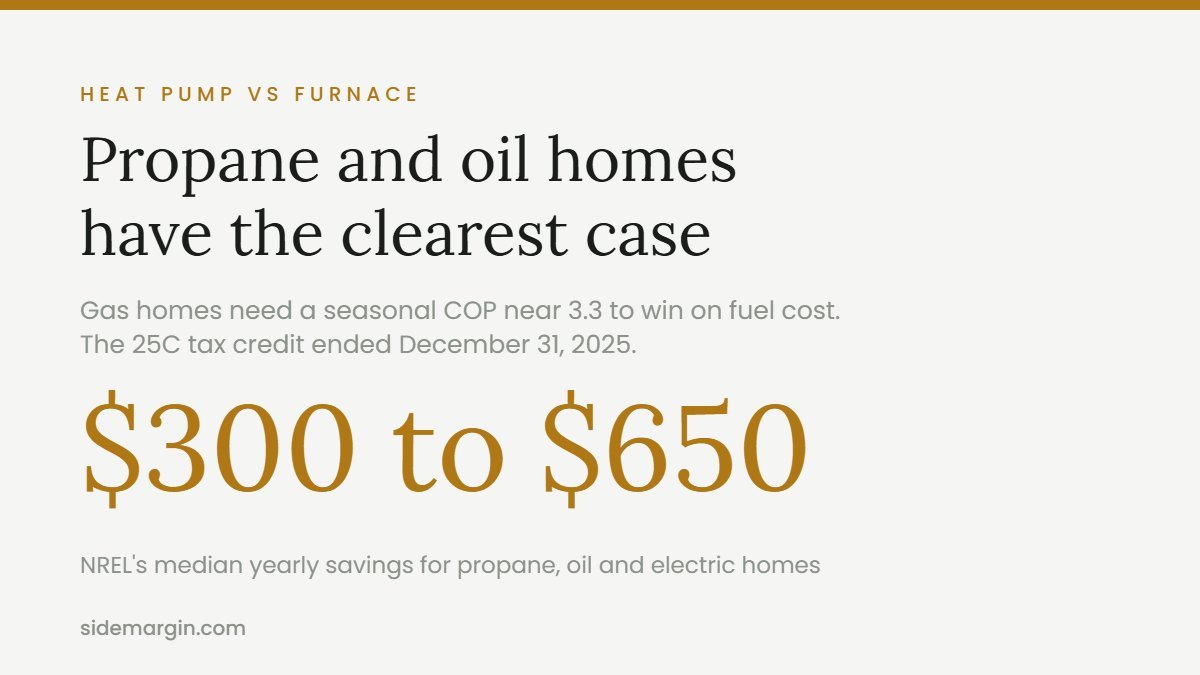
- Propane, oil and electric resistance homes are the clearest heat pump win. NREL found 92% to 100% of those homes (with existing AC) would see lower bills, with median savings of $300 to $650 a year.
- Gas homes are a closer call. At 2025 national average prices, a heat pump needs a seasonal efficiency (COP) of about 3.3 to beat a 95% furnace on fuel cost alone.
- Cold climate models work below 0°F, but field studies show sizing and installation quality matter as much as the label.
- The 25C tax credit ended. IRS: “The credit will not be allowed for any property placed in service after December 31, 2025.”
- Federal rebates run through states, and May 2026 guidance removed rebates for switching from gas, propane or oil to electric. Check your state.
- Dual fuel (heat pump plus gas furnace) is often the practical middle path for gas homes in cold places.
Heat pump vs furnace: how each one makes heat
A furnace burns fuel (natural gas, propane or oil) and blows the hot air through your ducts. Its efficiency is rated in AFUE, which the Department of Energy describes as “how efficient the appliance is at converting the energy in its fuel to heat”. A 95% AFUE furnace turns 95% of the fuel’s energy into heat for the house. DOE groups mid-efficiency systems at 80% to 83% AFUE and high-efficiency systems at 90% to 98.5%. Older low-efficiency systems ran at 56% to 70%.
A heat pump does not burn anything. It is an air conditioner that can run in reverse. In winter it pulls heat out of the outdoor air (there is heat in air even at 5°F) and moves it inside. Because it moves heat rather than making it, it can deliver more heat than the electricity it uses. DOE says today’s heat pump “can reduce your electricity use for heating by up to 75% compared to electric resistance heating such as furnaces and baseboard heaters.”
That ratio is called the coefficient of performance, or COP. A COP of 3 means three units of heat for every one unit of electricity. A furnace tops out below a COP of 1. A heat pump’s COP falls as it gets colder outside, which is the whole debate in one sentence.
A heat pump also replaces your central air conditioner. So if your AC is also old, you are really comparing a heat pump against a furnace plus a new AC.
Cold climate heat pumps: what the field data shows
The old rule that heat pumps are only for the South is out of date. Three benchmarks are worth knowing.
- NEEP’s cold climate specification (the Northeast Energy Efficiency Partnerships list many utilities use) requires a ducted central heat pump to reach a COP of at least 1.75 at 5°F at maximum capacity, plus HSPF2 of at least 7.7 and SEER2 of at least 14.3. Ductless systems need HSPF2 of 8.5 and SEER2 of 15.
- ENERGY STAR Cold Climate certification exists for units designed to work well down to 5°F, according to DOE.
- DOE’s Cold Climate Heat Pump Challenge set a higher bar: 100% of rated capacity at 5°F compared with 47°F, and a COP of at least 2.4 at 5°F for 2 to 4 ton units (2.1 for larger units). Eight major manufacturers, including Carrier, Daikin, Lennox and Trane, took part.
In DOE’s challenge field validation, 22 sites completed the study across nine states, and overall heat pump COPs were observed between 1.5 and 4.5 across outdoor temperatures from minus 15°F to 65°F, with systems operating efficiently below 0°F.
NREL’s earlier field study in Washington, Montana and Colorado is the more sobering read. Its seasonal heating COP from the compressor averaged 2.5 across sites, ranging from 1.7 to 3.5. But backup electric resistance heat “exceeded 40% of the compressor-based heating energy at 5 of the 11” all-electric sites, and at two of them the backup used more energy than the heat pump. The main reason was sizing: only two of the heat pumps were sized with extra heating capacity, and some were expected to cover less than 40% of the load at the design temperature.
My read: a cold climate heat pump can heat a Minnesota house. Doing it cheaply depends on sizing for your coldest days.
Heat pump vs furnace running costs: the arithmetic
The cleanest way to compare is the cost of one million Btu of heat actually delivered into your house. Here are the formulas, using EIA’s energy content figures: 1 kWh is 3,412 Btu, 1 cubic foot of natural gas is 1,036 Btu, a therm is 100,000 Btu, a gallon of propane is 91,452 Btu and a gallon of heating oil is 138,500 Btu.
- Heat pump: price per kWh × 1,000,000 ÷ (3,412 × COP)
- Gas furnace, price per Mcf: price per Mcf ÷ (1.036 × AFUE)
- Gas furnace, price per therm: price per therm × 10 ÷ AFUE
- Propane: price per gallon ÷ (0.091452 × AFUE)
- Heating oil: price per gallon ÷ (0.1385 × AFUE)
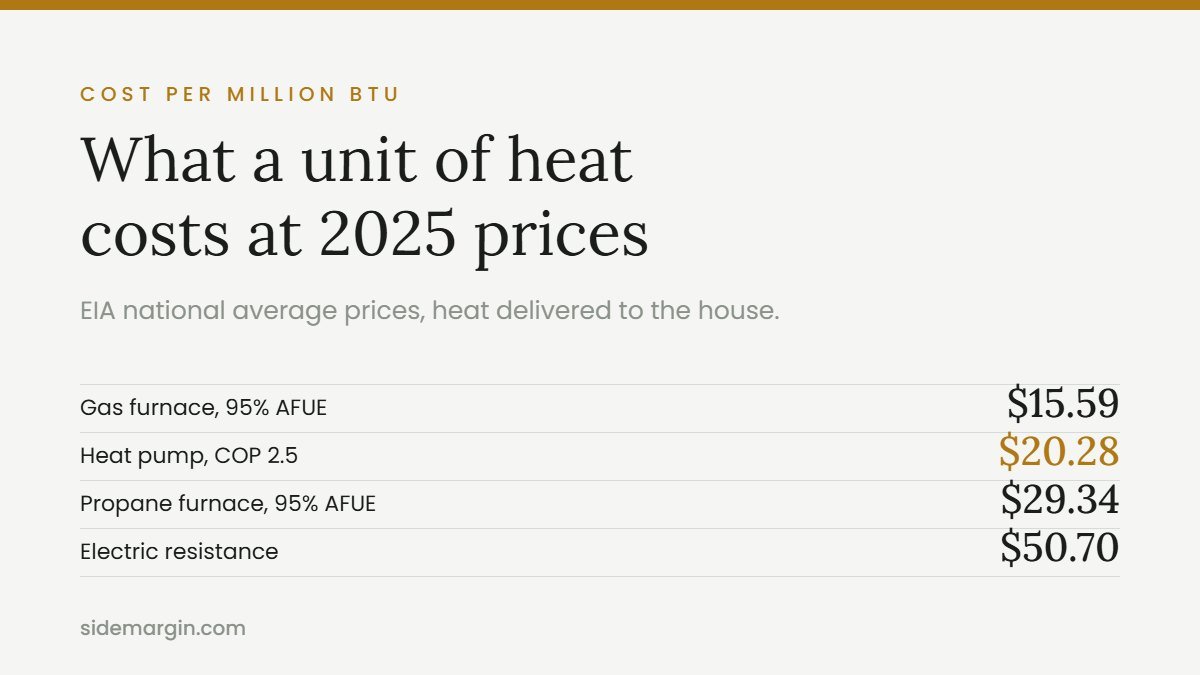
Write AFUE as a decimal (95% is 0.95) and electricity in dollars (17.3 cents is 0.173). For prices, I used EIA’s 2025 national averages so electricity and gas are from the same year: residential electricity averaged 17.3 cents per kWh and residential natural gas averaged $15.34 per thousand cubic feet (Mcf). For propane and heating oil I averaged EIA’s monthly residential prices for the October 2025 to March 2026 heating season: about $2.55 a gallon for propane and $3.98 for heating oil. EIA notes these two exclude taxes, so your delivered price will be somewhat higher.
| System (national average prices) | Cost per million Btu of delivered heat |
|---|---|
| Heat pump, COP 3.0 | $16.90 |
| Heat pump, COP 2.5 (NREL field average) | $20.28 |
| Heat pump, COP 2.0 | $25.35 |
| Electric resistance (baseboard, electric furnace) | $50.70 |
| Gas furnace, 95% AFUE | $15.59 |
| Gas furnace, 80% AFUE | $18.51 |
| Propane furnace, 95% AFUE | $29.34 |
| Propane furnace, 80% AFUE | $34.84 |
| Oil furnace, 85% AFUE (my assumption) | $33.79 |
That is my arithmetic on EIA’s prices. At national averages, a new 95% gas furnace is slightly cheaper per unit of heat than a heat pump averaging COP 2.5. A heat pump needs a seasonal COP of about 3.25 to tie that furnace, or about 2.74 to tie an old 80% furnace. Against propane, oil and electric resistance it wins at every COP in the table.
Two cautions. Electricity is rising: EIA’s residential price was 18.34 cents in June 2026, up 5.0% on a year earlier, and its September 2026 outlook projects 18.2 cents for 2026 and 18.6 cents for 2027. At 18.2 cents, the COP 2.5 figure rises to $21.34. Second, gas prices swing by month. EIA’s 2026 residential gas price ran from $13.96 per Mcf in January to $24.09 in June, since summer bills spread fixed costs over little gas.
To use your own rates, divide a year of electric bills by kWh used (that captures fixed charges), do the same for gas, and run the formulas. If your utility offers a heat pump rate, use it.
Heat pump vs furnace on propane or oil: the clearest case
NREL’s national modeling, published in the journal Joule, lines up. For the 49 million homes that heat with electricity, fuel oil or propane and already have air conditioning, it found “92% to 100% of homes would see energy bill savings, with median savings of $300 to $650 a year.”
For natural gas homes with central AC, the same study was much more sensitive to equipment quality: 38% would see savings (median $70 a year) with a minimum-efficiency heat pump, rising to 99% (median $380) with a high-efficiency cold climate model. Those results used winter 2021 to 2022 prices, so treat them as a direction, not a forecast for your house. Homes without AC fared worst (5% to 58% saving), since cooling adds a new bill.
Dual fuel: you may not have to pick
A dual fuel or hybrid system pairs a heat pump with a gas (or propane) furnace on the same ductwork. DOE describes it as combining “the efficiency of a heat pump with the reliability of a gas furnace.” The heat pump handles mild weather, and the furnace takes over in deep cold.
The switchover can be set on cost: find the COP at which your heat pump stops beating your furnace (the formulas above), then the outdoor temperature where the unit’s published COP falls to that level.
Dual fuel makes most sense when your furnace is still young but the AC is dying: replace the AC with a heat pump, keep the furnace. The backup is gas rather than electric resistance. The trade off: you keep a gas bill’s fixed charge and maintain two systems.
Heat pump vs furnace installation costs and lifespan
Quotes vary enormously by region and installer, so here are figures from one published study. NREL’s analysis in Joule, in January 2022 dollars, modeled these mean upfront costs for a cold climate segment of 18 million homes.
| Equipment (NREL model, 2022 dollars) | Mean upfront cost |
|---|---|
| Reference: furnace plus AC (homes with AC) | $11,000 |
| Reference: furnace only (homes without AC) | $5,000 |
| Minimum-efficiency heat pump | $9,000 |
| Medium-efficiency heat pump | $20,000 |
| High-efficiency cold climate heat pump | $24,000 |
| Envelope upgrades (insulation, air sealing), added | about $9,000 |
The study put the extra cost of a heat pump over the reference system at $2,000 to $18,000, depending on efficiency and whether the home already had AC. These are modeled averages in 2022 dollars, not quotes. Get at least three written bids for the same scope.
On lifespan, the comparison is less about which lasts longer and more about when to act. ENERGY STAR says to consider replacement when “your heat pump or air conditioner is more than 10 years old” or “your furnace or boiler is more than 15 years old.” DOE’s federal purchasing guidance uses a 15-year lifetime when it calculates heat pump energy costs.
If your furnace simply stopped working, rule out the cheap fixes first. Our guide to a furnace not turning on covers the thermostat, switch and filter checks, and a clogged filter is a common cause (see how often to change a furnace filter).
Ductwork and the electrical panel
Ducts. A ducted heat pump usually reuses your existing ducts, but it pushes a lot of air. DOE puts the target at about 400 to 500 cubic feet per minute of airflow per ton of capacity. Undersized or leaky ducts were one reason a site in the NREL study leaned on backup heat for about 20% of its winter load. Ask the installer to check duct size and seal leaks. If you have no ducts, ductless mini splits are the usual answer.
Panel. A heat pump adds electrical load, and electric backup heat strips add more. Lawrence Berkeley National Laboratory notes that homes with 200-amp panels are more likely to handle electrification than homes with 100-amp panels, and that about 35% of US homes have 200-amp panels. Where service and panel upgrades are needed, LBNL says “costs vary from about $5,000 to $30,000 or more,” depending on added loads, home size and rewiring. It also lists ways around an upgrade, such as circuit sharing and load control devices.
A gas furnace rarely triggers electrical work. If you keep any fuel burning appliance, keep working carbon monoxide alarms. If you smell gas, leave the house and call your gas utility from outside.
The 2026 tax credit change
Until the end of 2025, the Energy Efficient Home Improvement Credit (section 25C) allowed up to $2,000 a year for qualified heat pumps. The One Big Beautiful Bill Act, Public Law 119-21, signed July 4, 2025, ended it early. The IRS FAQ states plainly: “The credit will not be allowed for any property placed in service after December 31, 2025.”
What counts is when the equipment was placed in service, not when you paid. The IRS’s parallel guidance for the residential clean energy credit (25D) treats an expenditure as made “when the original installation of the item is completed.” So a heat pump paid for in December 2025 but installed in January 2026 does not qualify. A 2025 installation can still be claimed on your 2025 return; our guide to the energy efficient home improvement credit walks through Form 5695 and the manufacturer ID (QMID) requirement that applied for 2025.
Rebates that still exist
The Inflation Reduction Act rebates were not repealed. They are run by states, and availability varies. Under the statute for the High-Efficiency Electric Home Rebate program (often called HEAR or HEEHR), rebates can reach up to $8,000 for a heat pump, $4,000 for an electrical panel upgrade and $2,500 for wiring, with a $14,000 household cap. Households under 80% of area median income can get up to 100% of the project cost covered, and those between 80% and 150% up to 50%.
The catch is new. DOE’s Program Notice 26-2, effective May 29, 2026, told states to remove “allowances for upgrades for fuel-switching (i.e. replacement of non-electric appliances)” and allow HVAC rebates only for upgrading “from existing electric equipment to more efficient electric equipment.” It also allows homes “to retain existing fossil-fuel HVAC systems when installing a heat pump,” and requires insulation and air sealing first unless the home already meets a state standard.
My reading of that notice: a straight swap from a gas, propane or oil furnace to an all-electric heat pump no longer qualifies under the revised federal rules. Replacing electric baseboard or an old heat pump still can, and replacing an old central AC with a heat pump while keeping your furnace may fit. Launched state programs have three months to adopt the changes. DOE says rebates are “now available in select states” and tells homeowners to contact their state energy office.
Many utilities also run their own heat pump rebates, so check yours before you sign. If money is tight, the Weatherization Assistance Program can fund insulation and sometimes heating repairs for income-eligible homes, and LIHEAP helps with heating bills.
Heat pump vs furnace: which to choose by climate and fuel
A starting point built from the math above. Local prices can move any row.
| Your situation | Mild or mixed climate | Cold climate (zone 5 and up) |
|---|---|---|
| Propane or heating oil | Heat pump | Cold climate heat pump, or dual fuel keeping the existing furnace as backup |
| Electric baseboard or electric furnace | Heat pump (ducted or mini split) | Cold climate heat pump, sized for design temperature |
| Natural gas, AC also old | Heat pump, if your COP math clears the gas price | Dual fuel, or high-efficiency gas furnace plus AC |
| Natural gas, furnace young, AC dying | Replace AC with a heat pump (dual fuel) | Same: heat pump in place of AC, keep furnace |
| Natural gas, no AC, cheap gas | High-efficiency furnace is usually cheaper | High-efficiency furnace is usually cheaper |
| 100-amp panel, tight budget | Get a load calculation before deciding | Dual fuel avoids large electric backup loads |
What to do before you get quotes
- Pull 12 months of electric and gas (or propane or oil) bills. Divide total dollars by units used to get your real average price.
- Run the formulas above at COP 2.5 and 3.0 against your furnace’s AFUE. That tells you whether a heat pump is likely to save you money.
- Check your panel’s amp rating and ask for a load calculation, not a guess.
- Look up your state on DOE’s Home Energy Rebates page and your utility’s rebate page. Do this before installation, since each program sets its own rules.
- Ask every bidder for a Manual J load calculation, the model’s COP at 5°F, whether it is on the NEEP list or ENERGY STAR Cold Climate certified, and how much backup heat the design assumes.
- Do not budget for the federal 25C credit on a 2026 installation. It is gone.
Sources
- IRS, FAQs for modification of sections 25C, 25D and others under Public Law 119-21
- IRS, Energy Efficient Home Improvement Credit
- EIA, Short-Term Energy Outlook, electricity (September 2026)
- EIA, Electric Power Monthly, end-use prices (June 2026)
- EIA, US natural gas prices, annual
- EIA, US natural gas prices, monthly
- EIA, US residential propane price, monthly
- EIA, US residential heating oil price, monthly
- EIA, weekly heating oil and propane prices
- EIA, British thermal units
- DOE Energy Saver, Heat pump systems
- DOE Energy Saver, Air-source heat pumps
- DOE, Home heating systems fact sheet
- DOE Energy Saver, Minimizing energy losses in ducts
- DOE, Residential Cold Climate Heat Pump Challenge
- DOE, CCHP Technology Challenge field validation (2024 peer review)
- NEEP, Cold Climate Air Source Heat Pump Specification, Version 4.0
- NREL, Winkler and Ramaraj, Field validation of air-source heat pumps for cold climates (2023)
- NREL, Heat pumps for all? Distributions of the costs and benefits of residential air-source heat pumps (Joule)
- NREL, Benefits of heat pumps detailed in new report
- Lawrence Berkeley National Laboratory, Sizing electric service panels for electrification
- ENERGY STAR, When is it time to replace?
- DOE FEMP, Purchasing energy-efficient residential air-source heat pumps
- 42 U.S.C. 18795a, High-efficiency electric home rebate program
- DOE, Home Energy Rebates Program Notice 26-2
- DOE, Home Energy Rebates Program