
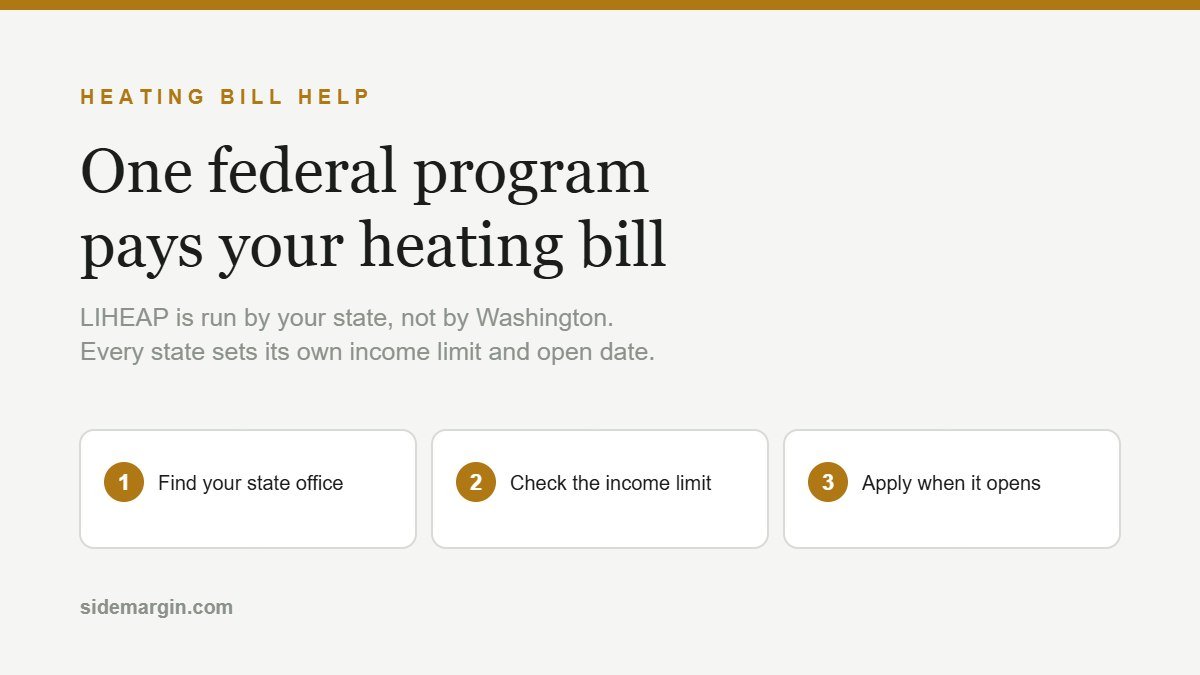
LIHEAP is a federal program that helps low income households pay heating and cooling bills. A LIHEAP application is free to file. The money usually goes straight to your utility company, and in many states, Pennsylvania among them, you do not have to be behind on a bill to qualify. Every state runs its own version, so the income limit and the opening date depend on where you live.
Key takeaways
- Applying is free. Nobody can charge you a fee to receive a LIHEAP benefit, and anyone who tries is running a scam.
- Your state sets the income limit inside a federal band. The same income can qualify in one state and not in another.
- There is no national start date. Windows open anywhere from October to January depending on the state.
- If your heat is already shut off or about to be, there is a separate crisis track with a legal deadline of 48 hours.
- Fewer than one in five eligible households gets help. Apply early in your state’s window.
Fact-checked against federal statute, HHS and state agency sources on September 1, 2026.
What LIHEAP is
LIHEAP stands for the Low Income Home Energy Assistance Program. The Department of Health and Human Services describes it as a program that “helps low income households pay for heating or cooling their homes.”
The federal government does not hand out the money itself. It sends block grants to states, territories and tribes. Each one runs its own program. Tribes can take their share directly rather than through the state.
That structure explains almost every confusing thing about LIHEAP. The income limit, the opening date, the grant size and the paperwork are all set locally.
What it pays for
- Heating bills, and in many states cooling bills
- Stopping a shutoff, or getting service turned back on
- Fixing or replacing a broken furnace or air conditioner
- Weatherization, such as insulation and air sealing
Cooling assistance is a state choice. Not every state offers it. Weatherization is optional too. States may spend up to 15 percent of their funds on it, or 25 percent with a waiver. Some spend nothing.
It does not cover water. “LIHEAP funds can only be used to help you pay to heat or cool your home. Generally, LIHEAP funds may not be used to pay water and sewer bills.”
In most cases the payment goes to your utility or fuel company rather than to you. Pennsylvania puts it plainly: “The grant will be sent directly to your utility provider or fuel company to be credited on your bill.”
Who qualifies, and why a LIHEAP application changes by state
Federal law sets a band, not a number. A state may not turn a household away on income grounds alone if its income is under 110 percent of the poverty level for that state. It also may not set its cut-off above the greater of two figures: 150 percent of the poverty level, or 60 percent of that state’s median income. Each state picks its own line in between.
Those two ceilings can sit far apart. That produces results that look unfair until you see the rule behind them. Compare the 2026 limit for one person:
| State | Income limit, 1 person | Which ceiling it uses |
|---|---|---|
| Pennsylvania | $23,940 | 150% of the poverty level |
| Rhode Island | $42,252 | 60% of state median income |
Same program, same year, and a gap of more than $18,000. So never assume you earn too much until you have checked your own state’s number.
If you already get other benefits
Federal law lets states approve a household automatically if someone in it receives TANF, Supplemental Security Income, SNAP, or certain veterans’ pension payments. This is a state option, not a national rule. Check whether yours offers it.
Renters
Renters qualify. The test is whether you have a home energy cost of your own.
If your heat is included in your rent, you may still qualify, though your grant can be smaller. Some states exclude households in subsidized housing where energy is included in the rent. That varies by state too.
When to file your LIHEAP application
There is no national opening date. Each state sets its own season, and the dates move from year to year.
Pennsylvania is a useful example of how much they shift. Its 2025 to 2026 season ran December 3 through May 8. Its 2026 to 2027 season “opens Monday, November 2, 2026, and will continue through Friday, April 23, 2027.” A month earlier than the year before.
Get your LIHEAP application in early. LIHEAP is a fixed pot of money, not an entitlement. It “has served less than 20 percent of income-eligible households.” Being eligible does not mean being funded.
If your heat is already off, use the crisis track
Federal law puts a clock on emergency help. A state program must, “not later than 48 hours after a household applies for energy crisis benefits, provide some form of assistance that will resolve the energy crisis if such household is eligible to receive such benefits.” Where the household is eligible and “is in a life-threatening situation,” the deadline drops to 18 hours.
That is a legal requirement, not a service target. It can be waived in a declared disaster area, and only where the Secretary determines the disaster makes compliance impracticable. Otherwise it holds.
Compare that with the regular queue. Missouri reviews ordinary applications “within approximately 30 business days.” So if you are facing a shutoff, say the word crisis when you apply. Make sure the application is filed on the emergency track.
What counts as a crisis is defined by your state. Pennsylvania counts a household with no heat, or with less than a 15-day fuel supply, or facing a utility termination.
How to file a LIHEAP application, step by step
- Find your local office. HHS points people to energyhelp.us, in English, Spanish and Chinese. The LIHEAP Clearinghouse search tool also finds your office.
- Or call the referral line. The National Energy Assistance Referral line is 1-866-674-6327, weekdays 9 AM to 7 PM Eastern. TTY is 1-866-367-6228.
- Gather your documents. Expect to show proof of income, a recent energy bill, and identification. The exact list is set by your state.
- Apply the way your state allows. Some take applications online, some by mail, some in person only.
- Say if it is an emergency. If your heat is off or about to be, that puts you on the 48-hour track.
Pennsylvania spells out two things that surprise people. You do not need to already receive public assistance, and you do not need an unpaid bill.
How much you actually get
Less than people expect. HHS says so directly: “LIHEAP is not meant to pay for all of your energy costs for the year, the season, or even the month.”
The most recent published figures cover 2022. The average heating grant was $539, against average annual heating costs of $1,987 for low income households. Grants have “historically funded less than half of recipients’ annual home heating costs.”
Published state ranges give a clearer picture. For 2026 to 2027, Pennsylvania sets regular grants at $200 to $1,000. The amount depends on region, income, heating type and household size. Crisis grants run from $25 up to a season maximum of $1,000.
In fiscal 2023 the program served 5.9 million households nationally. About 5 million got heating help and about 1.4 million got crisis help. The categories overlap, since a household can receive both.
A note on funding this year
Congress enacted about $4.045 billion for LIHEAP in the 2026 budget year. The President’s 2027 budget request proposes eliminating it, calling LIHEAP one of several “ineffective and/or duplicative programs.”
Congress has pushed back on that before and again this year. In April 2026, 74 House members wrote to appropriators opposing elimination. The House Appropriations Committee then approved a bill giving LIHEAP a $10 million increase instead.
As of mid-August 2026, when this was last checked, Congress had not finished the 2027 bill. One pattern is worth noting. Last year HHS released about 90 percent of the money up front and held the rest until spring. State programs still opened and still paid out. But if you are choosing when to apply, earlier is safer.
Scams, and one name that trips people up
HHS states the test in one line: “LIHEAP does not provide direct grants to individuals; LIHEAP does not charge a fee for receiving a benefit.” If someone offers you a LIHEAP grant or asks for a fee, that is the scam. The HHS fraud hotline is 1-800-447-8477.
The Federal Trade Commission is blunter: “No government agency will ever contact you to demand that you pay to get a grant.”
There is also a related scam that shows up in winter. Someone calls threatening to cut your power off today unless you pay at once by gift card, wire transfer or cryptocurrency. The FTC notes that “Real utility companies won’t demand immediate payment to avoid same-day disconnection.” Hang up and call the number printed on your bill.
Several sites that look official are not. The test is the address, not the word liheap. The federal program is on acf.gov, the official clearinghouse is liheapch.acf.gov, the referral service is energyhelp.us, and your state program is on your state’s own site. Commercial lookalikes exist with liheap in the name and no government connection. If a page asks for a fee or card details before you have spoken to your state office, leave.
Frequently asked questions
Can I get LIHEAP if I rent?
Yes, if you otherwise qualify. Renters are eligible. If your heat is included in your rent you may still qualify, though the grant may be reduced.
Does LIHEAP pay my water bill?
Generally no. The funds are for heating and cooling. Some states run separate water assistance programs, so ask your local office.
How long does a LIHEAP application take?
Regular applications can take weeks. Missouri quotes roughly 30 business days. Crisis applications are different. The federal deadline is 48 hours, or 18 hours if the situation is life-threatening.
Can I file a LIHEAP application every year?
Yes. LIHEAP is an annual program and you reapply each season. Approval one year does not carry over.
Do I have to be behind on my bill?
Not everywhere. Pennsylvania states directly that you do not need unpaid bills to apply for a regular grant, and other states take the same line. The crisis track is the one that requires an emergency. Check your own state.
The bottom line
Check your own state’s income limit rather than assuming. Apply as soon as your window opens, and use the crisis track if your heat is at risk. Applying costs nothing. The one reliable sign of a scam is anybody asking you to pay.
More from Side Margin
- Dolly Parton Imagination Library: Book List and Sign Up
- How to Cancel Subscriptions You Forgot You Had
Sources
- HHS Administration for Children and Families, LIHEAP program page
- ACF, LIHEAP FAQs for consumers
- 42 U.S. Code 8624, State plans and income eligibility
- 42 U.S. Code 8623, allotments and the crisis response deadlines
- ACF, LIHEAP Primer FY2024
- ACF, LIHEAP fact sheet, FY2023 figures
- Pennsylvania Department of Human Services, LIHEAP
- Rhode Island DHS, FFY2026 income guidelines
- Missouri Department of Social Services, LIHEAP
- USAGov, help with energy bills
- HHS, ACF FY2027 Congressional Justification (FY2026 enacted figure and the FY2027 elimination proposal)
- Pennsylvania DHS, 2026-2027 LIHEAP Important Facts for Customers (season dates and grant ranges)
- LIHEAP Clearinghouse, how to get help (referral and TTY numbers)
- American Public Power Association, on the FY2026 fund releases
- US House, letter opposing elimination of LIHEAP, April 2026
- American Public Power Association, House Appropriations FY2027 LIHEAP increase
- FTC, government grant scams
- FTC, scammers pretending to be your utility company