
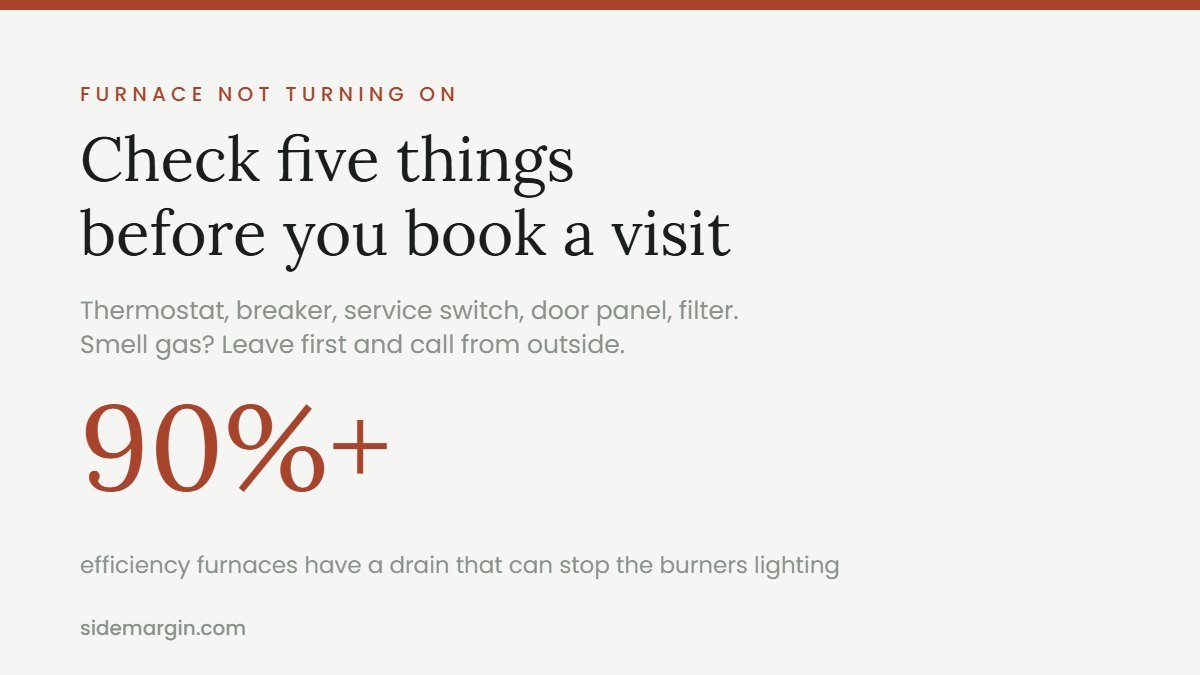
If your furnace is not turning on, the cause is usually something you can check yourself without tools: the thermostat mode or batteries, a tripped breaker, the furnace power switch that looks like a light switch, a loose blower door panel, or a clogged filter. If those are fine, a blink code on the control board will usually tell you, or your technician, which part to look at next. The one exception is any smell of gas. Then you stop checking and leave the house.
The steps below run from most likely and easiest to the parts that need a professional. They come from Carrier, Trane, Lennox and Rheem troubleshooting pages plus federal safety guidance, and where those disagree, I say so.
Key takeaways
- Gas smell means stop. Leave first, then call 911 or your gas utility from outside. Do not flip switches or relight anything.
- Start at the thermostat. It must be on Heat, set above room temperature, and powered.
- There are two power points to check. The breaker, and a separate furnace service switch on or near the unit.
- The furnace will not run with the door panel off. Carrier builds this in as a safety precaution.
- A dirty filter can make a working furnace shut itself off by tripping the high-limit switch.
- High-efficiency furnaces have a drain. If it clogs, a safety switch keeps the burners from lighting.
- Write down the blink code before you call. It narrows the problem and can shorten the visit.
First: gas smell, CO alarm, or neither?
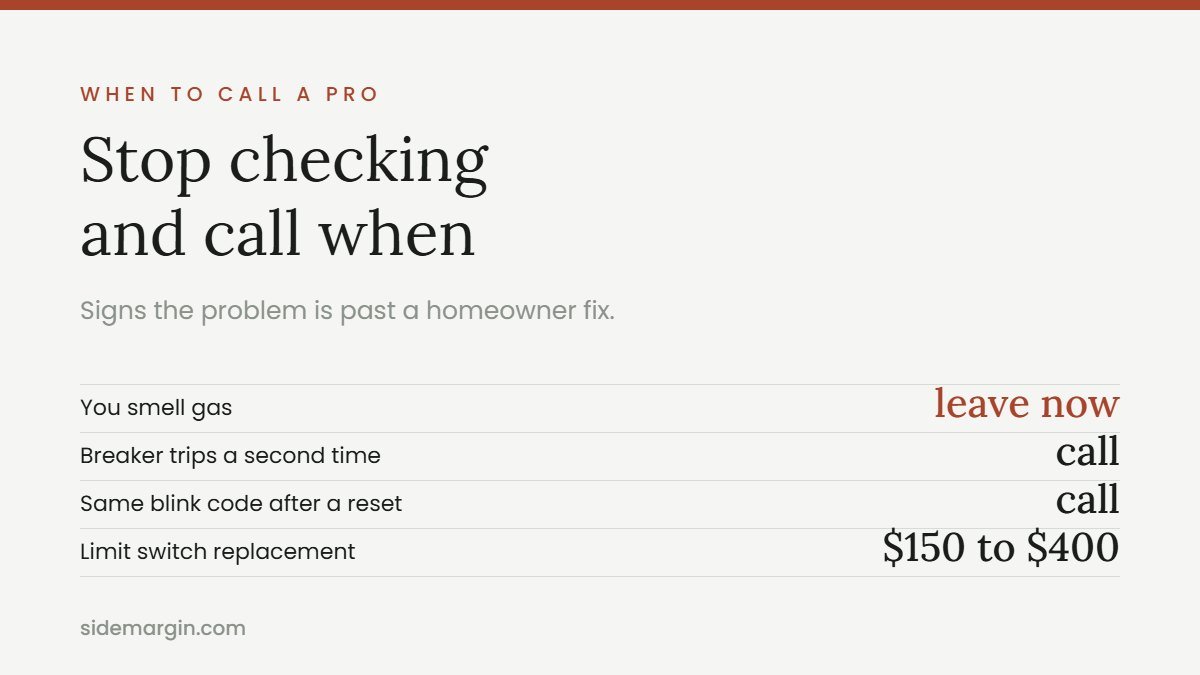
If you smell gas (natural gas is odorized to smell like rotten eggs), do not troubleshoot. Carrier’s guidance is plain: do not work any electrical switches, do not try to relight the furnace, leave the house, and contact your gas utility or emergency services. New Hampshire’s pipeline safety office adds: move at least 300 feet away and call from there, and do not use switches, phones or the garage door opener on the way out.
If your carbon monoxide alarm is sounding, the Consumer Product Safety Commission says to move outside to fresh air right away and call 911 or the fire department. Do not go back in until responders say it is safe. Early CO symptoms look like flu without a fever: headache, fatigue, nausea, dizziness.
CPSC recommends a CO alarm on every level of the home and outside sleeping areas. Our carbon monoxide detector placement guide covers where they go.
Furnace not turning on? Start at the thermostat
If the thermostat is not asking for heat, nothing else will happen. Carrier’s first step is to confirm the thermostat has power, is set to Heat, and is set higher than the current room temperature.
- Mode. It should say Heat. After a summer of air conditioning, a thermostat still on Cool is an easy miss.
- Setpoint. Raise it five degrees above room temperature. Check that a schedule or away mode is not overriding you.
- Batteries. A blank or dim screen often means dead batteries. Trane says dying batteries can make a thermostat behave oddly and suggests replacing them every year.
- Fan setting. If the fan is set to On instead of Auto, the blower runs all the time, including when the burners are off. Trane’s fix for cold air complaints is to switch the fan to Auto.
Smart thermostats and the C wire
Smart thermostats need steady power, usually from a common (C) wire. Google’s Nest help pages explain that the C wire does not control heating or cooling at all. It only supplies constant power to the thermostat. Without it, Google lists a drained battery, a dark display, the system turning on or off unexpectedly, and short, repeated cycling.
If the trouble started right after a smart thermostat install, power is a strong suspect. Google also notes that a blown fuse on the furnace control board can stop power from reaching the thermostat. So a dead screen can be a furnace problem.
If the furnace won’t turn on at all, check its power
A gas furnace still needs electricity for its igniter, control board and fans. Power can be cut in three places, and two are easy to miss.
1. The circuit breaker. Carrier says to find the breaker labeled Furnace or Heat. If it has tripped to the middle position, flip it fully off, then back on. If it trips again, stop there. Trane is direct: a second trip means an electrical problem, and it is time to call your HVAC company.
2. The furnace service switch. This is the one people miss. Carrier says it is usually on the side of the unit or a nearby wall, and often looks like an ordinary light switch. It gets flipped off by people hunting for the basement light.
3. The blower door panel. The front panel presses a small safety switch when closed. Carrier tells owners to put the access panel back after checking the filter, because “As a built-in safety precaution, the furnace will not run otherwise.”
If the heat stopped right after a filter change, check the door first and push it firmly into place. Never tape that switch down to run the furnace with the door open.
Runs, then quits: the filter and the high-limit switch
If the furnace starts, runs for a few minutes, then shuts off and blows cool air, a clogged filter is the first suspect. Carrier explains the chain: a clogged filter restricts airflow, the heat exchanger and blower motor are strained, and the system can overheat and shut itself down.
The part doing the shutting down is the limit switch, a safety sensor that watches the temperature inside the furnace. According to Carrier, it shuts down the burners if the system overheats. Trane warns that repeated overheating can wear out the high-limit switch, after which the system keeps blowing cool air even with a new filter.
- Switch the furnace off, pull the filter and hold it to a light. No light through it means replace it, arrow pointing toward the furnace.
- Make sure registers and return vents are open and not covered by furniture or drapes.
- Some furnaces have a manual-reset limit switch. Carrier notes that some have a small red or yellow button you can press if it has popped out. If it trips again, the problem is not fixed and needs a technician.
Carrier suggests changing filters monthly for 1-inch filters and every three months for 4-inch filters, and ENERGY STAR says to inspect filters once a month. Our guide to how often to change a furnace filter covers the variables.
Furnace not turning on in a high-efficiency unit: the drain and pressure switch
If your furnace vents through two white PVC pipes instead of a metal flue, it is almost certainly a condensing furnace. Trane defines these as high-efficiency gas furnaces with an AFUE rating of 90% or higher. Water condenses inside them and drains away through a small tube, to a floor drain or a small pump.
When that drain clogs, the furnace protects itself by refusing to light. Trane explains that a blocked drain line or pan triggers a safety feature that keeps the burners from igniting, so cool air comes out of the registers. The part that usually trips is the pressure switch, which checks that exhaust gases are moving out properly before the burners are allowed to fire. Rheem’s technical FAQ notes that a blocked vent can keep the pressure switch from closing, and that the condensate trap is a likely place for debris to collect.
- Water. Look for water around the furnace, or a drain tube that is kinked, loose or full of sludge.
- The condensate pump, if you have one. If the tube runs to a small box with a motor, check it is plugged in. A full tank with a silent pump means the pump has failed.
- The outside pipes. Carrier suggests going outside to check that the intake and exhaust vents are not clogged or blocked, and warns that blocked vents can lead to unsafe operation and carbon monoxide concerns. Think snow, leaves and nests.
Clearing snow from vent pipes is a homeowner job. Taking apart the trap is not, and a pressure switch that keeps failing with a clear drain needs a technician.
Read the blink code before you call anyone
Most modern furnaces diagnose themselves. Carrier notes that many furnaces have built-in diagnostics that signal trouble by blinking in distinct patterns. The light is an LED on the control board. Some furnaces have a small viewing window for it; otherwise it sits behind the door.
- Count the flashes. Codes are usually blinks, a pause, then a repeat. Watch a few cycles.
- Note the color. Trane says green lights generally mean normal operation, while red blinking lights on the furnace or control board generally signal a problem.
- Find the chart. The code key is usually on a label on the door panel, or in the owner’s manual. Codes differ by brand.
- Record it before you pull the door. Opening the panel trips the door switch and cuts power, so the code can vanish. If you have a viewing window, film it through that first.
Typical codes point to failed ignition, a limit trip or a pressure switch, the same suspects in this guide. Rheem describes one code as a soft lockout, where the furnace has stopped trying after failed attempts. Cutting power at the service switch for a minute restarts the sequence, but if the same code returns, resetting again will not fix it.
Furnace won’t turn on, or lights and quits: flame sensor and igniter
If everything above checks out, the problem is often ignition. Normally the small inducer fan starts, then you see an orange glow or hear a click, then the burners light.
The flame sensor
The flame sensor is a thin metal rod in the burner flame. Lennox explains that it confirms a flame is actually burning each time the furnace starts. Trane adds that if it detects no flame, it tells the control board to shut off the gas so gas cannot build up.
The classic symptom of a dirty sensor, per Lennox, is burners that ignite and then shut off after a few seconds. Carbon or oxidation builds up on the rod, it cannot confirm the flame, and the furnace shuts the gas off and retries.
Here the manufacturers do not agree. Lennox calls a dirty sensor the top cause of furnace shutdowns and says a quick cleaning usually fixes it, but still recommends a certified technician do it. Trane says outright: “You should not attempt to clean or replace the flame sensor yourself.” Trane also warns that opening the furnace for this kind of work could void a warranty.
My read: cleaning the sensor is a common homeowner repair, but none of the manufacturer pages I checked publish DIY steps. If the furnace is under warranty, or you are not comfortable working in the burner compartment, pay for it. Anything beyond the sensor, such as the gas valve, burners or piping, is professional work.
The hot surface igniter
Most modern gas furnaces light with a hot surface igniter instead of a pilot flame. Trane says furnaces made since 2010 have an electronic ignitor. Carrier explains that electric current heats the element until it glows hot enough to light the gas. A failed one shows as the inducer running with no orange glow at startup.
This is not a homeowner part. Carrier says igniters are extremely fragile and a new one can break from careless handling. It puts professional replacement at $150 to $450, depending on location and furnace model.
Gas supply and pilot lights on older furnaces
Test another gas appliance. If the stove lights and the water heater makes hot water, gas is reaching the house.
- The shutoff at the furnace. There is usually a small valve on the gas pipe leading into the furnace. Carrier says the handle should be parallel to the gas line when it is open. If it is perpendicular, it is closed.
- The meter. If all your gas appliances are dead, call the gas utility. Do not turn the valve at the meter back on yourself. Utilities such as Jackson Energy Authority tell customers plainly that once the gas is off, the utility turns it back on.
- Oil or propane. For oil furnaces, Carrier says to check the fuel level.
Pilot lights. Carrier notes that pilot lights were standard on gas furnaces before the 1990s. If an older furnace’s standing pilot has gone out, Carrier says to relight it following the owner’s manual. If the pilot will not stay lit, Trane says that is a job for a professional. Never relight anything if you smell gas.
Furnace not turning on: troubleshooting table
| Symptom | Likely cause | DIY check | Call a pro if |
|---|---|---|---|
| Nothing happens, thermostat screen blank | Dead batteries, no power, blown board fuse | Replace batteries; check breaker and service switch | Screen stays blank with power on |
| Thermostat calls for heat, furnace silent | Service switch off, door panel loose, breaker tripped | Switch on; reseat door; reset breaker once | Breaker trips again |
| Blower runs, air is cold | Fan set to On, ignition failure, clogged drain | Set fan to Auto; check filter and drain | Still cold with fan on Auto |
| Runs a few minutes, then shuts off | Clogged filter tripping the limit switch | Replace filter; open all vents | Keeps shutting off with a clean filter |
| Burners light, go out after a few seconds | Dirty flame sensor | Note the blink code | Any time you are not comfortable cleaning it |
| Inducer runs, no glow, no flame | Failed igniter, pressure switch, gas off | Check gas valve and other gas appliances | Igniter or pressure switch suspected |
| Water near furnace, no heat (90%+ unit) | Clogged condensate drain or failed pump | Check tube, pump plug, outside pipes | Trap or pressure switch needs service |
| Red LED blinking | Varies by code | Count flashes; read chart on door | Same code returns after a reset |
| Gas smell or CO alarm | Leak or combustion problem | None. Leave the house | Always: call 911 or the utility from outside |
What a repair costs, and when to book a tune-up
I could not find a primary source for a national average service call fee, so I will not invent one. Ask for the diagnostic fee before anyone comes out. Carrier publishes these ranges for common repairs:
| Repair | Range published by Carrier |
|---|---|
| Typical furnace repair | $150 to $300 (minor fixes from $50) |
| Hot surface igniter replacement | $150 to $450 |
| Limit switch replacement, parts and labor | $150 to $400 |
| Cracked heat exchanger | Can exceed $1,200, and may mean a new furnace |
Carrier credits its general figures to Forbes Home. Treat them as ballpark figures. Carrier also suggests weighing replacement if a furnace is over 15 years old and the repair quote approaches half the cost of a new one. Our comparison of a heat pump vs. a furnace covers the tradeoffs.
Tune-up timing. ENERGY STAR recommends a heating check-up in the fall, before the first cold night. CPSC recommends a professional inspection and service every year. ENERGY STAR’s list covers gas connections and pressure, burner combustion and the heat exchanger.
Help paying for heat or a repair
The federal Office of Community Services says LIHEAP money can go to energy bills, energy crises, weatherization and minor energy-related home repairs. Coverage varies by state. Massachusetts, for example, runs HEARTWAP, which provides emergency heating system repair and replacement for low-income households. Our step-by-step LIHEAP application guide covers how to apply. For longer-term help, the Weatherization Assistance Program studies your whole home and makes it safer and cheaper to heat.
What to do tonight if your furnace is not turning on
- Smell gas or hear the CO alarm? Leave now and call from outside. Nothing else on this list applies.
- Thermostat on Heat, fan on Auto, five degrees above room temperature, fresh batteries.
- Check the breaker once, the service switch by the furnace, and that the door panel is pushed fully closed.
- Replace the filter if no light shows through it.
- On a PVC-vented furnace, check for water, a full condensate pump and snow or debris at the outside pipes.
- Record the blink code, find the chart on the door, and note the model number from the rating label.
- Still nothing? Call a technician with the code, the model and what you checked.
Sources
- Carrier, Furnace not turning on: troubleshooting and repair guide
- Carrier, Furnace troubleshooting guide
- Carrier, Gas furnace repair and troubleshooting tips
- Carrier, Why is my furnace blowing cold air?
- Carrier, What is a furnace limit switch?
- Carrier, What is a furnace ignitor?
- Carrier, Furnace repair: signs, costs and troubleshooting
- Trane, Furnace not turning on? Troubleshooting tips
- Trane, Furnace not igniting
- Trane, Furnace not blowing hot air
- Trane, Furnace light blinking: what it means
- Trane, Thermostat says heat on but furnace not running
- Trane, What is a condensing furnace?
- Lennox, Understanding furnace flame sensor basics
- Rheem, Gas furnace technical frequently asked questions
- Google Nest Help, Learn about the common or C wire
- Google Nest Help, Troubleshoot when your thermostat won’t turn on
- U.S. Consumer Product Safety Commission, Carbon monoxide fact sheet
- New Hampshire Department of Energy, What to do if I smell gas
- Jackson Energy Authority, How to shut off gas at the meter
- ENERGY STAR, Maintenance checklist
- HHS Office of Community Services, LIHEAP fact sheet
- Mass.gov, Heating System Repair and Replacement Program (HEARTWAP)
- USAGov, Home weatherization and energy efficiency assistance