
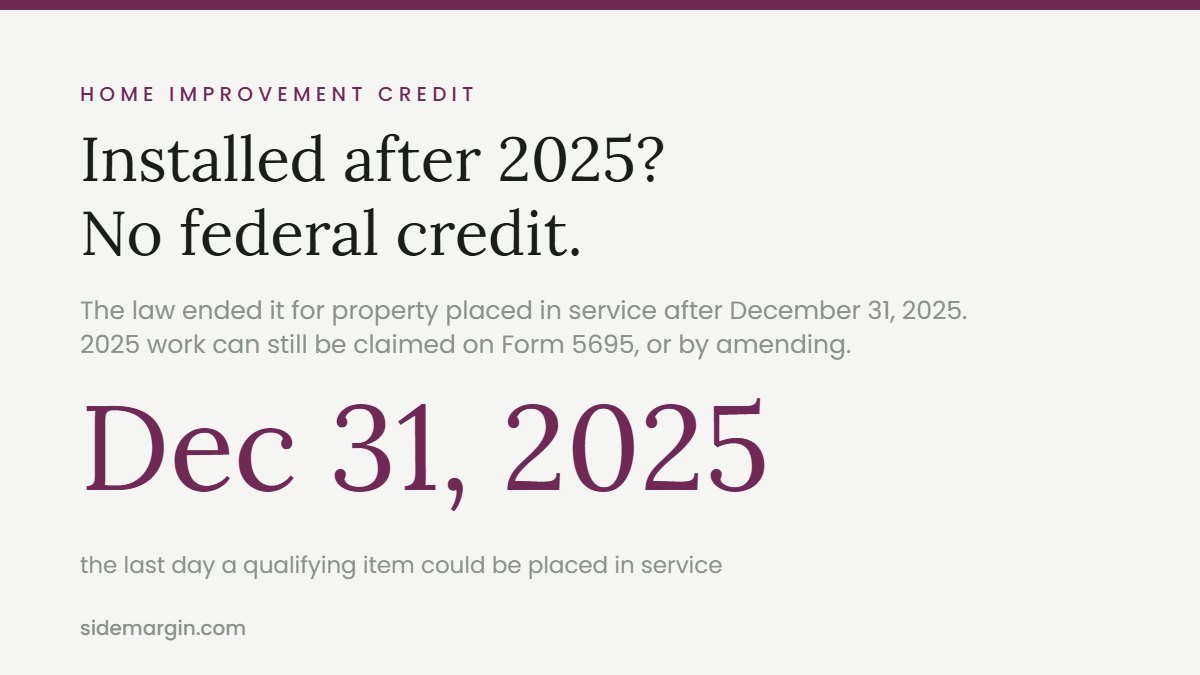
No. The energy efficient home improvement credit ended for anything placed in service after December 31, 2025. The One Big Beautiful Bill Act, signed July 4, 2025, cut the credit short, and it also ended its solar and battery cousin, the Residential Clean Energy Credit, for expenditures made after that same date. A heat pump, window or door installed in 2026 earns no federal credit, even if you paid for it in 2025.
What still counts is work installed in 2025. That can still be claimed on a 2025 return, and if you already filed without it, an amended return is open for years. This piece covers what changed, what the 2025 rules were, how to claim what you are owed, and what homeowners can use instead now that the credit is gone.
Key takeaways
- It is over for 2026 work. The statute now reads that the section “shall not apply with respect to any property placed in service after December 31, 2025.”
- Installation date decides it, not payment date. The IRS says you claim the credit for the year the property is installed, “not merely purchased.”
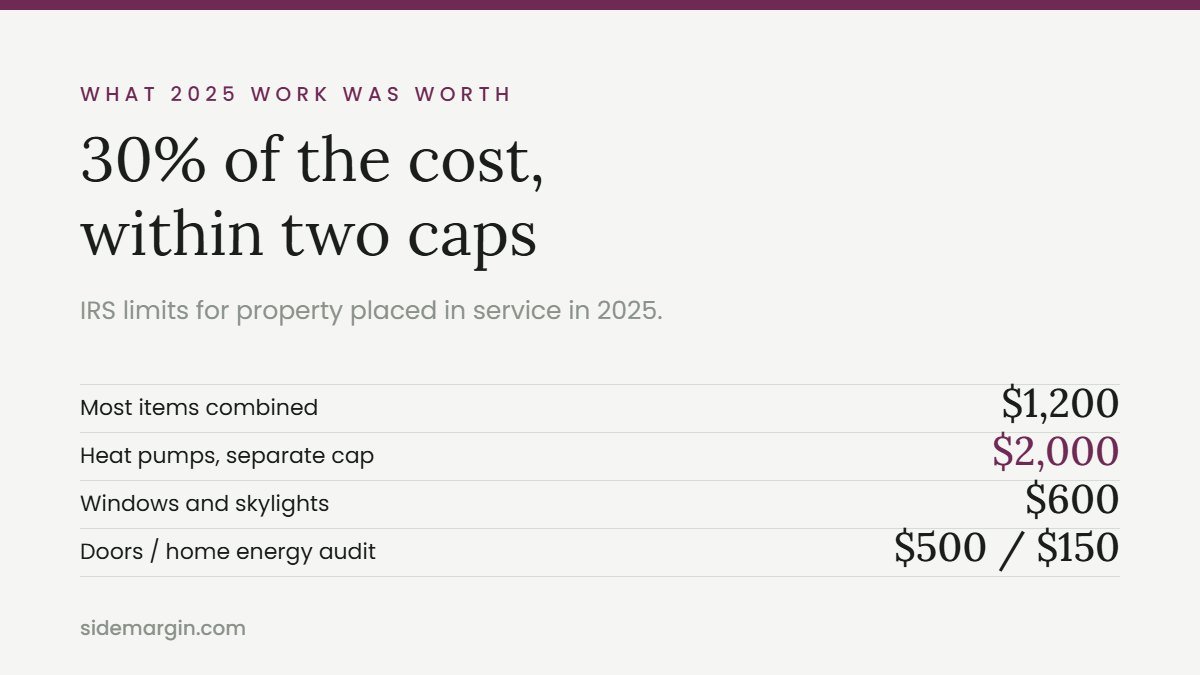
- 2025 work still qualifies. 30% of eligible costs, up to $1,200 a year, plus a separate $2,000 for heat pumps, heat pump water heaters and biomass equipment.
- 2025 had a new paperwork rule. Most items needed a qualified manufacturer code on Form 5695. No code, no credit.
- Missed it? Amend. You generally have 3 years from filing (or 2 years from paying the tax, if later) to claim a refund with Form 1040-X.
- The replacements are rebates, not credits. State Home Energy Rebates, utility programs and the Weatherization Assistance Program are where the money is now.
Is the energy efficient home improvement credit still available in 2026?
It is not. Public Law 119-21, the One Big Beautiful Bill Act, cut it short. Section 70505 of that law is titled “Termination of energy efficient home improvement credit,” and section 70506 does the same to the Residential Clean Energy Credit.
The two credits end on the same date but with slightly different wording, and the IRS repeats that wording in its August 2025 fact sheet on the changes:
- Section 25C (Energy Efficient Home Improvement Credit): no credit for property placed in service after December 31, 2025.
- Section 25D (Residential Clean Energy Credit, the one for solar panels, geothermal heat pumps, small wind, fuel cells and batteries): no credit for expenditures made after December 31, 2025.
The 2025 instructions for Form 5695 put both in one line: you cannot claim the residential clean energy credit for expenditures made after December 31, 2025, and you cannot claim the home improvement credit “for expenditures or property placed in service after December 31, 2025.”
Why do so many people still search for it? Contractor websites, old utility mailers and product boxes printed in 2024 still advertise “30% back from the IRS.” If a salesperson in 2026 tells you a new furnace or heat pump qualifies for a federal tax credit, ask them to show you the current IRS page. They will not find one.
Paid in 2025, installed in 2026: the date that decides it
You signed a contract and paid a deposit, or paid in full, in December 2025. The installer showed up in January 2026. Does it count?
The IRS answer is no. The credit pages for both 25C and 25D say you must claim the credit for the tax year when the property is installed, not merely purchased. The statute backs that up. Section 25C borrows the timing rules of section 25D(e), and under those rules an expenditure is treated as made when the original installation of the item is completed.
The IRS fact sheet asks this exact question for the solar credit: can a credit be claimed for property installed after December 31, 2025 “if a taxpayer pays for the property on or before December 31, 2025?” The answer is no, because installation completed after that date means the expenditure is treated as made after it. The fact sheet does not ask the same question separately for 25C, but 25C’s cutoff is written around “placed in service,” which points the same way. My read: a 2026 installation of anything is outside both credits, whatever the payment date.
The reverse case is less common. Work finished in December 2025 but billed in January 2026 is tied, under the installation rule, to when the job was completed. If that describes you, keep the completion paperwork and have a tax preparer look at it.
For new construction there is a separate rule under 25D: an expenditure for a new or rebuilt home is treated as made when your original use of the structure begins. The home improvement credit does not cover new construction at all.
How the energy efficient home improvement credit worked for 2025
From January 1, 2023 through the end of 2025, the credit equaled 30% of certain qualified expenses, with limits that reset every year. There were two buckets. Most items shared a $1,200 annual cap. Heat pumps, heat pump water heaters, biomass stoves and biomass boilers had their own $2,000 annual cap. Because the buckets are separate, a household could reach $3,200 in a single year.
| 2025 item | Credit | Limit |
|---|---|---|
| Heat pumps, heat pump water heaters, biomass stoves and boilers | 30% of cost | $2,000 a year (separate cap) |
| Central air conditioners | 30% of cost | $600 per item |
| Gas, propane or oil water heaters, furnaces, boilers | 30% of cost | $600 per item |
| Electrical panel and related upgrades | 30% of cost | $600 |
| Exterior windows and skylights | 30% of cost | $600 total |
| Exterior doors | 30% of cost | $250 per door, $500 total |
| Insulation and air sealing | 30% of cost | Counts toward $1,200 |
| Home energy audit | 30% of cost | $150 |
| All items except the $2,000 group | $1,200 a year combined |
Details that decide how much of a bill counts:
- Labor counts for equipment, not for the building envelope. IRS guidance lets you include labor for onsite preparation, assembly or original installation of energy property such as a heat pump. It does not let you include labor for windows, skylights, exterior doors or insulation. For those, only the materials count.
- Rebates come off first. The IRS says rebates generally reduce the cost of the property, “so the tax credit amount must be reduced by the amount of the rebate.” A $10,000 heat pump with a $2,000 utility rebate is an $8,000 cost for credit purposes.
- The home matters. Windows, doors and insulation had to go in a home in the United States that you own and use as your principal residence. Equipment like a heat pump had a looser test: a home in the United States used as a residence by you.
- Energy audits had rules. The audit had to be done by, or supervised by, a Qualified Home Energy Auditor certified by a Qualified Certification Program, and produce a signed written report.
A worked example on the published limits: in 2025 you installed a $9,000 heat pump (after rebates) and $2,500 of new windows. The heat pump earns 30%, which is $2,700, capped at $2,000. The windows earn 30%, which is $750, capped at $600. Total credit: $2,600. That is my arithmetic, not an IRS example, and it assumes you had enough tax liability to use it all.
The 2025 manufacturer code requirement
2025 was the first year of a new rule, and it is the most common reason a 2025 claim gets stuck. For property placed in service in 2025, no credit is allowed unless the item was made by a qualified manufacturer and you report that manufacturer’s identification number on your return.
The original plan was a 17-character product identification number (PIN) for each item. IRS guidance describes a PIN as “17 characters assigned by a QM to each item of specified property.” For 2025, the IRS simplified it. The Form 5695 instructions ask for “the four-character alphanumeric unique qualified manufacturer identification number (QMID) for each item.” ENERGY STAR says the same thing in plainer words: for 2025 installations it is enough to include the manufacturer’s four-character QM code.
Where to find it:
- On your installer’s invoice, if they listed it.
- On the manufacturer’s website, which often has a tax credit page with the code.
- From the manufacturer directly. IRS guidance says a qualified manufacturer must make its identification numbers available to taxpayers, including on request.
Insulation and air sealing materials are exempt from the number requirement. Almost everything else in the table above needs one. The codes go on specific lines of Form 5695 Part II (lines 19b, 20a, 22a, 23a, 24a, 25b, 29a, 29c and 29e in the 2025 instructions). Tax software will prompt you for them.
How to claim the energy efficient home improvement credit on a 2025 return
The credit goes on Form 5695, Residential Energy Credits. Part I is the Residential Clean Energy Credit (solar, batteries, geothermal). Part II is the energy efficient home improvement credit. The form attaches to your Form 1040 for tax year 2025.
| Your situation | What to do | Deadline |
|---|---|---|
| Have not filed 2025 yet, no extension | File now with Form 5695. Penalties and interest may apply to any tax owed. | Was April 15, 2026 |
| Filed an extension | Include Form 5695 with the return | October 15, 2026 |
| Already filed without the credit | File Form 1040-X with Form 5695 | 3 years from filing, or 2 years from paying the tax, whichever is later |
As of this writing, September 22, 2026, extension filers have a little over three weeks left. The IRS confirmed in April that an extension runs “until Oct. 15, 2026,” and that taxes owed were still due April 15.
For amended returns, the IRS rule is that you must file “within 3 years after the date you filed your original return or within 2 years after the date you paid the tax, whichever is later.” A return filed early is treated as filed on the due date. So if you filed your 2025 return in February 2026, the three years count from April 15, 2026, which takes the window to April 2029. That is my reading of the rule. Form 1040-X can be filed electronically through most tax software.
Step by step:
- Gather invoices showing what was installed, the cost of materials and labor, and the date installation was completed.
- Subtract any rebate or utility subsidy from the cost of that item.
- Find the four-character manufacturer code for each item that needs one.
- For an energy audit, keep the auditor’s signed report.
- Complete Form 5695 Part II. Your software applies the per-item and annual caps.
- Keep the paperwork with your tax records in case the IRS asks.
If you did this, can you still claim?
| What you did | Can you claim a federal credit? |
|---|---|
| Installed a heat pump in 2025, have not filed yet | Yes, on the 2025 return with Form 5695, if it meets the requirements and you have the manufacturer code |
| Installed windows in 2025, already filed without the credit | Yes, by amending with Form 1040-X |
| Paid in 2025, installation finished in 2026 | No. Installation date controls. |
| Installed anything in 2026 | No. Both credits ended December 31, 2025. |
| Installed solar panels in 2025, credit bigger than your tax | Partly. 25D excess can carry forward to 2026. |
| Home improvement credit in 2025 bigger than your tax | No carryforward. The excess is lost. |
| Energy audit in 2025 by a certified auditor | Yes, up to $150, with the signed report |
| Installed equipment with no manufacturer code available | No for items that required one, unless you can get the code from the manufacturer |
Nonrefundable, no carryforward: the limits of the energy efficient home improvement credit
The IRS is blunt about it: “The credit is nonrefundable, so you can’t get back more on the credit than you owe in taxes. You can’t apply any excess credit to future tax years.” A $2,000 credit only saves you $2,000 if your 2025 federal income tax, before this credit, was at least $2,000. If your tax was $900, the credit brings it to zero and the other $1,100 disappears.
The Residential Clean Energy Credit is different. The IRS says you “can carry forward any excess unused credit” and apply it to future tax owed, and the 2025 Form 5695 instructions show that carryforward going to 2026. So a household that put in $30,000 of solar in 2025 and could not use the full 30% can keep using it after the credit itself ended. If that is you, look for the carryforward line on your 2025 Form 5695 and make sure the amount shows up on your 2026 return.
One side effect worth planning for: if you relied on these credits to lower your tax in 2023 through 2025, your 2026 bill may be higher with nothing new to offset it. If you pay quarterly, it is worth rechecking your numbers against the estimated tax safe harbor rules before the next payment.
Common mistakes with the energy efficient home improvement credit
- Claiming 2026 work. Software built from 2025 templates, or a contractor’s old flyer, can mislead. 2026 installations get nothing.
- Using the payment date. A December 2025 deposit on a January 2026 install does not qualify.
- Forgetting the manufacturer code. For 2025, items that require it get no credit without it.
- Including labor on windows, doors or insulation. Only materials count for those.
- Not subtracting rebates. The credit is figured on your net cost.
- Stacking two heat pumps past $2,000. The cap is per year, not per unit.
- Claiming it for a rental you do not live in. The credit is for your own residence.
- Assuming you lost it because you filed already. An amended return fixes that.
What replaces the energy efficient home improvement credit for homeowners now
Nothing replaces it one for one. The federal tax code no longer pays you back for a new heat pump. What remains are rebates, mostly run by states and utilities, and most of them depend on where you live and what you earn. One upside: a rebate cuts the price at purchase, so you do not need tax liability to benefit.
State Home Energy Rebates
These were funded by the Inflation Reduction Act and are run by state energy offices. There are two programs. HOMES (Home Owner Managing Energy Savings) pays for whole-home upgrades that cut energy use, up to $8,000. The electrification program, often called HEAR and now listed by DOE as the High-Efficiency Electric Home Rebate program, offers “up to $14,000 on efficient upgrades” such as heat pumps and electric panels. Both pay more to lower-income households.
The catch is timing. As of DOE’s July 2026 update, the rebates “are now available in select states,” and the agency tells people to contact their state energy office for details. Before you buy, check whether your state has launched and whether you must be approved before the work starts.
Utility rebates
Many electric and gas utilities pay rebates on heat pumps, heat pump water heaters, smart thermostats and insulation. The ENERGY STAR Rebate Finder searches by zip code: “Find rebates and special offers near you on ENERGY STAR certified products.” If you are weighing a system swap, our heat pump vs furnace comparison covers the running costs now that the $2,000 credit is gone.
Free weatherization and bill help
For income-qualified households, the DOE Weatherization Assistance Program pays for insulation, air sealing and other efficiency work at no cost to the household. DOE says participating households “save on average $372 or more every year.” Our guide to the Weatherization Assistance Program covers eligibility and how to apply. If the problem is this winter’s bill rather than an upgrade, LIHEAP is the program that helps pay heating costs directly.
Could Congress bring it back?
Bills have been introduced. H.R. 5862, the American Energy Independence and Affordability Act, was introduced October 28, 2025 by Rep. Thompson of California with 96 cosponsors. Among other things it would extend the Residential Clean Energy Credit through 2034 at a declining rate and restore the home improvement credit’s product number rules.
An introduced bill is not law. As of this writing, the IRS pages for both credits still describe them as ending with 2025. I would not plan a purchase around it. If a future law restores it, the rules and dates will be new, and they may not reach back to work done in the gap.
What to do now
- If you installed qualifying items in 2025 and filed on extension: finish Form 5695 and file by October 15, 2026.
- If you already filed and skipped the credit: pull your 2025 invoices, get the manufacturer codes, and file Form 1040-X.
- If you installed solar or a battery in 2025: confirm your Form 5695 shows any carryforward, and that it lands on your 2026 return.
- If you are planning work in 2026 or later: ignore any “30% federal tax credit” pitch. Check your state energy office for Home Energy Rebates, run your zip code through the ENERGY STAR Rebate Finder, and call your utility before you sign.
- If money is tight: apply for weatherization and LIHEAP before winter.
Sources
- IRS, Energy Efficient Home Improvement Credit
- IRS, Residential Clean Energy Credit
- IRS, FAQs for modification of sections 25C, 25D and others under Public Law 119-21 (FS-2025-05)
- IRS, Instructions for Form 5695 (2025)
- IRS, FS-2025-01, updated FAQs on the Energy Efficient Home Improvement and Residential Clean Energy credits
- Legal Information Institute, 26 U.S. Code 25C
- GovInfo, Public Law 119-21
- IRS, Topic no. 308, Amended returns
- IRS, Amended return frequently asked questions
- IRS, If you need more time to file, request an extension (IR-2026-52)
- ENERGY STAR, Federal tax credits
- ENERGY STAR, Rebate Finder
- U.S. Department of Energy, Home Energy Rebates Program
- U.S. Department of Energy, Home Upgrades
- U.S. Department of Energy, Weatherization Assistance Program
- GovInfo, H.R. 5862, American Energy Independence and Affordability Act