
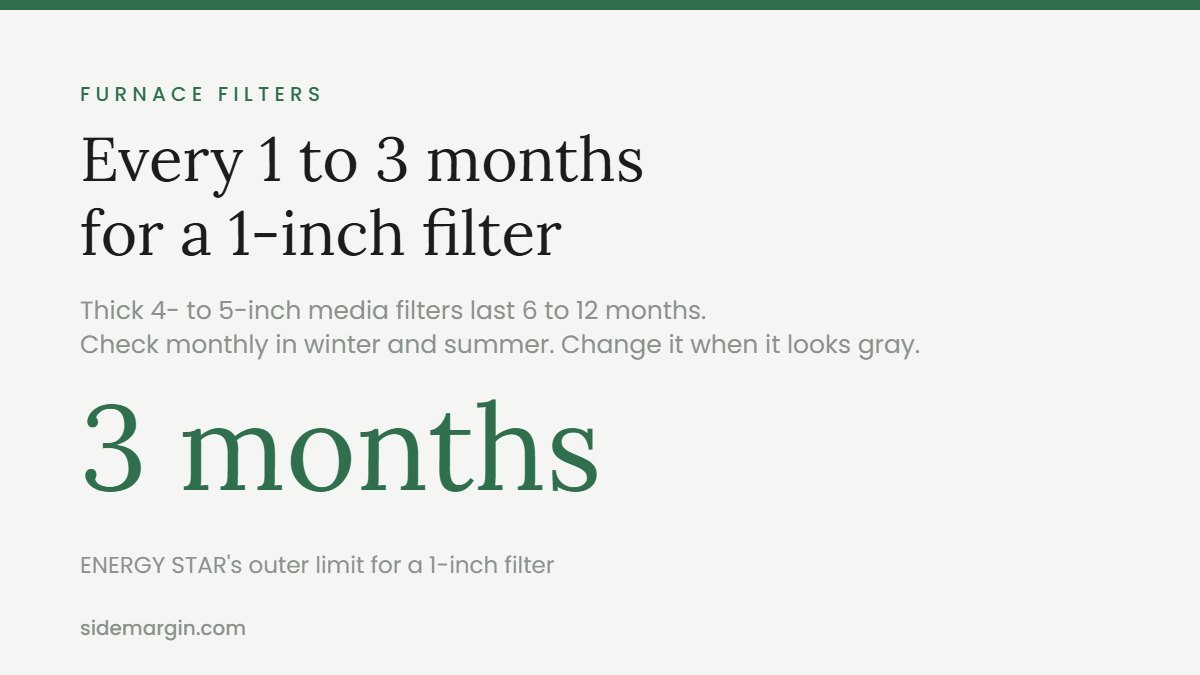
The short answer to how often to change furnace filter is this: a standard 1-inch filter every 1 to 3 months, and a thick 4- or 5-inch media filter every 6 to 12 months. ENERGY STAR’s rule is to check it monthly, change it when it looks dirty, and never go past 3 months on a 1-inch filter. Pets, allergies, smoke and a fan that runs all day push you toward the short end.
The rest of this piece covers the two questions that come next: how to set the interval for your own house, and which of the many nearly identical boxes to buy.
Key takeaways
- 1-inch filters: 30 to 90 days. Cheap fiberglass ones, every 30 days. ENERGY STAR sets 3 months as the outer limit.
- 4- to 5-inch media filters: 6 to 12 months, per Carrier, Honeywell and AprilAire.
- Check monthly in peak season. A calendar interval is a starting point. What the filter looks like is the real answer.
- MERV 13 is EPA’s target if you want better filtration, but only as high as your system fan and filter slot can handle.
- MPR and FPR are store brand scales, not a replacement for MERV. Look for the MERV number on the box.
- A clogged filter costs money. The Department of Energy says a clean one can cut air conditioner energy use by 5% to 15%.
How often to change a furnace filter, by filter type
The single biggest factor is thickness. A thicker filter has more pleated material packed into the same slot, so it takes longer to fill up. Here is what the manufacturers and federal agencies actually publish.
| Filter type | Published interval | Who says so |
|---|---|---|
| 1-inch fiberglass (the flat, see-through kind) | Every 30 days | Carrier |
| 1-inch pleated | Every 30 to 90 days | Carrier; Trane says 30 to 90 days |
| 1-inch, any type | Check monthly; change at least every 3 months | ENERGY STAR |
| 1-inch pleated (Filtrete) | At least every 3 months | 3M Filtrete |
| 2- to 6-inch filters (Filtrete) | Every 12 months as a general rule | 3M Filtrete |
| 4-inch media | Every 6 to 12 months | Carrier, Honeywell |
| AprilAire MERV 10, 11 or 13 media | Annually; check at 6 months if the fan runs 24/7 | AprilAire |
| AprilAire MERV 16 or MERV 13 with carbon | Every 6 months | AprilAire |
EPA’s guide to home air cleaners agrees: “Manufacturers typically recommend replacement every 60 to 90 days.” It adds that many factors affect how quickly a filter gets dirty, which is why every source pairs a calendar number with an instruction to look.
If your furnace manual gives a different interval, follow the manual. EPA says the same.
What makes a filter clog faster
The published intervals assume an ordinary house. These push you toward the short end, or below it.
- Pets. Carrier says a single pet is fine on the standard schedule, but a multi-pet house should “check the filter every 30 days.”
- Allergies or asthma in the house. Carrier suggests higher rated filters checked monthly for these households.
- Wildfire smoke. EPA says to plan to replace the filter more often than the manufacturer recommends during smoke events, and to change even more often if the filter comes out heavily soiled.
- Construction or remodeling. Carrier and Honeywell both list nearby construction. Check the filter as soon as dusty work ends.
- Smoking, candles, a fireplace, heavy cooking. All on Carrier’s list.
- Running the fan ON instead of AUTO. More hours of airflow means more particles caught, which is the point, but the filter fills faster. AprilAire says to check at six months instead of twelve if your fan runs 24/7.
- Peak season. ENERGY STAR singles out winter and summer, when the system runs the most.
The opposite is also true. A mild shoulder season, a small house with no pets, or a system that barely runs will stretch a filter. EPA notes that HVAC systems usually run less than 25% of the time during heating and cooling seasons, and a filter only works while air is moving through it.
How to tell when to change your furnace filter without guessing
You need two habits.
Look at it. Slide the filter out once a month during heavy use. Carrier’s signs are “visible dirt and debris” or a filter that looks “gray or clogged.” A useful household check is to hold it up to a light or a bright window. A new pleated filter lets some light through. If you can barely see any, or the pleats are packed with a gray felt of dust, it is done. If it only looks a little darker than new, put it back and check again next month.
Date it. Write the install date on the frame with a marker before you slide it in. It solves the main reason filters go unchanged: nobody remembers when the last one went in. After two or three changes you will know your house’s real interval. Filtrete’s app offers 30, 60 or 90 day reminders if you want something prebuilt.
Other signs Carrier lists that point at the filter: weaker airflow at the registers, more dust settling on furniture, rising utility bills, and longer heating or cooling cycles.
What a clogged filter actually does to your system
ENERGY STAR’s summary: “A dirty filter will slow down air flow and make the system work harder to keep you warm or cool.” It adds that a clean filter keeps dust from building up inside the equipment. The specific failures look like this.
Higher bills. The Department of Energy says replacing a dirty, clogged filter with a clean one “can lower your air conditioner’s energy consumption by 5% to 15%.” That figure is for cooling. The same airflow logic applies to heating, but I have not found a comparable federal number for furnaces, so I will not invent one.
High-limit trips. Every gas furnace has a high-limit switch that shuts the burners off if the heat exchanger gets too hot. Bryant, a Carrier brand, describes it this way: if an airflow restriction “such as a dirty air filter or a blocked vent” pushes the heat exchanger past safe temperatures, the switch is the fail-safe. The symptom is a furnace that fires, runs briefly, shuts off, and repeats. Bryant’s advice before anyone replaces that switch is to check for a clogged filter, blocked returns or a dirty coil first. If a new filter does not fix it, our guide on what to check when a furnace is not turning on walks through the next steps, including short cycling.
A frozen AC coil. The same filter serves your air conditioner or heat pump if it shares the blower. Trane lists a dirty filter among the top causes of frozen evaporator coils, because restricted airflow lets the coil get too cold. If you see ice on the refrigerant lines or the indoor coil, Trane’s advice is to turn the system off and let it thaw before running it again. Then change the filter.
A shorter equipment life. Carrier says restricted airflow “can shorten the lifespan of your furnace,” and your cooling system too. If you are already weighing a replacement, our comparison of heat pump vs furnace covers costs and efficiency.
MERV ratings, explained without the jargon
MERV stands for Minimum Efficiency Reporting Value. It comes from a lab test, ASHRAE Standard 52.2, which EPA calls the most widely used test method for duct filters in the United States. The test measures how much of three sizes of particle a filter catches, from 0.3 to 10 microns. Higher MERV means it catches more, especially of the smallest particles. The scale for home filters runs from 1 to 16.
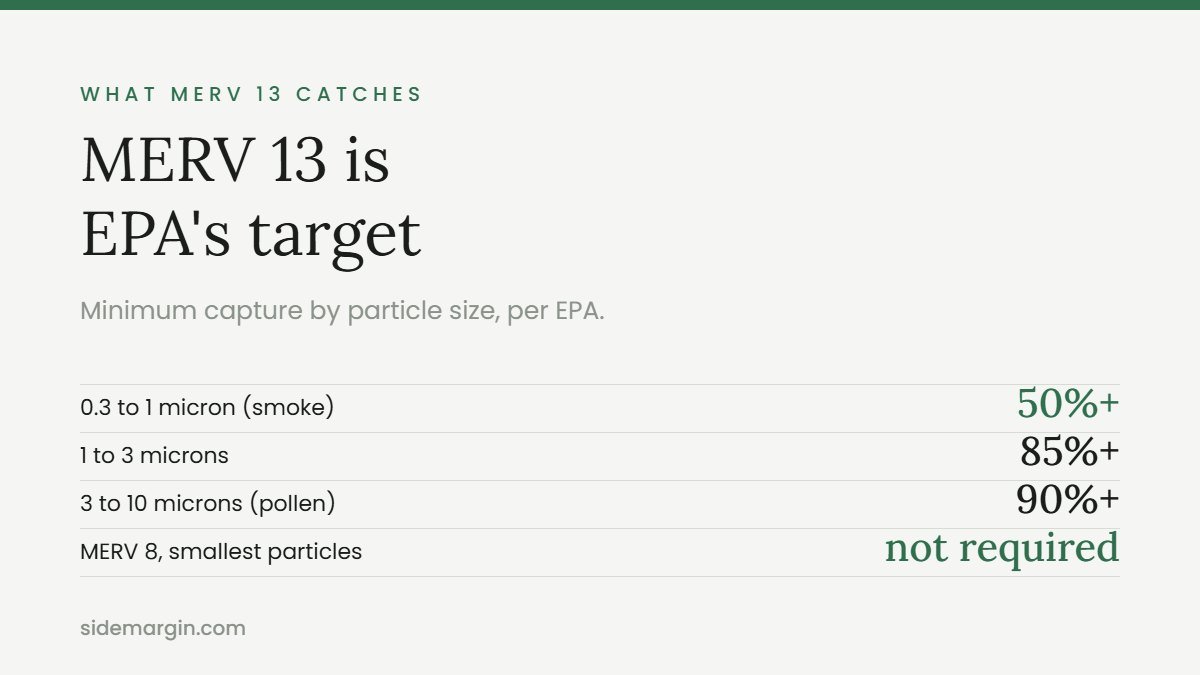
These are EPA’s minimum capture figures for the ratings you will actually see on store shelves.
| MERV | 0.3 to 1.0 µm (smoke, bacteria, fine dust) | 1.0 to 3.0 µm (fine dust, some mold spores) | 3.0 to 10 µm (pollen, dust mite debris, lint) |
|---|---|---|---|
| 5 | Not required | Not required | 20% or more |
| 8 | Not required | 20% or more | 70% or more |
| 11 | 20% or more | 65% or more | 85% or more |
| 13 | 50% or more | 85% or more | 90% or more |
| 16 | 95% or more | 95% or more | 95% or more |
The particle examples in the headers are rough illustrations; the percentages are EPA’s. The takeaway is in the first column. A MERV 8 filter does not have to catch any of the smallest particles, which is where wildfire smoke sits. MERV 13 is the first rating required to catch at least half of them.
Should you buy MERV 13? The airflow caveat
EPA’s recommendation, if you want better filtration, is to choose “a filter with at least a MERV 13 rating, or as high a rating as your system fan and filter slot can accommodate.” It also says most furnaces and HVAC systems can take a MERV 13 filter without equipment problems, “provided that the filter is replaced frequently.”
That last clause is the whole trade. A denser filter resists airflow more, and EPA’s technical summary notes that pressure drop across a media filter “will slowly increase over the filter’s useful life” as it loads with dust. A fresh MERV 13 in a system that can handle it is fine. A MERV 13 left in for five months is the clogged filter from the previous section, just more expensive.
How to decide:
- Check the furnace or air handler manual for the filter types and maximum resistance it was designed for.
- If the slot takes a 4- or 5-inch filter, you are in the best position. EPA says deeper pleated filters increase the filter area and limit airflow resistance, so a thick MERV 13 is usually easier on the blower than a thin one.
- If you have only a 1-inch slot and an older system, ask a technician at your next tune-up. EPA says you may need a professional to find the highest efficiency filter that works for your system. A technician can measure static pressure across the filter, which is the real test.
- After switching to a higher MERV, watch for the warning signs: weaker airflow, the furnace cycling off early, a whistling filter door. If they show up, step down a rating or change it more often.
My read: for a typical house with no allergies, a MERV 8 to 11 pleated filter changed on time does most of the job. With asthma in the house or a wildfire season, aim for MERV 13. During smoke events EPA highly recommends it and says to run the system fan as often as possible.
MPR, FPR and MERV: reading the box
Two of the biggest sellers use their own scales. EPA says only that for all rating methods, higher means better removal. It does not say they are interchangeable, and they are not.
- MPR (Microparticle Performance Rating) is 3M’s scale for Filtrete. It focuses on particles from 0.3 to 1 micron. Filtrete maps it roughly this way: MPR 300 is MERV 5, MPR 700 to 800 is MERV 8 to 10, MPR 1500 is MERV 12, MPR 2500 is MERV 14. Retail listings pair MPR 1000 with MERV 11 and MPR 1900 with MERV 13.
- FPR (Filter Performance Rating) is Home Depot’s scale, used on its store brand and others it sells. Building scientist Allison Bailes has pointed out that Home Depot’s own listings have paired FPR 10 with both MERV 8 and MERV 13, which tells you how loose the mapping is.
The practical rule: most boxes print a MERV number somewhere, often in small type next to the brand scale. Buy by that number.
Finding your filter size
The size is printed on the frame of the filter you already have, in the form width by height by depth, such as 16x25x1 or 20x25x4. Carrier notes most manufacturers print it right on the filter. Take a photo of the edge before you shop.
That printed number is the nominal size, a rounded label. The actual size is different. American Standard says the actual size of a standard filter is usually ½ to ¾ inch smaller in length and width. Thick media filters can go the other way: AprilAire’s 20x25x4 cartridge has an actual size of 20.6 by 26.63 inches because it fits a specific cabinet. So match the nominal size for standard filters, and match the part number for media cabinets.
If there is no old filter or the label has worn off, American Standard’s advice is to measure the slot itself from inner edge to inner edge. Filtrete warns that a wrong size leaves gaps, and air takes the easy path around the filter instead of through it.
Which way the arrow points
Every filter frame has an airflow arrow. It points in the direction the air travels, which is toward the blower. American Standard puts it as “pointing towards the furnace or air handler and away from the return air duct.” For a filter in a wall or ceiling return grille, the arrow points into the wall or ceiling, away from the room. Carrier’s tip: match the filter you just removed, assuming it was right.
How to change a furnace filter in five minutes
| Step | What to do |
|---|---|
| 1 | Set the thermostat to off so the blower is not pulling air while the slot is open. |
| 2 | Find the filter: a slot where the return duct meets the furnace, or behind a return grille. Some houses have more than one. |
| 3 | Slide the old filter out slowly. Note the size and arrow direction. |
| 4 | Write today’s date on the new filter’s frame. |
| 5 | Slide it in, arrow toward the blower, sitting flat with no gaps. |
| 6 | Close the cover, turn the system back on, set a reminder. |
Washable filters and electronic air cleaners have their own cleaning schedules. Follow their manuals.
While you are at the furnace, two quick safety checks are worth the extra minute. Make sure nothing is stored against the furnace or blocking the vent pipe, and test your carbon monoxide alarms. Our guide to carbon monoxide detector placement covers where they belong. If an alarm sounds, or anyone feels headachy, dizzy or sick while the furnace runs, leave the house and call 911 or your gas utility from outside. Do not stay to investigate.
What changing your furnace filter costs per year
The interval you pick drives the cost more than the brand does. The table below uses prices I checked on September 22, 2026: Walmart’s listed prices for Filtrete 16x25x1 filters and AprilAire’s own store price for its 20x25x4 MERV 13 cartridge. Prices move, so treat this as the method, not a quote.
| Filter | Price per filter | Changed every 3 months | Changed every 2 months | Changed monthly |
|---|---|---|---|---|
| Filtrete 16x25x1, MERV 5 (4-pack at $19.52) | $4.88 | $19.52 | $29.28 | $58.56 |
| Filtrete 16x25x1, MERV 11 (4-pack at $43.98) | $11.00 | $44.00 | $66.00 | $132.00 |
The AprilAire 20x25x4 MERV 13 cartridge was $64.99: $64.99 a year on its annual schedule, or $129.98 at every 6 months. The arithmetic is mine: price per filter times changes per year. First, that thick MERV 13 filter changed once a year costs about the same as a mid-grade 1-inch filter changed every three months, while filtering more and needing one visit a year instead of four. If your furnace has a media cabinet, the thick filter is not the luxury option. Second, the jump from quarterly to monthly changes on a 1-inch MERV 11 triples the cost. That is money well spent in a house with three dogs and wasted in a quiet condo.
Buying in multipacks lowers the per-filter price. The Filtrete MERV 5 single was $5.64 against $4.88 each in the 4-pack.
How often to change a furnace filter when you rent
Check your lease. Filter changes are often the tenant’s job even when the landlord owns the furnace. If the slot is inaccessible, or the furnace keeps tripping with a clean filter, report it in writing. If you own and money is tight, the federal Weatherization Assistance Program makes homes more energy efficient at no cost to eligible low-income households.
What to do this week
- Pull your current filter today. Photograph the size and MERV label on the frame. If it is gray, replace it now.
- Look up your furnace model number (label inside the blower door) and check the manual for recommended filter types and intervals.
- Pick your starting interval: 1-inch filters at 2 months if you have pets or allergies, 3 months otherwise; thick media filters at 12 months, or 6 if the fan runs all day.
- Buy a multipack in the right nominal size. Choose MERV 8 to 11 for most houses, MERV 13 if you need smoke or allergy protection and the system can handle it.
- Write the date on each new filter and set a monthly reminder to look, not necessarily to replace.
- If the furnace short cycles or shuts off early even with a clean filter, stop swapping filters and book a technician.
Sources
- ENERGY STAR, Heat and cool efficiently
- U.S. Department of Energy, Energy Saver: Maintaining your air conditioner
- U.S. EPA, Guide to Air Cleaners in the Home
- U.S. EPA, What is a MERV rating?
- U.S. EPA, Residential Air Cleaners: A Technical Summary, 3rd edition
- U.S. EPA, Indoor airPLUS and wildfires
- Carrier, How often to change your air filter
- Carrier, Changing furnace filters
- Bryant, What is a furnace limit switch?
- Trane, Top causes of frozen AC coils
- Honeywell Store, Honeywell HVAC filters: why and how often to change them
- AprilAire, Air purifier and air filter FAQs
- AprilAire, 213 MERV 13 replacement filter (price and actual size)
- 3M Filtrete, How to choose the best air filter for your new home
- 3M Filtrete, MPR 700 MERV 8 2-inch filter product page
- American Standard, Furnace filter sizes explained
- Energy Vanguard, Understanding filter ratings: MERV, FPR and MPR
- Walmart, Filtrete 16x25x1 MPR 300 MERV 5, 4-pack listing
- Walmart, Filtrete 16x25x1 MPR 1000 MERV 11, 4-pack listing