
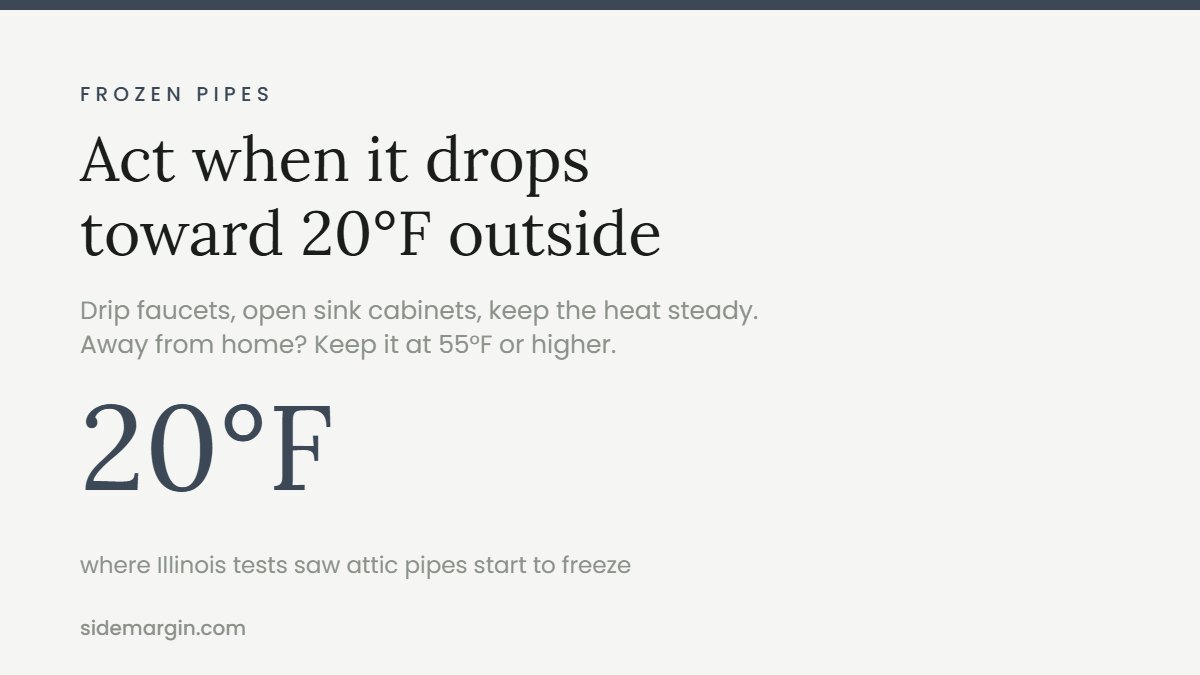
You prevent frozen pipes by keeping cold air off the water lines and keeping water moving through them. In practice that means disconnecting hoses and draining outdoor faucets before winter, insulating pipes in attics, crawlspaces and garages, and on the coldest nights letting a faucet drip, opening sink cabinets and leaving the heat at a steady temperature. If you go away, the American Red Cross says to leave the heat on at no lower than 55°F.
If a pipe has already frozen, you thaw it slowly with electric heat, never a flame. If it has burst, you shut off the main water valve first and deal with everything else second. This guide covers all three stages, plus what your homeowners or renters policy is likely to pay for and the one clause that can sink a claim.
Key takeaways
- Risk starts around 20°F outside. University of Illinois research found pipes in an unheated attic began to freeze when the outdoor temperature fell to about 20°F, which is why that number is called the temperature alert threshold.
- The ice is not what breaks the pipe. Pressure builds between the ice blockage and a closed faucet. A dripping faucet gives that pressure somewhere to go.
- Keep the heat on and steady. Same temperature day and night, and no lower than 55°F if you are away.
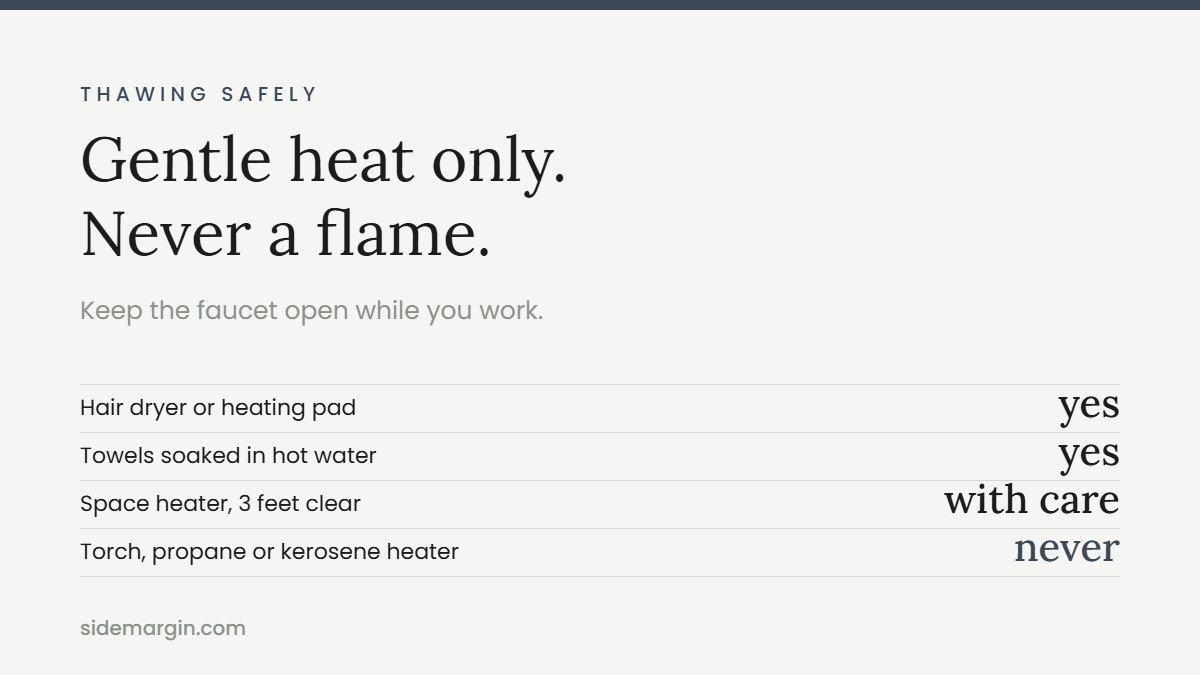
- Thaw with a hair dryer, heating pad or hot towels. Never a torch, propane heater or any open flame.
- Know where your main shutoff is before you need it. A burst pipe can release a lot of water fast, and State Farm’s average frozen pipe claim payment was over $30,000.
- Insurance usually covers sudden burst damage, but the standard HO-3 policy excludes freezing damage unless you used reasonable care to keep the heat on or shut off and drain the water.
When frozen pipes become a real risk
Water freezes at 32°F, but a pipe inside or under your house does not freeze the moment the outdoor thermometer hits 32°F. The building slows the cold down. The more useful number comes from the Building Research Council at the University of Illinois.
The City of Horseshoe Bay, Texas summarizes it this way: “In research tests at the University of Illinois, water pipes placed in an unheated, insulated attic consistently started forming ice when the outdoor temperature dipped just below 20 degrees F.” The city calls 20°F the temperature alert threshold. A South Carolina Farm Bureau Insurance summary adds that a survey of 71 plumbers in southern states matched it: burst pipe problems showed up when temperatures fell into the teens.
That threshold was measured for poorly protected pipes in unheated space. A pipe in a drafty crawlspace can freeze sooner. A pipe in a heated interior wall may survive much colder weather. Treat 20°F as the night you act, not a guarantee.
Why pipes burst
Water expands as it freezes. The less obvious part is where the break happens. According to the Farm Bureau summary of the Illinois research, the ice usually does not split the pipe. Continued freezing pushes water pressure up between the ice blockage and a closed faucet at the end of the line, and that pressure causes the failure. So the break can show up away from the coldest spot, and a dripping faucet helps.
Which pipes freeze first
The Red Cross lists the usual suspects. Pipes exposed to severe cold, such as outdoor hose bibs, swimming pool supply lines and sprinkler lines. Water lines in unheated spaces: basements, crawlspaces, attics, garages and kitchen cabinets. And pipes that run along exterior walls with little insulation. It also flags the spot where your water service enters the house through the foundation.
To find your own weak points, walk the house and ask of every sink, toilet and appliance: is this on an outside wall? A kitchen sink under a window is a classic problem. So is a laundry room in an unheated garage, or plumbing in a crawlspace with open vents.
How to prevent frozen pipes before winter
Most of the work happens in the fall, on a mild weekend, when it costs little and nothing is urgent.
Outdoor faucets and hoses
Disconnect and drain garden hoses. If your outdoor faucet has a shutoff valve inside the house, the Red Cross says to close that inside valve and then open the outside hose bib so the water drains out. The D.C. Department of Insurance, Securities and Banking also suggests covering exterior faucets.
Many newer homes have frost-free sillcocks instead. The faucet body reaches through the wall, so the valve seat sits inside the heated house. It only works if it drains: the body should slope down toward the outside, and the hose must come off. InspectAPedia notes that water in an attached hose can stop the faucet draining even when it is off. A frost-free faucet with a hose left on can still freeze and split inside the wall.
Insulation and air sealing
Foam pipe sleeves are cheap and slip over exposed pipe in attics, basements, crawlspaces and garages. The D.C. regulator also lists pipe tape, batt insulation and expanding foam. Insulation slows heat loss but creates no heat, so a sleeved pipe can still freeze in a long cold snap.
Drafts matter as much as air temperature. State Farm’s list includes sealing leaks that let cold air in. Look for gaps where pipes, cables and vents pass through exterior walls and the rim of the foundation, and seal them with caulk or foam. Keep the garage door closed if water lines run through the garage. If your home needs more than a weekend of sealing, low-income households may qualify for free work through the Weatherization Assistance Program.
Heat cable, used exactly as the label says
For a pipe that cannot be protected any other way, the Red Cross suggests UL-listed heat tape or heat cable. It is an electrical product wrapped around plumbing, and it causes fires when misused. In guidance reissued in 1996, the Consumer Product Safety Commission estimated about 1,500 fires a year were linked to faulty heat tapes. The CPSC rules:
- Plug it into a GFCI protected outlet, using the 3-prong plug in a 3-prong outlet.
- Do not wrap it over itself unless the manufacturer’s instructions permit it.
- Do not cover it with insulation unless the manufacturer advises it.
- Inspect it every year and replace it if it shows wear.
If the same pipe freezes every winter, the Red Cross suggests considering relocating it. That is a plumber’s job, but a one-time cost against a recurring risk.
Frozen pipes prevention checklist
| When | Task | Why it helps |
|---|---|---|
| Fall | Disconnect and drain garden hoses | Lets outdoor faucets drain, including frost-free ones |
| Fall | Close inside valves to hose bibs, open the outside tap | Empties the pipe that is most exposed |
| Fall | Drain pool and sprinkler supply lines | These lines sit outside with no heat at all |
| Fall | Sleeve exposed pipes in attic, crawlspace, basement, garage | Slows heat loss from the pipe |
| Fall | Seal gaps where pipes and cables pass through outside walls | Stops cold drafts hitting the pipe directly |
| Fall | Find and label the main water shutoff | Cuts the damage if something bursts |
| Fall | Service the heating system | Heat is the main defense. A furnace failure on a cold night is the setup for a freeze |
| Cold night | Drip faucets on vulnerable lines | Relieves pressure and keeps water moving |
| Cold night | Open sink cabinets on outside walls | Lets room heat reach the pipes |
| Cold night | Keep the thermostat the same day and night | Avoids an overnight dip when it is coldest |
| Away | Heat at 55°F or higher, or shut off and drain | The two conditions a standard policy expects |
If your furnace has been acting up, see our guide on what to check when the furnace is not turning on before the first hard freeze, not during it.
On a very cold night
When the forecast drops toward the 20°F threshold, or lower, do four things before bed.
- Drip the faucets fed by exposed pipes. The Red Cross says even a trickle helps. Triple-I suggests opening both hot and cold. Ice may still form, but an open faucet lets water escape before pressure builds high enough to burst the pipe.
- Open the cabinet doors under sinks on outside walls so room air reaches the pipes. Move cleaners out of reach of children.
- Leave the thermostat alone. The Red Cross says to keep it the same day and night. A nighttime setback is not worth it during a hard freeze.
- Close the garage door if any water lines run through the garage.
How warm? Sources differ. Triple-I says a minimum of 65 degrees. The D.C. regulator says around 69 degrees and no lower than 55 in all areas. The Red Cross and State Farm use 55°F as the floor. My read: 55°F is the minimum when you are away. When you are home, a normal living temperature is safer.
If the heating bill is the real problem, the LIHEAP energy assistance program helps eligible households pay for heat.
How to thaw frozen pipes safely
The first sign is usually simple: you turn on a faucet and only a trickle comes out. Then work in this order.
- Open the faucet and keep it open. Flowing water helps melt the rest, and the open tap relieves pressure.
- Find the frozen section. Check pipes on exterior walls, in cabinets, and where the water line enters through the foundation.
- Apply gentle heat. The Red Cross lists a heating pad, a hair dryer, a space heater kept away from flammable materials, or towels soaked in hot water.
- Keep going until full water pressure returns.
- Check every other faucet. Others may be frozen too.
| Method | Safe? | Notes |
|---|---|---|
| Hair dryer | Yes | Start near the faucet and work back toward the frozen spot. Keep it away from standing water |
| Electric heating pad | Yes | Wrap it around the pipe section |
| Towels soaked in hot water | Yes | Slow but no electrical risk |
| Electric space heater | With care | At least 3 feet from anything that burns, plugged directly into a wall outlet, never left running unattended |
| Blowtorch or any open flame | No | Fire risk inside walls and cabinets. Can overheat the pipe |
| Kerosene or propane heater | No | Named on the Red Cross list of devices not to use |
| Charcoal stove | No | Also on the Red Cross list. Never burn charcoal indoors |
Take the space heater row seriously. The CPSC’s January 2026 release estimates portable heaters are involved in about 1,600 fires a year, with an average of 70 deaths, based on 2020 to 2022 data. Keep heaters three feet from anything that burns, plug them straight into the wall, and turn them off when sleeping.
Stop and call a licensed plumber if you cannot find the frozen section, cannot reach it, or cannot thaw it. A pipe frozen inside a finished wall is not a hair dryer job.
If frozen pipes burst: the first ten minutes
Signs of a burst: water spraying or pooling, a wet patch spreading on a ceiling or wall, running water sounds when nothing is on. Bursts often show up as the pipe thaws, when water flows through the crack again.
- Shut off the main water valve. Triple-I’s first instruction for a burst pipe is to turn off the water. SERVPRO lists the common locations: the basement where the main line enters, the crawlspace, near the water heater or under the kitchen sink in slab homes, an exterior wall in warmer climates, or the yard under an access panel. Find yours this fall and label it.
- Be careful with electricity. Do not walk into standing water if outlets or cords may be live. If you can reach the breaker panel from a dry spot, switch off the wet area. If not, stay out and call your utility or an electrician. Electrical Safety Foundation guidance is to keep power off until an electrician inspects, and not to use wet appliances until one says it is safe.
- If the water heater is involved, turn off its power or gas supply as well. Our guide on a leaking water heater covers how to do that safely.
- Take photos and video before you clean up.
- Stop further damage. The standard HO-3 policy requires you to protect the property from further damage and keep a record of repair costs. Mop, run fans, and keep every receipt.
- Call your insurer as soon as you can, and dry things quickly to limit mold, as Triple-I advises.
How much water are we talking about? State Farm reported more than 20,000 frozen pipe claims from January 2024 through June 2025, totaling over $628 million in paid losses. State Farm says the average claim payment exceeded $30,000. The five costliest states were Illinois, Oregon, Washington, Texas and Tennessee, so this is a southern problem too.
Leaving home for the winter
An empty house is where frozen pipes do the most damage, because nobody notices the leak for days. You have two options, and the standard policy recognizes both.
- Keep the heat on at 55°F or higher, and ask someone to check the house regularly, especially after a power outage.
- Or shut off and drain. The D.C. regulator says an unheated vacant property should have the water shut off and the systems and appliances drained. For a boiler or complicated plumbing, have a plumber winterize it.
Smart devices add a third layer. Leak sensors sit near water heaters, washers and sinks and alert your phone. PURE Insurance notes some include low temperature sensors that warn of a possible freeze. Automatic shutoff valves on the main line go further, closing the water when a leak is detected or, on some models, when the temperature drops too low. Farmers says installing one may earn a discount, but eligibility varies by state, so ask your insurer before you buy.
An alert is only useful if someone can act on it. Give a neighbor a key and show them the shutoff.
Does homeowners insurance cover frozen pipes?
Usually, yes, for the sudden damage. The D.C. regulator says most homeowner policies cover frozen pipe damage from a sudden and accidental discharge from a plumbing system. Triple-I says standard policies cover most disasters that result from a freeze.
The catch is written into the policy. The standard HO-3 form, in the sample Triple-I publishes, excludes freezing of a plumbing, heating or air conditioning system, or a leak caused by freezing, with this condition: “This provision does not apply if you have used reasonable care to: (a) Maintain heat in the building; or (b) Shut off the water supply and drain all systems and appliances of water.” In plain English, if the pipes froze because the heat was off and the water was left on, the insurer can deny the claim.
Vacancy adds risk. The same sample HO-3 drops vandalism and glass coverage once the home has been vacant more than 60 consecutive days. Triple-I says most policies limit or exclude coverage after typically 30 to 60 consecutive days empty, and that failing to heat a home in winter could void coverage even under a vacant home policy. Read the vacancy and freezing sections of your own policy before you leave.
Your deductible applies, and the cost of fixing the pipe itself may be handled differently from the water damage it caused. Ask your insurer how your policy treats it.
If you rent
The building and its pipes are generally your landlord’s to insure and repair, but the NAIC notes that your landlord’s insurance does not cover your belongings. Renters insurance does, plus liability, and some policies pay living expenses if the unit becomes uninhabitable. Report a burst to your landlord in writing right away, take photos, and file with your renters insurer. If you travel, check your lease for a required heat setting and do not turn the heat off.
What to do this fall
- This weekend: find your main water shutoff, check that it turns, and tag it.
- Before the first freeze: disconnect every hose, close the inside valves to outdoor faucets and open the outside taps.
- Sleeve exposed pipes in the attic, crawlspace, basement or garage, and seal drafty gaps.
- Get the heating system checked and replace the filter. See how often to change a furnace filter.
- Set a phone alert for nights forecast at 20°F or below. On those nights, drip, open cabinets and leave the thermostat alone.
- Traveling: choose heat at 55°F or higher with house checks, or a full shutoff and drain.
- Consider a leak sensor or automatic shutoff valve, and ask your insurer whether it earns a discount.
Sources
- American Red Cross, Preventing and thawing frozen pipes
- City of Horseshoe Bay, Texas, Recommended hard freeze protection
- South Carolina Farm Bureau Insurance, How pipes freeze and burst
- D.C. Department of Insurance, Securities and Banking, If my frozen pipes burst, am I covered by insurance?
- Triple-I, Sample HO-3 homeowners special form
- Triple-I, The homeowner’s severe cold weather survival guide
- Triple-I, When no one’s home: understanding the role of vacancy insurance
- Triple-I, Mitigation reduces winter weather risks for homes and vehicles
- State Farm, Frozen pipes? Not so nice (January 2026)
- Carrier Management, Frozen pipes lead to $628M in losses for State Farm
- CPSC, CPSC reissues heat tape guidelines
- CPSC, Keep warm and safe this winter (January 2026)
- InspectAPedia, Frost-proof sillcock installation and repair
- SERVPRO, Where to find the main water shutoff valve
- Electrical Safety Foundation International, Flood electrical safety
- PURE Insurance, Preventing water damage with leak detection sensors
- Farmers Insurance, Home leak detection and shutoff
- NAIC, For rent: protecting your belongings with renters insurance