
The third-quarter deadline for estimated tax payments is Tuesday, September 15, 2026. If you are reading this in a mild panic, here is the part nobody leads with: the penalty is interest, not a fine, and there is a rule that lets you stop guessing at your income entirely.
That rule is the safe harbor, and it is built on a number you already know.
Key takeaways
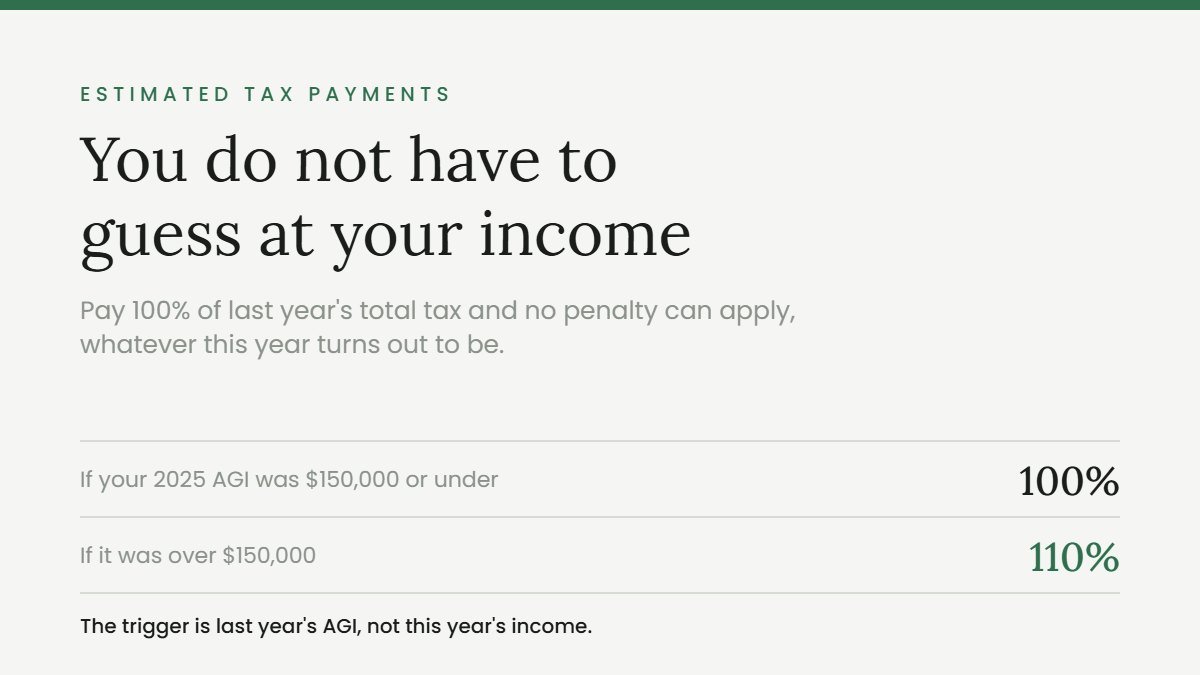
- Pay 100% of last year’s total tax and you cannot be penalised, no matter what this year turns out to be. It is 110% if your 2025 AGI was over $150,000.
- The penalty is interest at 7%, charged from each missed date. Being $5,000 short from September 15 to next April costs roughly $205, not a catastrophe.
- Withholding counts as paid evenly across the year, whenever it actually happened. A December paycheck adjustment can retroactively fix a shortfall from March.
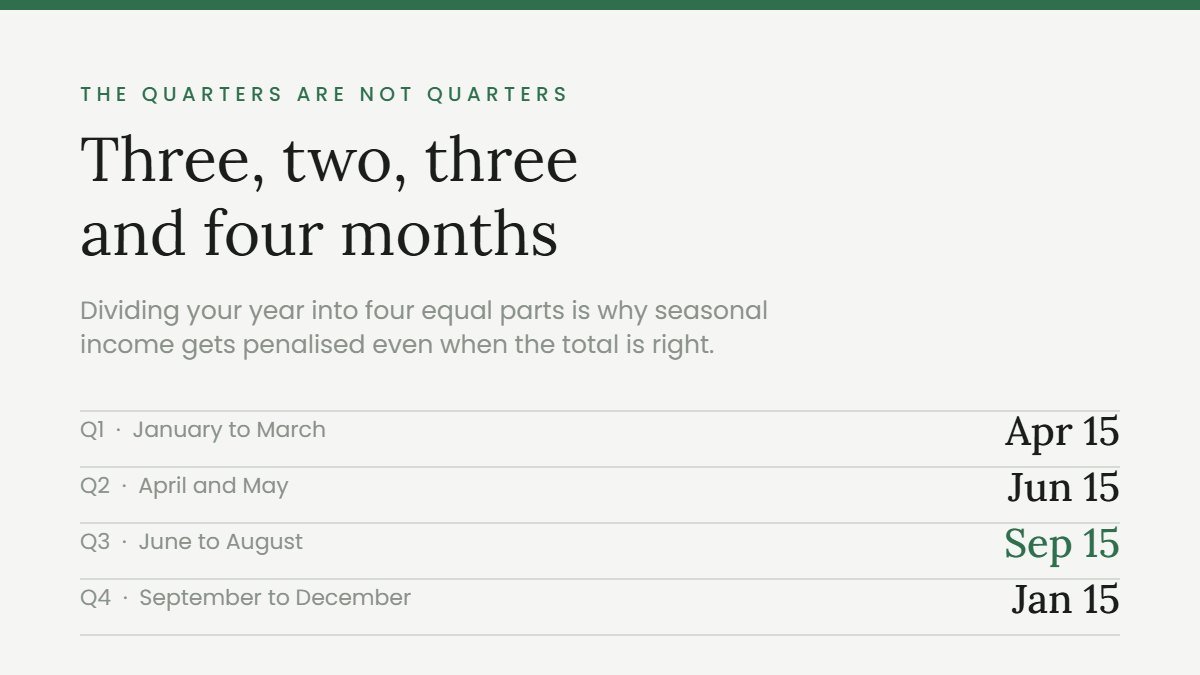
- The “quarters” are 3, 2, 3 and 4 months long. Dividing your year by four is why seasonal income gets penalised.
- If your income arrived unevenly, Schedule AI on Form 2210 can erase penalties for the quarters before the money showed up. Almost no article mentions it exists.
- The trigger is $1,000 of tax owed after withholding, not $1,000 of income.
The 2026 due dates for estimated tax payments
All four 2026 dates fall on weekdays, so none of them shifted.
| Payment | Income period covered | Due |
|---|---|---|
| 1st | January 1 to March 31 | April 15, 2026 |
| 2nd | April 1 to May 31 | June 15, 2026 |
| 3rd | June 1 to August 31 | September 15, 2026 |
| 4th | September 1 to December 31 | January 15, 2027 |
Look at the middle column. Those periods are three months, two months, three months and four months. The word “quarterly” is doing a lot of lying here.
This matters if your income is seasonal. The IRS default assumption is that you pay in four equal amounts, but the second payment covers only two months of earning and the fourth covers four. A landscaper who makes most of their money between May and September is being asked to pay on a schedule that does not match the work.
One escape hatch on the last one: you can skip the January 15, 2027 payment entirely if you file your 2026 return by February 1, 2027 and pay the balance in full.
Who actually has to make estimated tax payments
The IRS threshold, in its own words from Form 1040-ES: you need to pay if
“You expect to owe at least $1,000 in tax for 2026, after subtracting your withholding and refundable credits.”
Read that carefully. It is $1,000 of tax owed, after withholding. It is not $1,000 of income, and it is not a rule that only applies to the self-employed.
The people it catches by surprise are usually not freelancers, who tend to know. They are:
- Someone who sold stock or property and has a large capital gain
- A retiree taking IRA distributions without electing withholding
- Anyone with significant interest or dividend income
- Someone with a W-2 job and a side business, where the W-2 withholding no longer covers the combined bill
There is one absolute exemption worth knowing. If you had no tax liability at all for a full 12-month 2025 tax year, and you were a US citizen or resident alien for that whole year, you owe no estimated tax payments for 2026 regardless of what you earn this year.
The safe harbor rule for estimated tax payments
This is the most useful paragraph in this article. You cannot be penalised if your withholding plus estimated tax payments add up to at least the smaller of these two:
- 90% of the tax you will owe for 2026, or
- 100% of the tax shown on your 2025 return
And the adjustment that catches people out, quoted from Form 1040-ES:
“If your adjusted gross income (AGI) for 2025 was more than $150,000 ($75,000 if your filing status for 2026 is married filing separately), substitute 110% for 100%”
Three things about this that most write-ups get wrong.
The 110% trigger is based on last year’s AGI, not this year’s income. If your 2025 AGI was $152,000 and your 2026 income collapsed to half of that, you are still on the 110% track. The test looks backwards, and it looks at AGI specifically, not taxable income.
It uses total tax, a number already sitting on your filed return. You do not have to forecast anything. Find the total tax line on your 2025 Form 1040, multiply by 1.0 or 1.1, divide by four, and that is a payment schedule that cannot be penalised even if 2026 turns out to be your best year ever.
It is the smaller of the two. If you are having a bad year and 90% of your actual 2026 tax is less than last year’s number, you can pay the smaller amount. The safe harbor is a floor you can reach from either direction.
What missing an estimated tax payments deadline costs
People treat this like a speeding ticket. It is not. There is no flat fine for late estimated tax payments. The IRS charges interest on each underpaid installment, running from that installment’s due date until you pay it or until the return is due.
The rate is the federal short-term rate plus three percentage points, reset every quarter and compounded daily.
| 2026 quarter | Underpayment rate |
|---|---|
| Q1 (Jan to Mar) | 7% |
| Q2 (Apr to Jun) | 6% |
| Q3 (Jul to Sep) | 7% |
| Q4 (Oct to Dec) | 7% |
Put a number on it. If you are $5,000 short from September 15 until the April 15, 2027 filing date, that is roughly $205. Real money, but not the disaster the word “penalty” suggests.
The reason to say this out loud is that the panic causes worse decisions than the penalty does. People drain an emergency fund or take a distribution they did not need, to avoid a couple of hundred dollars in interest.
If you are setting withholding for next year rather than this one, the 2027 tax brackets move up about 3.2%, which changes what a December adjustment has to cover.
The withholding rule that fixes the whole year
Here is the mechanism that makes this article worth bookmarking. From the Form 2210 instructions:
“For withheld federal income tax and excess social security or tier 1 RRTA, you are considered to have paid one-fourth of these amounts on each payment due date unless you can show otherwise.”
Withholding is treated as though it was spread evenly across the year, regardless of when it actually happened. Estimated tax payments are not. They count on the day you make them.
That asymmetry is an enormous lever, and it runs backwards in time. If you are behind for the whole year, extra tax withheld in November or December is credited as though a quarter of it arrived in April, a quarter in June, a quarter in September and a quarter in January. It can erase penalties for quarters that are already long gone.
Two ways to pull that lever:
- File a new W-4 with your employer and ask for additional withholding on the remaining paychecks. Line 4(c) is a flat extra dollar amount per pay period.
- Take an IRA distribution late in the year with a large withholding election. You can direct a substantial percentage of the distribution straight to the IRS as withholding, and all of it is treated as paid evenly.
The second one is a real technique used by retirees and anyone with a large one-time gain. Talk to whoever does your return before using it, because the distribution itself is taxable income.
If your income arrived unevenly, use Schedule AI
The default assumption behind estimated tax payments is four equal installments. If that does not describe your year, there is a form that says so. Again from the Form 2210 instructions:
“If your income varied during the year because, for example, you operated your business on a seasonal basis or had a large capital gain late in the year, you may be able to lower or eliminate the amount of one or more required installments by using the annualized income installment method.”
That method is Schedule AI of Form 2210. It recomputes each required installment against the income you had actually earned by that point in the year, rather than against a flat quarter of the annual total.
Who it helps: someone who sold a business in October, a consultant whose contracts all closed in the fourth quarter, anyone with a seasonal trade, and anyone who took a large capital gain late. If you had almost no income in the first half of the year, Schedule AI can reduce the first two required installments to nearly nothing, and the penalty with them.
It is more paperwork. On a large uneven year it is worth it.
How to make estimated tax payments before Tuesday
Ranked by how fast they work if you are reading this with days to spare.
- IRS Online Account. Fastest, and it shows your balance and payment history so you can confirm what you have already paid this year.
- IRS Direct Pay. Free, no sign-in required, straight from a checking or savings account. A scheduled payment can be cancelled up to two days before. There is a $10 million cap per payment.
- EFTPS. Free and reliable, but enrollment takes days because it involves a mailed PIN. If you are not already enrolled, this is not your option this week.
- Debit or credit card. Same day, but you pay a processor fee. Debit is a flat $2.10 to $2.15. Credit is 1.75% to 1.85% of the payment. None of that fee goes to the IRS.
- Cheque with a Form 1040-ES voucher. Slowest, and the postmark is what counts.
On a $5,000 payment, the credit card route costs about $88 in fees. That is worth it only if you are chasing a card bonus worth more than that.
Two other deadlines sit close to this one. Marketplace open enrollment starts 1 November, and the income you estimate there is the same figure that decides your ACA subsidy. Workplace benefits elections land in the same weeks, which is when the FSA and HSA limits start to matter.
Special cases and the waiver routes
Farmers and fishermen. If at least two-thirds of your gross income for 2025 or 2026 comes from farming or fishing, you substitute 66 and two-thirds percent for the 90% figure, and a different payment schedule applies.
Penalty waivers on Form 2210. Two routes exist that most people never see. The first covers a casualty, disaster or other unusual circumstance where charging the penalty would be inequitable. The second covers someone who retired after reaching age 62 or became disabled, where the underpayment was due to reasonable cause and not wilful neglect.
Federally declared disasters. Relief is applied automatically by county, and it can move the deadline itself. Several 2026 disaster notices postpone estimated tax payments past September 15. If you are in a declared disaster area, check the IRS relief page for your county before assuming you are late.
State estimated taxes are separate. Most states with an income tax run their own regime, with their own thresholds and forms. The deadlines often match the federal ones but not always. Check your own state revenue department rather than assuming.
The bottom line
If you have four days and no idea what you owe, take last year’s total tax, multiply by 1.0 or 1.1 depending on your 2025 AGI, work out what a quarter of that is, subtract what you have already paid in, and send the difference through Direct Pay. You are then safe regardless of how 2026 turns out, and you can do the real arithmetic in April.
Sources
- IRS — Form 1040-ES, Estimated Tax for Individuals (2026)
- IRS — Estimated Taxes
- IRS — Topic No. 306, Penalty for Underpayment of Estimated Tax
- IRS — Instructions for Form 2210
- IRS — Quarterly Interest Rates
- IRS — IR-2026-98, Interest rates for the fourth quarter of 2026
- IRS — Third Quarter Tax Calendar
- IRS — Pay by debit or credit card
Fact-checked against these sources on 11 September 2026. Tax rules change and individual situations vary. This is general information, not tax advice for your specific return.