
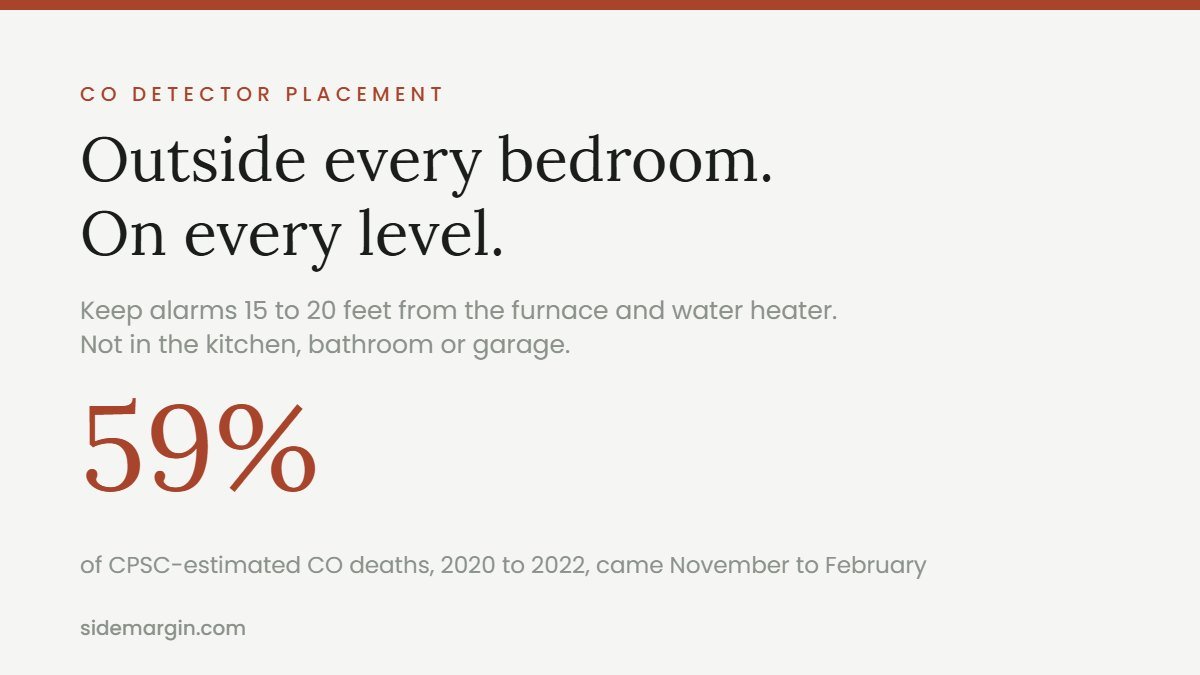
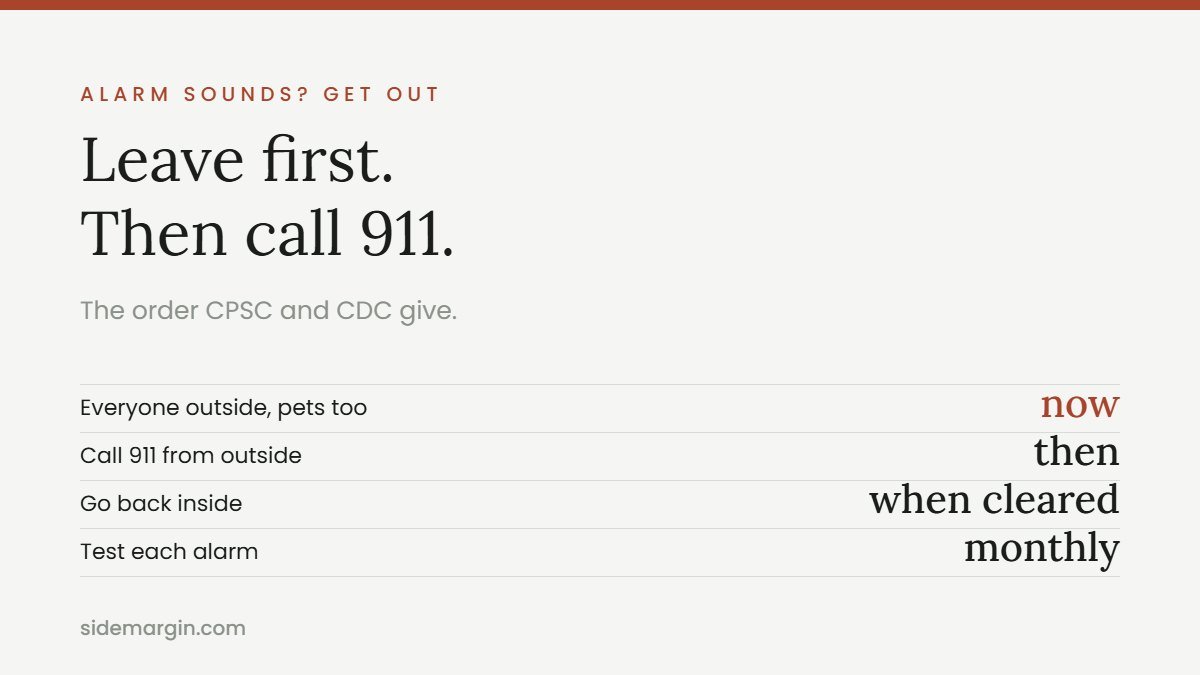
The short answer on carbon monoxide detector placement: put one CO alarm outside each separate sleeping area, in the hallway by the bedroom doors, and at least one on every level of the home, basement included. Mount it where the manual for your model says, because height rules differ between brands, and keep it away from the furnace, water heater, kitchen and garage, where it will false alarm or miss the air you actually breathe. If it goes off, everyone goes outside first and you call 911 from there.
Heating season is when this matters most. The Consumer Product Safety Commission counted an estimated 274 unintentional, non-fire CO deaths tied to consumer products in 2022. Across 2020 to 2022, 59% of those deaths happened in November, December, January and February. Here is where each alarm goes, how many you need, and what to do when one sounds.
Key takeaways
- Two rules cover most homes. One alarm outside each sleeping area, and one on every level. CPSC, the US Fire Administration and the model residential code all say the same thing.
- Height is set by the manual, not by folklore. CO mixes with room air, so it does not need to be near the floor. Some models are designed for plug-in outlets, others for wall or ceiling mounting.
- Distance from appliances varies by brand. One Kidde manual says never within 5 feet of heating or cooking appliances and recommends 15 feet. One First Alert manual says no closer than 20 feet from a furnace or water heater.
- Alarms wear out. Sensors last roughly 5 to 10 years depending on the model. Check the date on the back and replace at the end-of-life chirp.
- Alarm sounds, you leave. Get everyone outside, call 911 or the fire department, count heads, and do not go back in until responders say so.
- Generators were tied to 93 of 274 CPSC-estimated CO deaths in 2022. Run one outside only, 20 feet from the house.
Does your home need CO alarms at all?
If anything in the house burns fuel, yes. That includes a gas or oil furnace, a gas water heater, a gas range or dryer, a wood stove, and a fireplace of any kind. An attached garage counts too, and CDC warns never to run a vehicle in one.
That list is not my invention. It is the trigger written into the residential building code. North Carolina’s version of section R315, which follows the model code, requires alarms in any dwelling unit that has a fuel-fired appliance, a fireplace or an attached garage. Most states use the same logic, though the details are set state by state (more on that below).
The numbers explain why this is worth the effort. CDC says more than 400 Americans die each year from unintentional CO poisoning not linked to fires, more than 100,000 visit an emergency department, and more than 14,000 are hospitalized. CPSC’s narrower count, which only covers deaths tied to consumer products, averaged 238 a year from 2020 to 2022. The agencies count different things, but every figure is large for a hazard a small alarm can warn you about.
Carbon monoxide detector placement: the two rules that cover most homes
Rule one: outside each separate sleeping area. The US Fire Administration says to install alarms in a central spot outside each separate sleeping area and on every level. The code adds that they belong in the immediate vicinity of the bedrooms. In practice: the hallway just outside the bedroom doors. If bedrooms are split across two ends of the house, that is two sleeping areas and two alarms.
Asleep, you cannot notice the headache or dizziness, so the alarm has to be close enough to wake you. Kidde’s manual says to make sure you can hear the alarm from every sleeping area.
Rule two: every level. CPSC, USFA and both major manufacturers say at least one alarm per floor, and First Alert specifically includes finished and unfinished basements. The basement often holds the furnace and water heater.
One exception worth knowing. If a fuel-burning appliance sits inside a bedroom or its attached bathroom (a gas fireplace in the primary suite, for example), the code requires an alarm inside that bedroom too. Minnesota’s State Fire Marshal also says within 10 feet of each sleeping room or inside it, a useful yardstick for immediate vicinity if your state’s rule is vague.
How many carbon monoxide detectors you need
Count sleeping areas, then count floors, then take whichever gives you more alarms, making sure every floor has one. A few worked examples, using the minimums First Alert publishes:
| Home | Minimum alarms | Where they go |
|---|---|---|
| One-level apartment, bedrooms together | 1 | Hallway outside the bedrooms |
| One-story house, bedrooms at opposite ends | 2 | One outside each bedroom wing |
| Two-story house, bedrooms upstairs, no basement | 2 | Upstairs hallway, plus main floor living area |
| Two-story house with basement furnace | 3 | Upstairs hallway, main floor, basement |
| Any home with a gas fireplace in a bedroom | Add 1 | Inside that bedroom |
Height and carbon monoxide detector placement: the floor myth
You will hear two opposite pieces of advice. One says CO is heavier than air, so mount low. The other says it rises with warm air, so mount high. Neither is how the manufacturers frame it. First Alert says “Carbon monoxide mixes evenly with air as it circulates through a room” and that detectors do not need to be near the floor.
What the manuals actually say varies by model, which is why the only safe rule is to follow yours:
- CPSC says CO alarms can go in a plug-in receptacle or high on the wall. Both are acceptable.
- Kidde’s plug-in model with a digital display notes that eye level makes the digital display easiest to read. That is about reading the number, not about where CO collects.
- First Alert’s CO410 battery model can go on a wall or ceiling, but not closer than 4 inches from where the wall meets the ceiling. That corner is dead air.
The things that matter more than height: free air circulation, a spot where you can reach the test button, and a location where you will hear it.
Where not to put a carbon monoxide detector
Bad spots either cause false alarms, so people unplug the alarm, or hide it from the air it should sample.
Too close to fuel-burning appliances. First Alert says spacing avoids false triggers from normal fuel-burning operation. The distances in the manuals differ:
- Kidde’s plug-in manual: never within 5 feet of heating or cooking appliances, with 15 feet recommended. Kidde’s FAQ repeats the 15-foot figure.
- First Alert’s CO410 manual: not closer than 20 feet from a furnace or other fuel-burning appliances like a water heater, and not within 5 feet of any cooking appliance.
CPSC’s own guidance is shorter: no alarms in kitchens or above fuel-burning appliances. Use the figure in your model’s manual. If you do not have the manual, 20 feet from a furnace or water heater satisfies both brands.
The rest of the no list, pulled from the Kidde and First Alert manuals and CPSC:
- Garages, where exhaust causes frequent false alarms.
- Bathrooms, laundry rooms and other humid spots. First Alert says at least 10 feet from a shower, humidifier, dishwasher or laundry room.
- Near heating vents, ceiling fans, open windows or doors, where moving air dilutes the sample.
- Dead air spaces: the peak of a vaulted ceiling, tight corners, behind curtains or furniture.
- Direct sunlight, and anywhere below 40°F or above 100°F, such as attics, crawl spaces or porches.
- Outlets controlled by a wall switch or dimmer, for plug-in models.
Carbon monoxide detector placement by room
Distances come from the two manufacturer manuals cited below.
| Location | Put a CO alarm here? | Why |
|---|---|---|
| Hallway outside bedrooms | Yes, always | Required by code; wakes sleepers |
| Inside a bedroom | Only if it has a fuel-burning appliance, or as an extra | Code requires it where a fireplace or heater is in the room |
| Each floor, including basement | Yes | Every level rule from CPSC and USFA |
| Main living room or family room | Recommended | Where people spend waking hours |
| Furnace or utility room | Nearby, not inside | Kidde says avoid furnace rooms; keep 15 to 20 feet away |
| Kitchen | No | Cooking appliances cause false alarms; CPSC advises against |
| Bathroom or laundry room | No | Humidity; First Alert says 10 feet away |
| Garage | No | Exhaust and temperature extremes |
| Attic, crawl space, porch | No | Outside the 40°F to 100°F operating range |
Plug-in, battery or hardwired: what to buy
Whatever you buy, check the package for a UL 2034 listing. That is the safety standard for CO alarms, and both CPSC and the building code refer to it. A combination smoke and CO alarm must carry both UL 2034 and UL 217, the smoke alarm standard.
| Type | Best for | Watch out for |
|---|---|---|
| Plug-in with battery backup | Hallways with a free outlet; renters | Outlet must not be on a switch; needs backup to work in a power outage |
| Battery only (replaceable) | Anywhere, quick install | Batteries need changing; CDC suggests checking them each spring and fall |
| 10-year sealed battery | Set and forget; no battery swaps | Whole unit is replaced at end of life |
| Hardwired, interconnected | New construction, remodels, owners wanting whole-house alerts | Electrician usually needed; must still have battery backup |
| Combo smoke and CO | Replacing hallway smoke alarms; fewer devices on the ceiling | Both sensors are replaced together at end of life |
Two points decide most purchases. First, power. CPSC says to install battery-operated alarms or alarms with battery backup, and the code for new homes requires wiring from the building with battery backup. A plug-in with no battery goes dark in exactly the outage when people start generators.
Second, interconnection. CPSC says interconnected alarms are best, because when one sounds, they all sound. A basement alarm you cannot hear from an upstairs bedroom protects nobody.
When a CO alarm goes off
CPSC is blunt: “Never ignore an alarming CO alarm! It is warning you of a potentially deadly hazard.” Do not stay inside to look for the source. Follow this order:
| Step | What to do |
|---|---|
| 1 | Get everyone outside to fresh air right away, pets included |
| 2 | Call 911 or the fire department from outside or from a neighbor’s home |
| 3 | Do a head count and make sure everyone is out |
| 4 | Do not go back in until emergency responders say it is safe |
| 5 | If anyone has symptoms, tell the 911 dispatcher and get medical care |
| 6 | Have a qualified technician inspect every fuel-burning appliance before using them again |
A CO alarm is designed to sound before levels become life threatening, not at the first trace. The UL 2034 response times printed in First Alert’s manual are: alarm within 60 to 240 minutes at 70 ppm, 10 to 50 minutes at 150 ppm, and 4 to 15 minutes at 400 ppm. CPSC says sustained concentrations above 150 to 200 ppm can cause disorientation, unconsciousness and death. A sounding alarm means the air has been bad for a while. Leave even if everyone feels fine.
Alarm versus chirp. A loud, repeating pattern is the emergency alarm. On Kidde units that is four quick beeps, a pause, then four more. A single chirp every 30 seconds or once a minute is usually a low battery or end-of-life signal, and the manual for your model will tell you which. If you are not sure which one you are hearing, treat it as an alarm and go outside.
If the fire department finds CO coming from the furnace, the fix is a technician, not a reset. Side Margin’s guide to a furnace that will not turn on covers the safe homeowner checks and when to stop. For a gas water heater with rust, soot or a leak, see what to do when a water heater is leaking.
CO poisoning symptoms to know
CDC says infants, older adults and people with chronic heart disease, anemia or breathing problems are at higher risk. It lists the most common symptoms as headache, dizziness, weakness, upset stomach, vomiting, chest pain and confusion, and notes they are often described as flu-like. CPSC separates them by exposure: headache, fatigue, shortness of breath, nausea and dizziness at low to moderate levels; mental confusion, vomiting, loss of muscle coordination, loss of consciousness and death at high levels.
If you suspect CO poisoning, CPSC’s instruction is to get outside to fresh air immediately, then call 911. That applies whether or not an alarm has sounded.
Testing, batteries and replacement
Testing. CPSC says to test alarms once a month. Some manuals ask for more: both the Kidde plug-in and First Alert CO410 manuals say once a week. Press and hold the test button until it sounds.
Batteries. CDC suggests checking CO alarm batteries when you change the clocks each spring and fall. Minnesota’s State Fire Marshal says to change them at least once a year. Sealed 10-year models skip this step.
Replacement. The sensor wears out, and the lifespan depends on the model:
- Kidde says its CO alarms last seven to ten years depending on the model, with most models since 2013 rated for 10 years.
- First Alert’s CO410 manual gives a replacement date five years after installation.
- CDC’s general advice is to replace following the manufacturer’s instructions or every 5 years.
Look on the back of the unit for the manufacture date. If there is no date, or you cannot remember when you installed it, CPSC’s advice is to consider replacing it. At end of life most units chirp on a regular cycle (every 30 seconds on Kidde models) and digital models show ERR or END. A new battery does not stop an end-of-life signal. The unit is done.
A good habit is to pair the checks. When you change the furnace filter, press the test button on every CO alarm and glance at the date on the back.
Generators and power outages
This is where the heating season deaths come from. In CPSC’s 2022 estimates, 107 of the 274 consumer product CO deaths, or 39%, involved an engine-driven tool, and 93 of those involved generators. Another 76 deaths, 28%, were tied to some type of heating appliance. Sixty-four percent happened at home.
CPSC says one portable generator can produce as much CO as hundreds of cars. The rules are short:
- Never run a generator inside a home, garage, basement, crawl space or shed, even with doors and windows open.
- Keep it outside, at least 20 feet from the house, with the exhaust pointing away. CDC adds: away from windows, doors and vents.
- Do not put it on a porch or in a semi-enclosed space close to the house.
- Never use a gas oven or range to heat the house, and never bring a charcoal grill or camp stove indoors.
- Never let a car idle in an attached garage, even with the garage door up.
- After a snowstorm, clear snow from the dryer, furnace and fireplace vents, as USFA advises.
Before storm season, confirm every alarm has a working battery.
State laws on carbon monoxide detector placement
There is no single national rule for existing homes. The National Conference of State Legislatures, in a table last updated September 29, 2025, says most states now require carbon monoxide detectors, through statute, regulation or building and fire codes.
The rules differ on the details that matter to you: whether they apply only to new construction or also to sales and rentals, whether a landlord or tenant is responsible, and how close to bedrooms the alarm must be. Minnesota, for example, says within 10 feet of each sleeping room. If you are selling, buying or renting out a home, check with your state fire marshal or building department.
For the technically curious: the national installation standard for CO detection used to be NFPA 720. It has since been folded into NFPA 72, the fire alarm code, starting with the 2019 edition.
What to do this week
- List every fuel-burning appliance and fireplace, note an attached garage, then count sleeping areas and floors.
- Pull each existing alarm and read the date on the back. Replace anything past its rated life or with no date.
- Buy UL 2034 listed units with battery backup, ideally interconnected. Combo smoke and CO units are a good swap for hallway smoke alarms.
- Install per the manual: outside bedrooms, each level, and 15 to 20 feet from the furnace and water heater. Not in the kitchen, bathroom or garage.
- Book a furnace and chimney check before the first cold snap. CDC recommends annual service by a qualified technician.
- Agree on the rule with everyone in the house: alarm sounds, everyone out, call 911 from outside.
If an old or unsafe furnace is behind the worry and money is tight, read Side Margin’s guide to the Weatherization Assistance Program to see what income-eligible households can get help with.
Sources
- CPSC, Carbon Monoxide Information Center
- CPSC, Carbon Monoxide Questions and Answers
- CPSC, Non-Fire Carbon Monoxide Deaths Associated with the Use of Consumer Products, 2022 Annual Estimates
- CPSC, carbon monoxide talking points
- CDC, About carbon monoxide poisoning
- US Fire Administration, Carbon monoxide poisoning prevention
- US Fire Administration, Carbon monoxide safety flyer
- North Carolina Office of State Fire Marshal, Residential Code section R315, carbon monoxide alarms
- National Conference of State Legislatures, Carbon monoxide detector requirements, laws and regulations
- Minnesota State Fire Marshal, Smoke and carbon monoxide alarm tips
- Kidde, Carbon monoxide comprehensive guide
- Kidde, When should I replace my carbon monoxide alarm
- Kidde, KN-COPP-3 plug-in carbon monoxide alarm user’s guide
- First Alert, Where to install carbon monoxide detectors
- First Alert, Carbon monoxide alarm installation and placement guide
- First Alert, CO410 battery operated carbon monoxide alarm user’s manual
- Henderson Engineers, Carbon monoxide detection and the merger of NFPA 720 into NFPA 72