
Most FSA vs HSA comparisons get the headline right and the mechanics wrong. Yes, the HSA is yours forever and the FSA expires. But that framing hides the one situation where the FSA is straightforwardly the better instrument, and it skips five rules that quietly cost people real money every year.
Open enrollment is the only moment you can act on any of this. Here are the FSA vs HSA numbers for 2026 and 2027, then the rules that decide which one you are even allowed to have.
Key takeaways
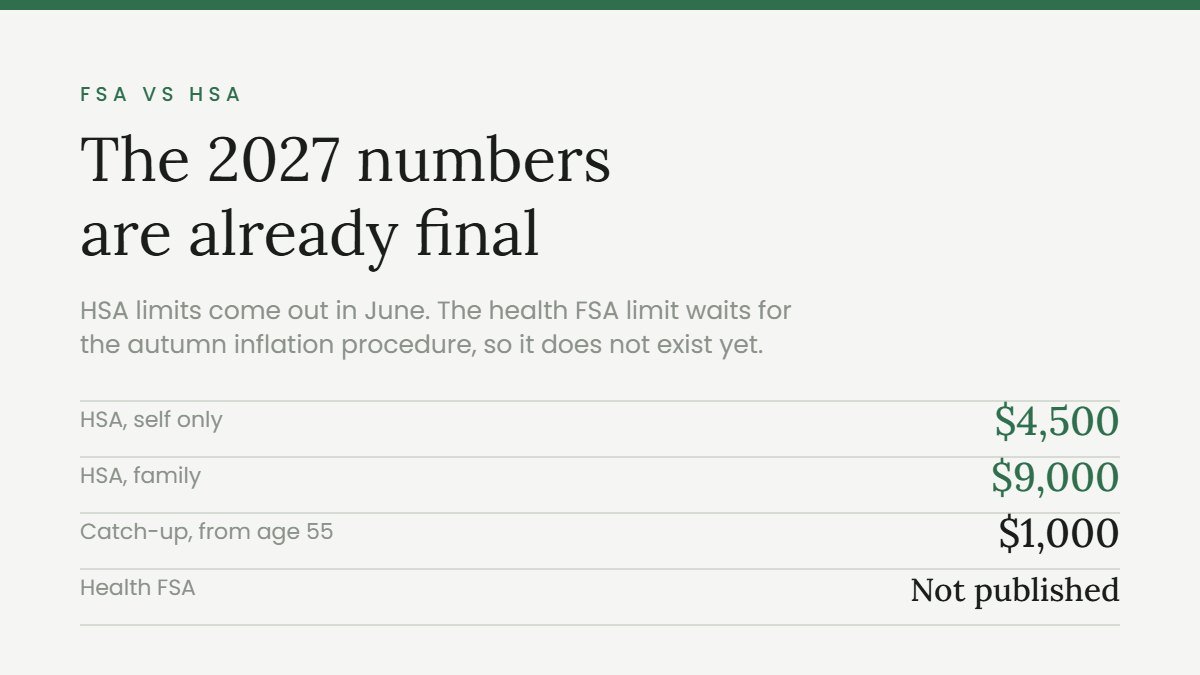
- 2027 HSA limits are already final: $4,500 self only, $9,000 family. The 2027 health FSA limit has not been published yet.
- The HSA catch-up starts at 55, not 65, and it cannot be shared. Each spouse needs their own HSA to use their own $1,000.
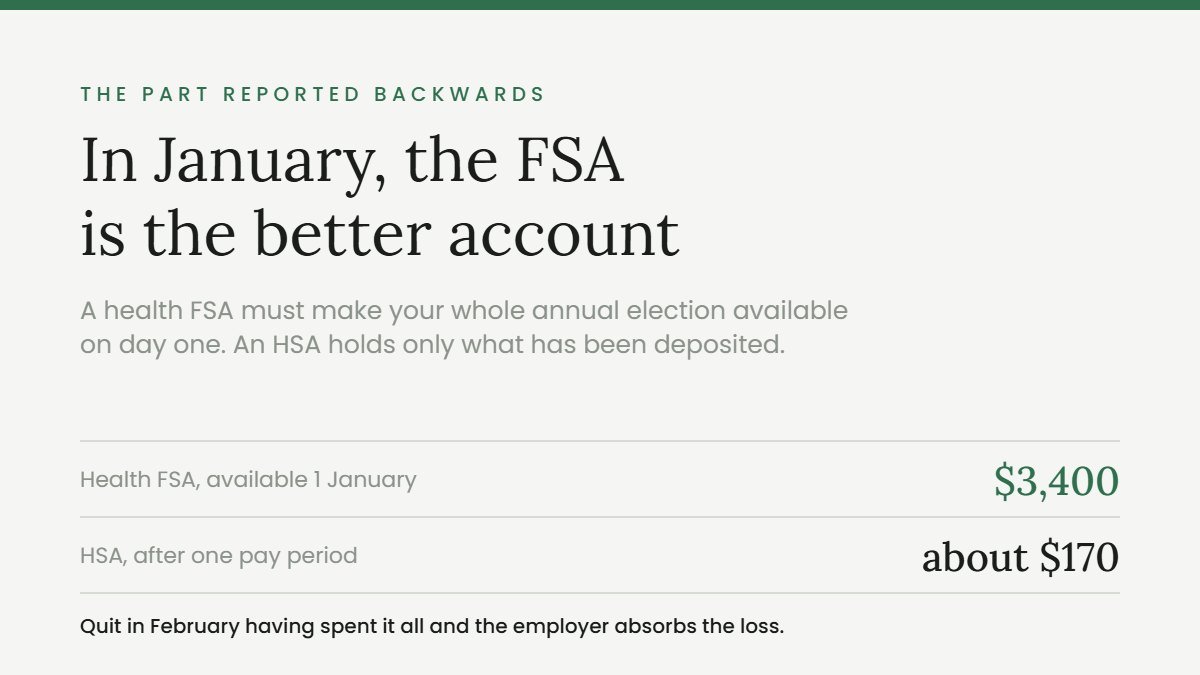
- The FSA is the better cash flow instrument. Your full annual election is available on day one. An HSA only holds what has actually been deposited.
- A general purpose health FSA blocks HSA contributions, including your spouse’s, because it covers the whole family by default. A limited purpose FSA does not.
- Dependent care FSA jumped to $7,500 for 2026, the first change since 1986. Your employer is not required to adopt it.
- A plan can offer a grace period or a carryover. Never both.
The FSA vs HSA numbers for 2026 and 2027
HSA and high deductible health plan figures for both years, from the IRS revenue procedures.
| Item | 2026 | 2027 |
|---|---|---|
| HSA contribution, self only | $4,400 | $4,500 |
| HSA contribution, family | $8,750 | $9,000 |
| Catch-up, age 55 and over | $1,000 | $1,000 |
| HDHP minimum deductible, self only | $1,700 | $1,750 |
| HDHP minimum deductible, family | $3,400 | $3,500 |
| HDHP maximum out of pocket, self only | $8,500 | $8,700 |
| HDHP maximum out of pocket, family | $17,000 | $17,400 |
The $1,000 catch-up is statutory and not indexed. It has been $1,000 since 2009 and will still be $1,000 in 2027. Everything else on that table moves with inflation; this one does not.
| Item | 2026 | 2027 |
|---|---|---|
| Health FSA salary reduction limit | $3,400 | Not yet published |
| Health FSA carryover maximum | $680 | Not yet published |
| Dependent care FSA | $7,500 | Not yet published |
If you see a confident 2027 health FSA number quoted anywhere before the IRS publishes, it is a projection. As of 13 September 2026 the official figure does not exist.
The FSA vs HSA comparison people actually need
| Health FSA | HSA | |
|---|---|---|
| Who owns it | Your employer | You |
| Requires a specific health plan | No | Yes, a qualifying HDHP |
| Money available at the start of the year | The full election | Only what is deposited |
| Unused money at year end | Forfeited, subject to one relief option | Rolls over forever |
| If you leave your job | Gone, unless you elect COBRA | Goes with you |
| Can be invested | No | Usually yes |
| Change your contribution mid year | Only on a qualifying life event | Any time |
Row three is the one that gets reported backwards. A health FSA is governed by the uniform coverage rule: the entire annual election must be available from the first day of the plan year, regardless of how little has been withheld. Elect $3,400, have surgery in January, spend all of it, quit in February, and your employer absorbs the loss. They cannot bill you for it.
An HSA does the opposite. In January it holds one pay period’s contribution. If you have a known, dated, front loaded expense and no cash to bridge it, the FSA is the better tool and it is not close. The HSA wins over years. The FSA wins in January.
Five FSA vs HSA rules that cost people money
1. A general purpose FSA disqualifies you from HSA contributions
IRS Publication 969 puts it directly: someone covered by an HDHP and a health FSA or HRA that reimburses qualified medical expenses generally cannot contribute to an HSA.
This includes your spouse’s FSA, and the reason is worth understanding rather than memorising. A general purpose health FSA ordinarily covers the employee’s spouse and dependents by default. So your spouse’s FSA is coverage that you hold, and it disqualifies you. The exceptions that preserve eligibility are a limited purpose FSA, restricted to dental, vision and preventive care, and a post deductible arrangement that pays nothing until the HDHP minimum deductible is met.
In any FSA vs HSA decision where both spouses have workplace benefits, this is the first thing to check, before contribution limits or anything else.
2. The last month rule has a 13 month tail
If you are HSA eligible on 1 December, you are treated as eligible for the whole year and can contribute the full annual limit even if you only had the plan for a month. Genuinely useful, and widely advertised.
The part that is not advertised is the testing period. It begins in December of that year and ends on the last day of the twelfth month following, so for 2026 it runs from 1 December 2026 to 31 December 2027. Thirteen months, not twelve. Lose eligibility inside that window for any reason other than death or disability, and the amount you gained is pulled into income plus a 10% additional tax.
3. Medicare ends HSA contributions, retroactively
Publication 969: beginning with the first month you are enrolled in Medicare, your contribution limit is zero. Then the sentence that causes the damage: this applies to periods of retroactive Medicare coverage, so if you delayed applying and your enrollment is later backdated, contributions made during that backdated period are excess contributions.
Part A can be backdated when you enrol after your initial window. Someone who works past 65, contributes normally, and signs up at 67 can find several months of perfectly reasonable contributions reclassified as excess. If you are working past 65 with an HSA, stop contributing well before you file for Social Security or Medicare, not on the day you file.
4. Grace period or carryover, never both
Use it or lose it has two permitted softeners and a plan may adopt only one. A grace period of up to two and a half months after the plan year, in which you can still incur expenses. Or a carryover of up to $680 for 2026 into the next year. IRS Notice 2013-71 is explicit that a plan adopting carryover is not permitted to also provide a grace period.
Find out which one your plan has before you elect, because they suit different people. A carryover protects a small over-election permanently. A grace period protects a large one, but only for ten weeks.
5. The catch-up is 55, and it does not combine
The HSA catch-up contribution starts at age 55. The most common error in this whole subject is assuming 65, which is the age at which the penalty changes, not the age at which the catch-up starts.
And it is individual. A married couple both over 55 on a family HDHP can put the family limit into one account, but the second $1,000 catch-up requires a second HSA in the other spouse’s name. Couples routinely leave that $1,000 deduction on the table because one spouse holds the only account.
How to decide FSA vs HSA, in order
The FSA vs HSA question is usually settled before you get to it, because the HSA has a gate the FSA does not.
- Does your employer offer a qualifying high deductible health plan? If not, the HSA is off the table entirely and the only question is how much to put in the FSA. No amount of wanting an HSA creates eligibility.
- Is anyone in your household covered by a general purpose health FSA? If yes, and you cannot switch it to limited purpose, the HSA is blocked. See rule 1.
- Is the HDHP actually cheaper for your family once you price the deductible? Compare the annual premium difference against the out of pocket maximum, not against the deductible. The worst realistic year is the number that matters.
- If both are genuinely available, take the HSA, then use a limited purpose FSA alongside it for dental and vision if your employer offers one. That combination is the best outcome in the whole FSA vs HSA landscape and most people do not know it exists.
- If you are stuck with the FSA, elect conservatively. Find out whether your plan has a carryover or a grace period first, and elect to the floor of what you are confident you will spend, not the ceiling of what you might.
One framing that helps: an FSA is a discount on spending you have already decided to do. An HSA is a retirement account that happens to pay medical bills. Judging them against each other as if they were the same kind of object is what produces the bad answer.
The missing 2027 health FSA figure arrives with the same annual revenue procedure that sets the 2027 tax brackets, usually in mid October.
What happens at 65
The 20% additional tax on non medical HSA withdrawals disappears once you reach 65, are disabled, or die. It does not become tax free. Non medical withdrawals are still ordinary income, which makes an HSA behave like a traditional IRA from that point, with the extra feature that medical withdrawals remain completely tax free.
The FSA has no equivalent milestone. It is a one year benefit for as long as you hold the job, which is the real FSA vs HSA difference stated as plainly as it can be.
These accounts touch two other decisions. HSA contributions reduce modified adjusted gross income, which matters if you are anywhere near the ACA subsidy cliff, and enrolling in Medicare ends HSA eligibility outright, which is worth reading alongside Medicare Part C.
The dependent care FSA, which is neither of these
It is worth separating out because it is not part of the FSA vs HSA question at all, despite sharing three letters, and 2026 is the first year it has moved in a generation.
The limit rose from $5,000 to $7,500 for tax years beginning on or after 1 January 2026, under the One Big Beautiful Bill Act signed on 4 July 2025. The $5,000 figure had stood since 1986, apart from a temporary bump in 2021.
Employers are not required to adopt the higher limit. Plans may keep a lower cap, so check your plan document rather than the headline. If your employer has not updated, asking during open enrollment is a reasonable thing to do and costs nothing.
One 2027 change nobody is covering
Rev. Proc. 2026-24 also set the 2027 ceiling for direct primary care service arrangements: $150 a month for an individual and $300 a month for a multi-individual arrangement. Direct primary care became compatible with HSA contributions under the 2025 law, so a monthly retainer practice below those ceilings no longer disqualifies you.
If you have been avoiding a direct primary care practice because it would break your HSA, that reason has expired.
Current as of 13 September 2026. The 2027 health FSA and dependent care figures will be added when the IRS publishes them.
Sources
- IRS Revenue Procedure 2026-24, 2027 HSA and HDHP amounts
- IRS Revenue Procedure 2025-19, 2026 HSA and HDHP amounts
- IRS Revenue Procedure 2025-32, 2026 inflation adjustments including the health FSA limit
- IRS Publication 969, Health Savings Accounts and Other Tax-Favored Health Plans
- IRS Notice 2013-71, the health FSA carryover rule
- IRS, tax inflation adjustments for tax year 2026