
If you buy your own health insurance, your ACA subsidy for 2027 is being decided right now, in rate filings you will never see, and the notice that tells you what it means arrives in October. The short version: insurers asked for a median 15% increase, and for a large group of people the subsidy that used to absorb increases like that no longer exists at all.
Those are two separate forces acting on the same bill, and only one of them is about your ACA subsidy. Almost every article about 2027 premiums blurs them together. Keeping them apart is the difference between a bill you can plan for and a bill that ambushes you.
Key takeaways
- The median proposed increase is 15%, across 276 insurers in all 50 states and DC. The range runs from a 1% decrease to a 54% increase.
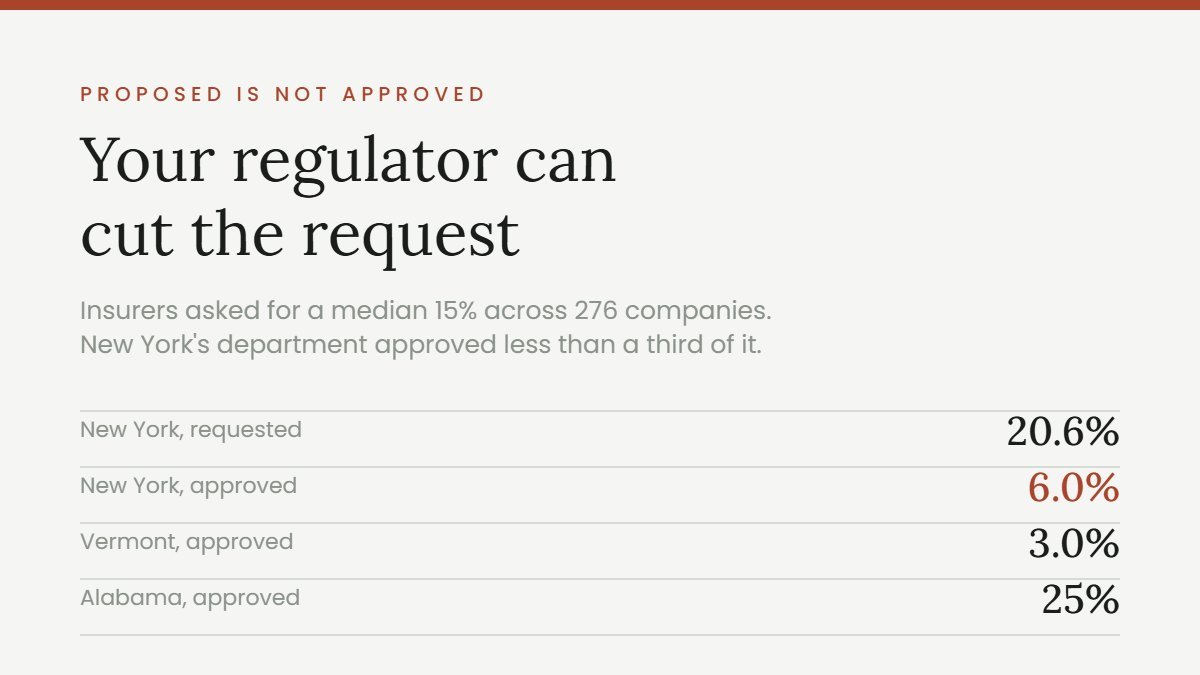
- Your state regulator can cut that request, and some do it hard. New York approved 6% against a requested 20.6%. Vermont finalised 3%. Alabama finalised 25%.
- The 400% poverty line cliff is back. For 2027 coverage that is $63,840 for one person. One dollar over and the ACA subsidy is zero, not smaller.
- The lowest incomes lost something too. Under the enhanced credits, people below 150% of the poverty line paid nothing for benchmark silver. For 2027 the floor is 2.15% of income.
- The $5 monthly charge for auto-reenrolled $0 premium plans is not happening. A court vacated it. It is still being reported as though it were live.
- Nobody loses their subsidy for failing to file and reconcile in 2027. CMS has told exchanges in writing to stop enforcing that.
What the 2027 filings do to your ACA subsidy
The Peterson-KFF tracker read the public rate filings from 276 insurers across all 50 states and the District of Columbia. The median proposed increase for 2027 is 15%.
| Measure | 2027 proposed |
|---|---|
| Median increase | 15% |
| Full range | −1% to +54% |
| 25th percentile | 11% |
| 75th percentile | 22% |
| Insurers proposing 10% to 25% | 63% |
| Insurers proposing above 25% | 51 |
| Insurers proposing a decrease | 1 |
None of that is about your ACA subsidy directly. It is the sticker price the subsidy is measured against. Insurers gave three main reasons. Medical cost trend came in at a median of 10%, against roughly 8% in recent years. Roughly 4 percentage points is attributed to the risk pool getting sicker as healthier people drop coverage after the enhanced credits expired. And GLP-1 drugs show up directly: one insurer put the increase at $28.30 per member per month between 2025 and 2027.
That third one matters because it is not a policy choice anyone can reverse at open enrollment. It is baked into the price of every plan on the shelf.
Proposed is not approved, and the gap can be enormous
Every filing goes to a state insurance regulator. Some states rubber stamp. Some do not.
New York is the clearest example on record for 2027. Insurers requested 20.6% in the individual market. The Department of Financial Services approved 6.0%, cutting roughly 71% of the request. DFS put the saving at about $1.6 billion across roughly 860,000 New Yorkers. In the small group market the request was 23.7% and the approval was 8.0%.
Here is where things stand by state. Read the column header carefully. Approved figures are final. Proposed figures are still requests and several will be cut before open enrollment opens.
| Approved (final) | Rate |
|---|---|
| Vermont | 3% |
| New York | 6% |
| Iowa | 6.7% |
| Utah | 6.8% |
| Massachusetts | 10.8% |
| Hawaii | 11.1% |
| Connecticut | 11.2% |
| Maine | 14.8% |
| Delaware | 16.5% |
| Indiana | 17.5% |
| Oregon | 21.6% |
| New Mexico | 24.4% |
| Alabama | 25% |
| Proposed (not final) | Rate |
|---|---|
| Arkansas | 7.6% |
| District of Columbia | 9.5% |
| California | 9.9% |
| Colorado | 11% |
| Minnesota | 11.9% |
| Missouri | 12.5% |
| Texas | 13.1% |
| Maryland | 13.7% |
| Illinois | 14.1% |
| Michigan | 14.2% |
| North Carolina | 14.9% |
| Florida | 15.9% |
| Pennsylvania | 17.1% |
| Georgia | 20.7% |
| Washington | 22.4% |
| Montana | 23.4% |
| Kansas | 24.2% |
| Arizona | 29% |
If your state appears in the second table, the number you have read in the news is a starting position, not your premium, and not yet an input to your ACA subsidy.
Two things are happening to your ACA subsidy at once
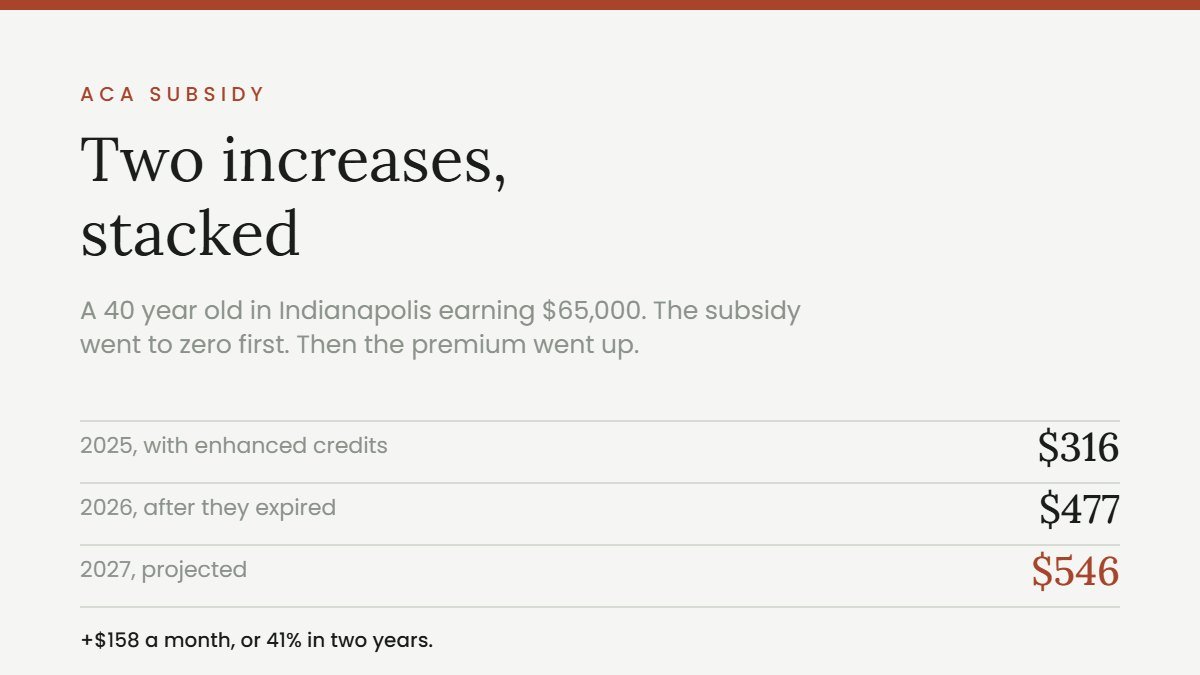
KFF worked a single example that shows the mechanism better than any explanation. A 40 year old in Indianapolis earning $65,000, on an Anthem plan:
| Year | Monthly premium paid |
|---|---|
| 2025, with enhanced credits | $316 |
| 2026, after they expired | $477 |
| 2027, projected | $546 |
Now look at why. At $65,000, a single filer is above 400% of the federal poverty line in both years. That person’s ACA subsidy did not shrink. It went to zero. The jump from $316 to $477 is the cliff. The jump from $477 to $546 is the underlying premium going up.
Two different mechanisms, stacked. If you are under the cliff, only the second one applies to you and your increase will be far smaller, because the subsidy formula caps your payment as a percentage of income and absorbs the rest. If you are over it, you eat the whole thing.
The 2027 ACA subsidy formula, as written
The IRS sets the sliding scale every year. For 2027 it is in Revenue Procedure 2026-26. This table is what actually determines your ACA subsidy: it says what percentage of your income you are expected to pay for the benchmark silver plan, and the credit covers the rest.
| Household income (% of poverty line) | Initial % | Final % |
|---|---|---|
| Under 133% | 2.15% | 2.15% |
| 133% to under 150% | 3.23% | 4.30% |
| 150% to under 200% | 4.30% | 6.78% |
| 200% to under 250% | 6.78% | 8.66% |
| 250% to under 300% | 8.66% | 10.22% |
| 300% to 400% | 10.22% | 10.22% |
| Over 400% | No credit at all | |
The enhanced credits changed both ends of this table, and both ends changed back. Under the enhanced regime the bottom band was 0%, so people under 150% of the poverty line paid nothing for benchmark silver. It is now 2.15%. The top band was 8.5% with no cliff at all. It is now 10.22% and the cliff is back.
One more line worth noticing: the required contribution percentage was 9.96% for 2026 and is 10.22% for 2027. Even inside the subsidy, the share you are expected to carry went up.
Where the ACA subsidy cliff sits for 2027
Plan year 2027 uses the 2026 federal poverty guidelines, not 2027 ones. For the 48 contiguous states and DC:
| Threshold | 1 person | Family of 4 |
|---|---|---|
| 100% of poverty line | $15,960 | $33,000 |
| 138% (Medicaid expansion) | $22,025 | $45,540 |
| 250% (cost sharing reductions end) | $39,900 | $82,500 |
| 400% (the cliff) | $63,840 | $132,000 |
A single person at $63,840 gets an ACA subsidy capped at 10.22% of income, roughly $543 a month toward the benchmark plan. At $63,841 they get nothing. That is the whole subsidy turning on one dollar of income, and the income that counts is your modified adjusted gross income for the year, which you will not know for certain until you file.
Two rules people are still being warned about that are not in effect
A federal court in Maryland vacated parts of the 2025 Marketplace Integrity and Affordability rule in June 2026. The government has appealed to the Fourth Circuit, so this could move. As it stands today, two widely reported changes are not happening.
The $5 monthly charge is dead. The rule would have applied a $5 premium to people auto-reenrolled into $0 premium plans who did not submit an updated eligibility application, by trimming their advance credit. It was stayed in August 2025 and vacated in June 2026. CMS says it will not take effect. If you are auto-reenrolled into a $0 plan for 2027, you are not being charged $5.
Failure to reconcile is not being enforced for 2027. The 2027 final rule made it mandatory on the federal platform for plan year 2027 and would have tightened it further in 2028. The court struck it down, and CMS has instructed exchanges in writing to stop removing or denying advance credits on that basis, adding that exchanges “must continue in this manner for plan year 2027” and that earlier guidance on the two year policy is no longer valid.
That does not make filing optional. It means one specific penalty is off the table while the appeal runs.
Which side of that line you land on is decided by modified adjusted gross income, and the threshold for every household size is in the 2027 Obamacare income limits.
The dates, including the ones that are not November 1
| Event | Date |
|---|---|
| Open enrollment opens (healthcare.gov) | 1 November 2026 |
| Deadline for coverage starting 1 January | 15 December 2026 |
| Open enrollment closes | 15 January 2027 |
Several state run exchanges are on their own calendar, and two of them close far earlier than the federal one:
- Idaho: 15 October to 15 December 2026. The earliest close in the country.
- Rhode Island: 1 November to 31 December 2026.
- California: 1 October 2026 to 31 January 2027.
- New York, New Jersey and DC: 1 November to 31 January.
- Massachusetts: 23 October to 23 January. Connecticut: 23 October to 15 January.
One more for 2027: the monthly special enrollment period for people under 150% of the poverty line is gone. It was prohibited after plan year 2026. If you are in that income band, you no longer get to enroll in any month you like. You get open enrollment like everyone else.
The levers that lower that income all work before adjusted gross income is struck, which is why an HSA is worth checking first, and why anyone self employed should read this next to their estimated tax payments.
What to do about it
- Find your state in the tables above and note whether it says approved or proposed. If proposed, do not plan around it yet.
- Work out where you sit against $63,840, or $86,560 for two, or $132,000 for four. That single comparison tells you whether you are in the cliff conversation or the premium increase conversation.
- If you are near the cliff, the levers are the ones that reduce modified adjusted gross income: traditional 401(k) and IRA contributions, HSA contributions, and for the self employed the deductible half of self employment tax and the self employed health insurance deduction.
- Do not let yourself be auto-reenrolled without updating your income. Your ACA subsidy is recalculated every year whether you look at it or not. If your plan is discontinued the exchange picks your replacement by algorithm, and your credit is recalculated against a new benchmark even if nothing about you changed.
- Read the notice that arrives in October. It carries your specific numbers. The 15% is a median across 276 companies and it is nobody’s actual premium.
One caveat worth stating plainly, because the whole picture above depends on it. Everything here assumes the enhanced premium tax credits stay expired. Extending them has been live legislative territory throughout 2026. If Congress acts before January, the cliff and the 2.15% floor both change, every ACA subsidy in the country is recalculated, and the arithmetic in this article changes with them.
Figures current as of 13 September 2026. Rate approvals, the Fourth Circuit appeal and any congressional action can all move them.
Sources
- Peterson-KFF Health System Tracker, 2027 marketplace premiums
- New York Department of Financial Services, 2027 rate decisions, 4 September 2026
- healthinsurance.org, 2027 proposed and approved rates by state
- IRS Revenue Procedure 2026-26, applicable percentage table for 2027
- IRS Fact Sheet 2025-10, premium tax credit changes
- healthcare.gov, dates and deadlines
- CMS statement on the failure to reconcile requirement for plan years 2026 and 2027
- CMS, information regarding City of Columbus v. Kennedy
- CMS, HHS Notice of Benefit and Payment Parameters for 2027 final rule