
The Weatherization Assistance Program pays contractors to make your home cheaper to heat and cool, and you do not pay for the work. The Department of Energy describes it as a program that “reduces energy costs for low-income households by increasing the energy efficiency of their homes, while ensuring their health and safety.”
Two things about it are widely misunderstood. Renters qualify. And the program is far smaller than the number of people eligible for it, which changes how you should approach applying.
Who qualifies for the Weatherization Assistance Program
The federal income threshold is 200 percent of the federal poverty guidelines. North Carolina’s program, applying the federal rule, puts it plainly: eligibility covers “Families with incomes below 200 percent of the federal poverty guidelines.”
Some households skip the income test entirely. North Carolina makes families eligible if they are “receiving cash assistance payments under Work First or Supplemental Security Income”. If you get SSI, that is usually enough on its own, but the list of qualifying benefits is set by your state, not by Washington.
Confirm the threshold your own state uses. If your household already receives SNAP, your income is almost certainly inside the weatherization ceiling, because SNAP’s own gross income limit is 130 percent of the poverty line. States are allowed some latitude in how they measure income, and the figure that governs your application is your state’s, not a national table.
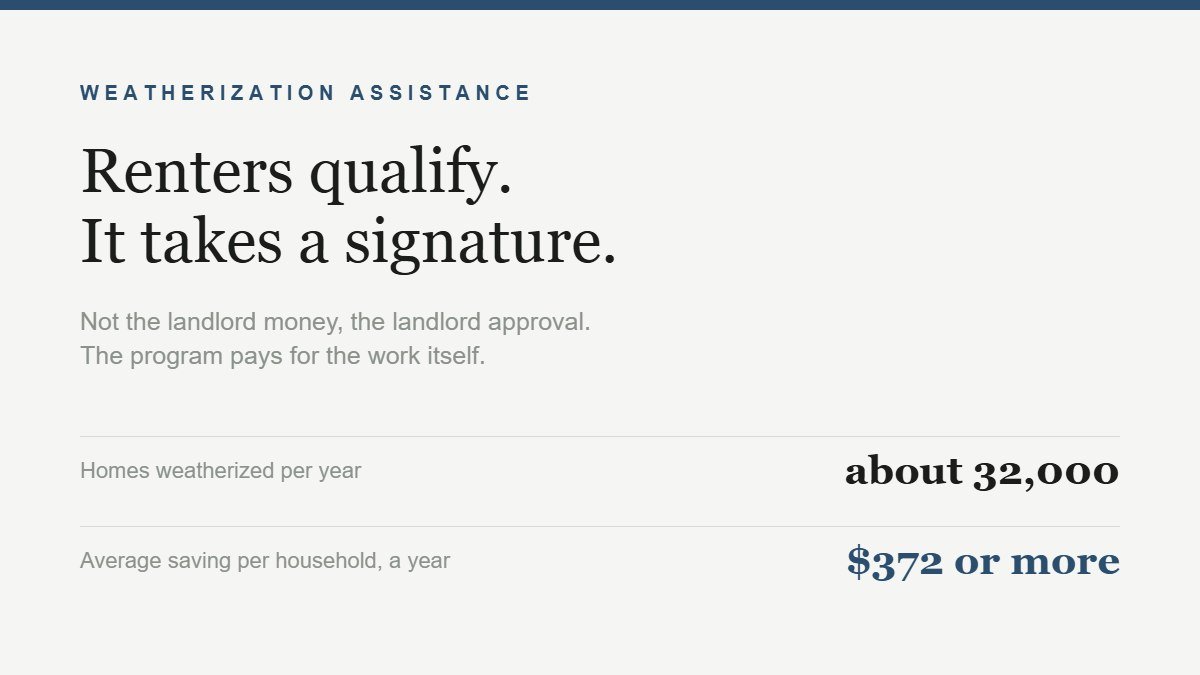
Renters can apply. Most people do not know this.
This is the single most valuable fact in the program and it is buried in every guide.
“Weatherization assistance is available to homeowners and renters (with landlord approval), for single-family site-built and manufactured homes.”
You need your landlord’s signature, not their money. The work is paid for by the program, it raises the value of their property, and it costs them nothing. That is an easy conversation to have, and it is the conversation almost no tenant ever starts because they assume the answer is no.
Manufactured homes are explicitly included, which matters because they are among the most expensive housing in the country to heat.
Who gets seen first
Because demand outstrips supply, states prioritize. The program “prioritizes assisting the elderly, individuals with disabilities, families with children, high energy users, and energy-burdened households.”
Two of those are worth flagging because people do not think to mention them. High energy users and energy-burdened households are categories you can evidence. If your bills are large relative to your income, say so on the application and attach twelve months of bills. That is not an aside, it is a priority category.
The honest part: this program is small
Every other article about weatherization stops before this bit, and it is the bit that determines whether applying is worth your afternoon.
| Measure | Figure |
|---|---|
| Families helped since 1976 | more than 7.2 million |
| Homes weatherized per year | approximately 32,000 |
| Average annual saving per household | $372 or more |
| Jobs supported | 8,500 |
Thirty-two thousand homes a year, in a country where tens of millions of households sit under 200 percent of the poverty line. The arithmetic is not subtle. Waiting lists in many states run to years, not weeks.
That is not a reason to skip it. It is a reason to change how you treat it: apply now for a benefit you will receive later, and do something about this winter separately. The list only moves for people who are on it.
Weatherization and LIHEAP do different jobs
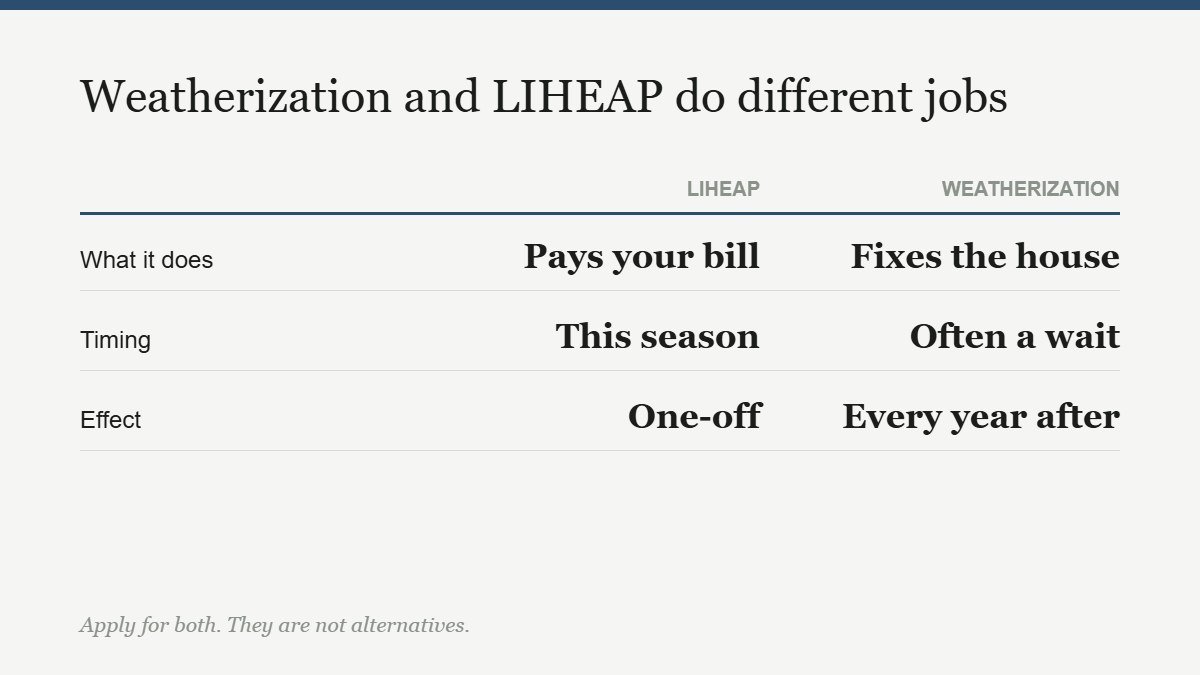
People treat these as alternatives. They are not.
| LIHEAP | Weatherization | |
|---|---|---|
| What it does | Pays part of your energy bill | Fixes the house so the bill is smaller |
| Timing | This season | Often a wait |
| Effect | One-off | Every year afterwards |
Apply for both. LIHEAP gets you through this winter, weatherization makes the next ten cheaper. Many states run them out of the same agency, and in several places a LIHEAP application is treated as a referral to weatherization automatically. Ask whether yours does.
What the work usually covers
An energy audit comes first, and the audit decides the work. What follows commonly includes attic and wall insulation, air sealing around windows, doors and ducts, and repair or replacement of heating equipment where it is unsafe or failing.
The health and safety half of the DOE description is not decoration. Auditors test for carbon monoxide and check combustion appliances, and a dangerous furnace found during an audit gets dealt with. For some households that inspection is worth more than the insulation.
What is not covered varies by state, and cosmetic work never is. Weatherization is not a home improvement grant and the auditor’s report, not your wish list, decides the scope.
How to apply
- Find your state weatherization administrator. The Department of Energy funds the program but every state runs its own, usually through local community action agencies. There is no federal application.
- Gather proof of income for everyone in the household, or your SSI or Work First award letter if you qualify categorically.
- Get your landlord’s written approval if you rent. Do this before you apply, not after. Explain that it is free to them and improves the property.
- Attach twelve months of energy bills. This is how you evidence the high energy user and energy burden priority categories.
- Apply for LIHEAP at the same time, and ask whether the LIHEAP application refers you to weatherization automatically.
- Expect to wait, and follow up. Ask where you sit on the list and whether anything would move you up.
Frequently asked questions
Does the Weatherization Assistance Program cost me anything?
No. The program pays for the audit and the work. There is no co-payment and no loan.
Will my landlord have to pay anything?
No. They give permission, not money. Some states ask landlords to agree not to raise the rent because of the improvements, which is worth checking locally before you approach them.
Can I apply if I live in a mobile home?
Yes. Manufactured homes are specifically included alongside single-family site-built homes.
How long is the wait?
It depends entirely on your state and your priority category, and it is often measured in years rather than months. Ask your local agency directly. Nobody can tell you from a national article.
Is $372 a year really worth the paperwork?
That is the average, and it recurs every year for the life of the improvements. Over a decade it is several thousand dollars for one application, and the health and safety inspection comes with it.
The bottom line
If your household is under 200 percent of the poverty line, or you receive SSI, apply. If you rent, ask your landlord first and lead with the fact that it costs them nothing. Attach a year of bills to make the priority categories work for you, apply for LIHEAP in the same week for this winter, and treat the wait as the price of a benefit that pays out every year afterwards.
This is general information, not professional advice. Eligibility rules, covered work and waiting times are set state by state. Confirm with your state weatherization administrator.
Sources
- US Department of Energy, Weatherization Assistance Program, program description and figures
- US Department of Energy, How to Apply for Weatherization Assistance
- North Carolina DEQ, Weatherization Assistance Program eligibility guidelines, income threshold, categorical eligibility, renter rules and priority groups
Fact-checked against these sources in September 2026.