
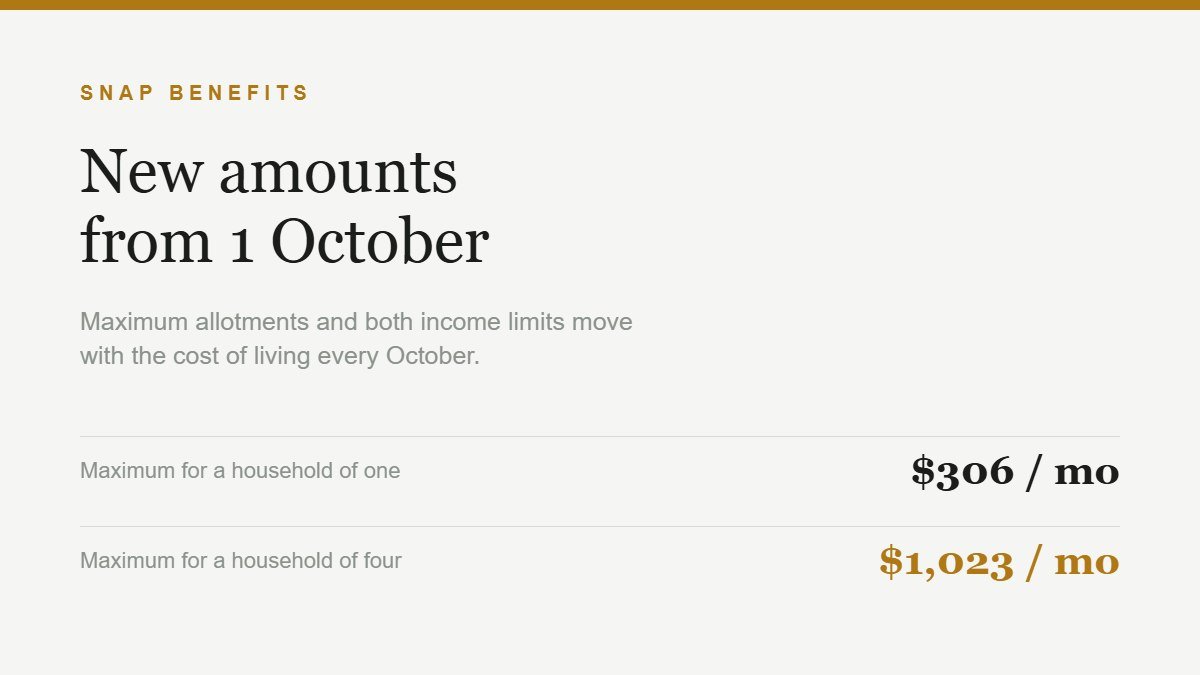
SNAP benefits change on 1 October 2026, when the new federal fiscal year starts. The USDA has published the figures, the maximum monthly allotment for a household of four in the 48 states and DC goes to $1,023, and you do not have to do anything to get the new amount. It applies automatically.
What is worth doing is checking the eligibility numbers, because one of them is far more generous than most people realize and it is the reason a lot of households never apply.
The new maximum allotments
| Household size | Maximum monthly allotment from 1 October 2026 |
|---|---|
| 1 | $306 |
| 2 | $562 |
| 3 | $808 |
| 4 | $1,023 |
| 5 | $1,217 |
| 6 | $1,463 |
| 7 | $1,616 |
| 8 | $1,841 |
The minimum benefit is $25. That number matters more than it looks, and we come back to it below.
These are maximums, not what most households receive. What lands on your card depends on your income after deductions, and the maximum goes to households with effectively no countable income.
There are two income tests, not one
People check gross income, see they are over, and stop. That is the wrong test to stop at.
| Household size | Gross monthly income limit (130% of poverty) | Net monthly income limit (100% of poverty) |
|---|---|---|
| 1 | $1,729 | $1,330 |
| 4 | $3,575 | $2,750 |
Net income is what remains after deductions, and the deductions are substantial. The standard deduction alone runs from $217 for a household of one to three, to $229 for four, $268 for five and $308 for six or more. On top of that sit deductions for earned income, dependent care, and in many cases shelter costs.
Households containing someone aged 60 or over, or someone with a disability, are treated differently again: in many cases they only have to meet the net income test, not the gross one.
This is why “I earn too much” is usually a guess rather than a finding. The only way to know is to let the state run the arithmetic.
The asset limit almost nobody knows about
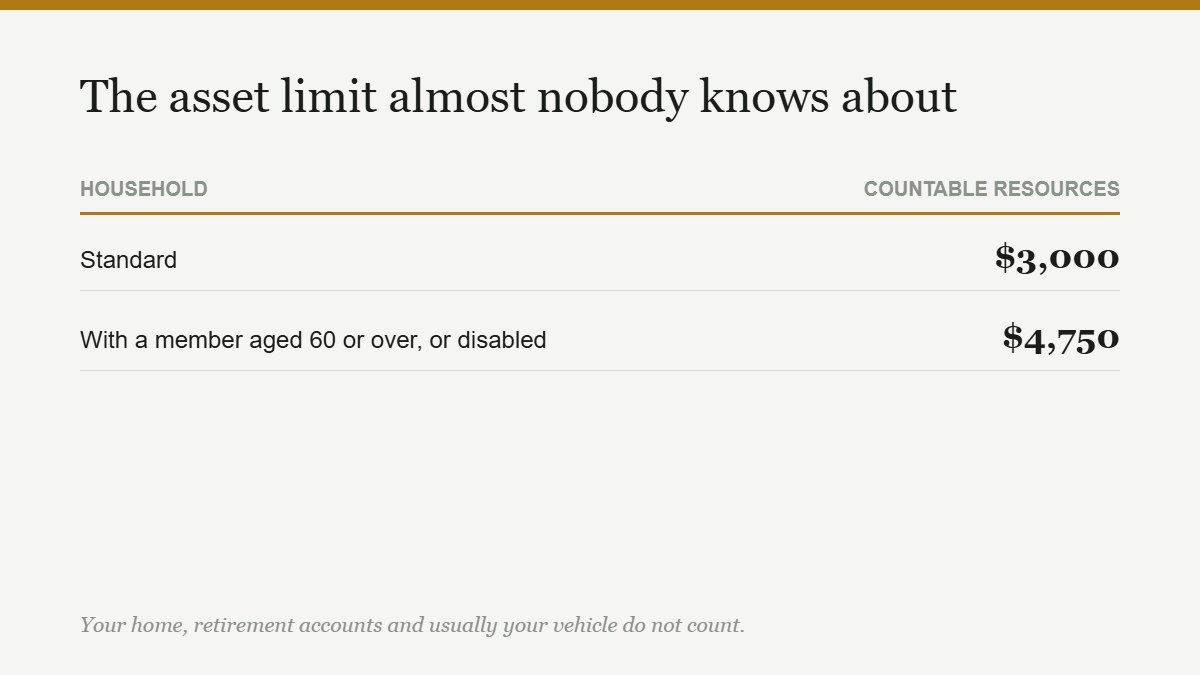
Here is the number worth the whole article.
| Household | Countable resource limit from 1 October 2026 |
|---|---|
| Standard | $3,000 |
| With at least one member aged 60 or over, or disabled | $4,750 |
$4,750 in countable resources for a household with an older or disabled member. A retired person with a few thousand dollars set aside for a funeral or a boiler assumes that disqualifies them. Under this limit, frequently it does not.
And countable is doing work in that sentence. Your home does not count. Retirement accounts generally do not count. In most states your vehicle does not count either. The limit is aimed at cash and easily accessible savings, not at everything you own.
Many states have gone further and dropped the asset test entirely through broad-based categorical eligibility. Your state may have no asset limit at all, which is one more reason a national table cannot answer the question for you.
Do I need to do anything on 1 October?
No. If you already receive SNAP, the new amount applies automatically to your October benefit. There is no form and no reapplication.
Two things to watch anyway.
- Your deposit date does not change. States stagger issuance across the month by case number or surname. A higher allotment does not mean an earlier deposit, and the two get confused every October.
- Report changes that would raise your benefit. A drop in income, a rent increase, a new dependent or a medical expense for an older or disabled household member can all increase what you receive, and none of them are picked up automatically.
Why $25 is the number to argue with yourself about
The most common reason people who qualify do not apply is the belief that they would only get a token amount, so it is not worth the paperwork.
The minimum benefit is $25 a month, which is $300 a year for one application and a periodic renewal. But the more useful point is that SNAP is a doorway. In many states, receiving SNAP opens or simplifies access to other things: discounted internet, reduced utility rates, free school meals, and in some places museum and transport schemes. The $25 is rarely the whole value. A household inside the SNAP income limits is also inside the ceiling for free home weatherization, which lowers the bill instead of helping you pay it.
And the estimate in your head is usually wrong in the same direction. People guess low because they use gross income and forget the deductions.
Frequently asked questions
When exactly do the SNAP benefits changes take effect?
1 October 2026, the first day of federal fiscal year 2027. The adjustment happens on the same date every year.
Are the amounts the same everywhere?
No. The figures above are for the 48 contiguous states and the District of Columbia. Alaska, Hawaii, Guam and the US Virgin Islands have their own, higher, allotments.
Will everyone get more?
Not necessarily. The maximum allotment rises, but your own benefit is calculated from your income and deductions. If your income rose during the year, your benefit can fall even in a year when the maximum goes up.
Do savings disqualify me?
Only above the countable limit, which is $3,000, or $4,750 for households with a member aged 60 or over or disabled. Your home does not count and many states have removed the asset test entirely.
I was refused before. Should I try again?
Yes. The limits rise every October and your circumstances change. A refusal in a previous year tells you nothing about this one.
The bottom line
If you already get SNAP, the new amount arrives on its own from 1 October and there is nothing to do. If you do not, check the net income limit rather than the gross one, and if anyone in your household is 60 or over or disabled, note that the resource limit is $4,750 and that your home is not counted. Apply through your state SNAP agency. The arithmetic is theirs to do, not yours to guess at.
This is general information, not professional advice. SNAP rules and asset tests vary by state. Confirm with your state SNAP agency.
Sources
- USDA, SNAP Fiscal Year 2027 Cost-of-Living Adjustments, effective 1 October 2026
- USDA Food and Nutrition Administration, SNAP Cost-of-Living Adjustment information
Fact-checked against these sources in September 2026.