
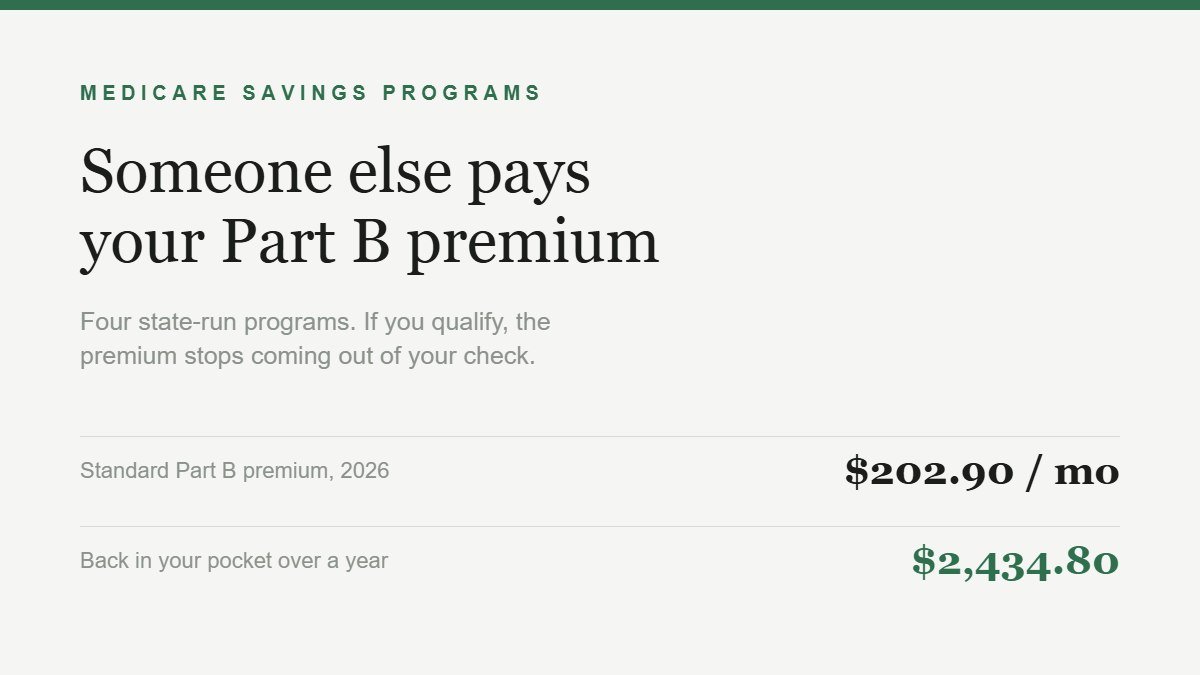
Medicare Savings Programs are four state-run programs that pay some or all of your Medicare costs. The largest of them, QMB, covers your Part B premium plus your deductibles, coinsurance and copayments. In 2026 a single person can qualify for QMB with a monthly income up to $1,350 and $9,950 in countable resources, and the limits are higher for the other three programs.
Most people who qualify never apply. Some of them are already halfway through an application without knowing it, because of a federal rule that took effect on 1 April 2026.
What each Medicare Savings Program pays
There are four, and they are not interchangeable. QMB is by far the most valuable. The figures below are the 2026 federal limits published by Medicare.
| Program | What it pays | 2026 monthly income | 2026 resources |
|---|---|---|---|
| QMB Qualified Medicare Beneficiary | Part A premiums (if you pay one), Part B premiums, deductibles, coinsurance and copayments | $1,350 single $1,824 married | $9,950 single $14,910 married |
| SLMB Specified Low-Income Medicare Beneficiary | Part B premiums only. You must have both Part A and Part B. | $1,616 single $2,184 married | $9,950 single $14,910 married |
| QI Qualifying Individual | Part B premiums only. You must have both Part A and Part B. | $1,816 single $2,455 married | $9,950 single $14,910 married |
| QDWI Qualified Disabled and Working Individual | Part A premiums only | $5,405 single $7,299 married | $4,000 single $6,000 married |
QDWI is the odd one out. It exists for people under 65 who went back to work, lost their premium-free Part A because of it, and now have to buy Part A. The income limit looks generous because of that.
What a Medicare Savings Program is worth in 2026
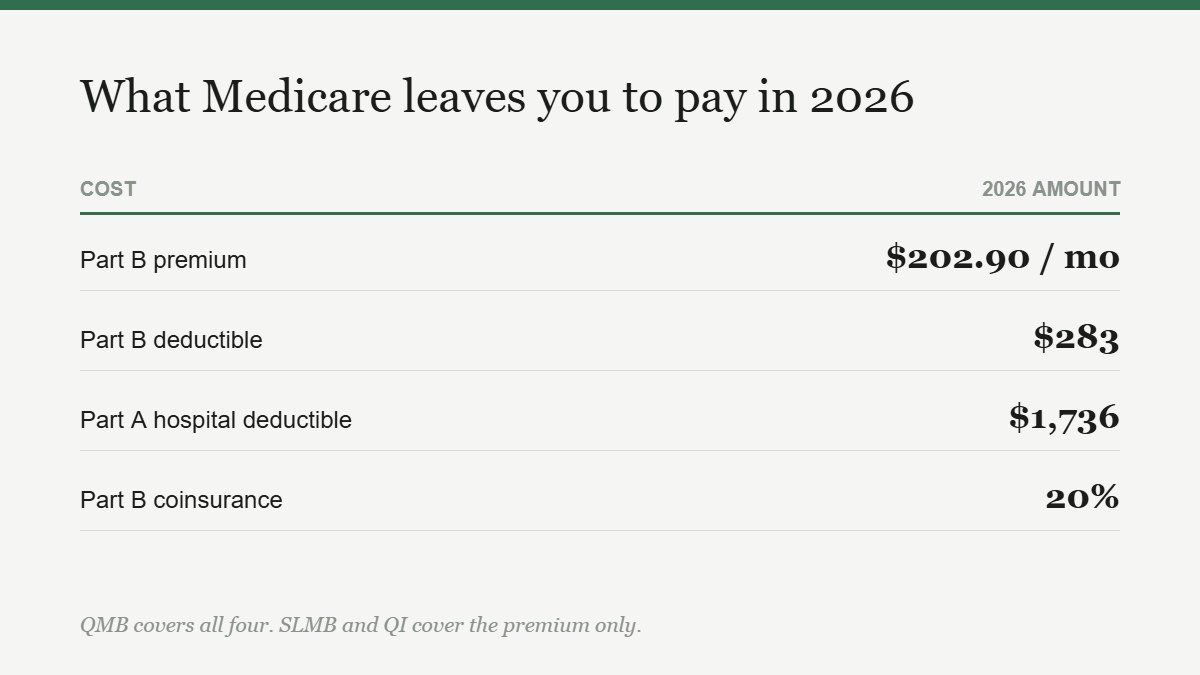
The dollar value went up this year. CMS announced on 14 November 2025 that “the standard monthly premium for Medicare Part B enrollees will be $202.90 for 2026, an increase of $17.90 from $185.00 in 2025.”
So the cheapest of these programs is not cheap:
- SLMB or QI pays your Part B premium. At $202.90 a month, that is $2,434.80 a year back in your pocket.
- QMB pays that and your cost sharing. The 2026 Part B deductible is $283, and the Part A hospital deductible is $1,736 per benefit period. On top of those, QMB covers the 20% coinsurance that Original Medicare normally leaves you to pay.
One hospital admission is enough to make QMB worth more than $4,000 in a single year. There is no upper bound on the coinsurance it saves you, which is the part people underestimate.
The QMB protection that matters more than the money
This is the part of the program almost nobody explains, and it is the reason QMB is worth applying for even in a year when you barely see a doctor.
CMS states it plainly: “Federal law prohibits all Original Medicare and MA providers and suppliers (not only those that accept Medicaid) from billing QMBs for Part A and Part B cost sharing.” That covers deductibles, coinsurance and copayments.
The authority sits in sections 1902(n)(3)(B), 1902(n)(3)(C), 1905(p)(3), 1866(a)(1)(A) and 1848(g)(3)(A) of the Social Security Act. It applies to every Medicare provider, not only the ones who take Medicaid.
The Medicare Rights Center adds a detail worth knowing before you get talked into anything: “You cannot choose to waive these protections and pay Medicare-cost sharing, and a provider cannot ask you to do this.” A front desk cannot get around the rule by asking you to agree to it.
If a bill arrives anyway, and they do arrive, the Medicare Rights Center’s guidance is: “If you are having issues with a provider who continually attempts to bill you, or if you have unpaid cost-sharing bills that have been sent to collection agencies, call 1-800-MEDICARE or contact your Medicare Advantage Plan.”
You get Extra Help with drug costs automatically
Enrolling in any of the first three programs also enrolls you in Extra Help, the Part D low income subsidy. You do not file a second application.
Medicare’s own wording: “You’ll also get Extra Help paying for your prescription drugs. You’ll pay no more than $12.65 in 2026 for each drug covered by your Medicare drug plan.”
For anyone on several brand-name prescriptions, that clause is frequently worth more than the premium saving.
The rule that changed on 1 April 2026
CMS finalized a rule in September 2023 to strip paperwork out of these programs. Several of its provisions carried a compliance date of 1 April 2026, which means they are in force now and very little consumer writing has caught up.
Four changes are worth knowing:
- Your Extra Help application now starts an MSP application. States must accept the Part D low income subsidy leads data to begin an MSP application, and must “accept LIS leads data as verified without additional confirmation from the individual.” If you applied for Extra Help through Social Security, your state should already be working on this.
- States cannot demand extra paperwork up front for interest income, dividends, non-liquid resources or burial funds. At the point of application, “they cannot be required to submit additional documentation” for those categories.
- You get at least 90 days to respond to any post-enrollment verification request.
- Life insurance got easier. You can give “an attestation of cash surrender value” and the state must “assist individuals with the task of obtaining the cash surrender value.”
A separate provision took effect earlier: since 1 October 2024, “36 states and the District of Columbia will be required to automatically enroll SSI recipients in QMB.” If you receive SSI and live in one of those states, you may already be enrolled and not know it. Check before you pay another Part B premium.
Apply even if you think you earn too much
The single most common reason people skip this is a quick look at the table above followed by “I’m over.”
Medicare’s own page addresses that directly: “You may still qualify for these programs in your state even if your income or resources are higher than the federal limits listed.”
The federal numbers are a floor, not a ceiling. States may set higher income limits, disregard more of your income, or drop the asset test altogether. Several have done exactly that. Because the rules are set state by state, the only reliable way to find out is to apply in your state rather than read a national table.
Two more things the table does not show. Countable resources generally exclude your home and usually your car. And working income is often treated more generously than the flat monthly figure suggests.
How to apply for a Medicare Savings Program
- Contact your state Medicaid office. These programs are run by states even though the benefit is Medicare. There is no federal application form.
- Ask your State Health Insurance Assistance Program for help first. SHIP counseling is free, unbiased and staffed by people who fill these forms in every day. They also know your state’s actual limits, which are the ones that matter.
- Say which program you are applying for, or ask to be screened for all of them. If you are over the QMB line you may still be under SLMB or QI.
- Bring proof of income, resources and your Medicare card. Remember rule two above: for interest, dividends, non-liquid resources and burial funds, the state cannot require documentation at application.
- If you already applied for Extra Help, say so. Since April that application should have started this one.
Most people who qualify are not enrolled
The best-known participation estimates come from a MACPAC analysis published in August 2017, using 2009 and 2010 data. They found participation of “53 percent for the Qualified Medicare Beneficiary (QMB) program”, “32 percent for the Specified Low-Income Medicare Beneficiary (SLMB) program” and “15 percent for the Qualifying Individual (QI) program.”
Those figures are old and we are flagging that rather than dressing them up as current. What has not changed is the shape of the problem: the program with the least money attached to it, QI, is the one almost nobody claims, and the gap is largest where the paperwork is heaviest. The 2026 rule changes above exist because of exactly this.
Frequently asked questions
Does a Medicare Savings Program count as Medicaid?
It is administered by your state Medicaid agency, but qualifying for an MSP does not mean you get full Medicaid coverage. Some people qualify for both. Many qualify only for the MSP.
Can I get a Medicare Savings Program on a Medicare Advantage plan?
Yes. The QMB billing protection specifically covers Medicare Advantage providers as well as Original Medicare, which is why the CMS wording says “not only those that accept Medicaid.”
Is there a deadline to apply?
No. Unlike Medicare Open Enrollment, these programs accept applications year round. QI is the exception worth watching, because it is funded by a capped federal allotment and states process it first come, first served each year.
Does my house count against the resource limit?
Generally no. The home you live in is normally excluded, and so is one vehicle. The resource test is aimed at bank accounts, stocks and bonds. Check your state’s specific rules, since this is one of the areas states vary on.
What if I am already being billed for Medicare cost sharing as a QMB?
You do not owe it, and you should not pay it to make the problem go away. Call 1-800-MEDICARE. Paying an improper bill makes it harder to unwind, especially once a collection agency is involved.
The bottom line
If your monthly income is anywhere near $1,800 as a single person or $2,455 as a couple, apply. The federal limits are a floor your state can raise, the Part B premium alone is worth $2,434.80 a year in 2026, and since April the paperwork is genuinely lighter than the last time anyone told you about it.
This is general information, not professional advice. Program rules are set state by state and change. Confirm your own eligibility with your state Medicaid office or a free SHIP counselor.
Sources
- Medicare.gov, Medicare Savings Programs, 2026 income and resource limits and Extra Help figures
- CMS, 2026 Medicare Parts A and B Premiums and Deductibles, announced 14 November 2025
- CMS Medicare Learning Network, Prohibition on Billing Qualified Medicare Beneficiaries
- Medicare Rights Center, QMB improper billing
- Federal Register, Streamlining Medicaid; Medicare Savings Program Eligibility Determination and Enrollment, final rule
- Justice in Aging, Final Rule to Streamline Enrollment in Medicare Savings Programs, compliance dates
- MACPAC, Medicare Savings Programs: New Estimates Continue to Show Many Eligible Individuals Not Enrolled, August 2017
Fact-checked against these sources in September 2026.