

Unclaimed money is free to search for and free to claim, as long as you go through official government sites. Check the federal pools first, because those are the only ones with deadlines, then search every state you have lived in. Roughly one in seven Americans has money waiting somewhere, though the typical amount is small.
Key takeaways
- Searching and claiming are free. Nobody should ever charge you.
- One search is not enough. State databases and federal ones are separate systems.
- State-held property generally never expires. Several federal pools do expire, some in as little as 18 months.
- Several states now send small amounts back automatically, with no claim filed at all.
- The median claim paid is about $100.
Fact-checked against NAUPA, state treasury, IRS, FDIC and FTC sources on September 1, 2026.
What unclaimed property actually is
Unclaimed property is money or an asset that a company holds for you but cannot return, usually because you moved and they lost track of you. After a set period of no contact, state law requires the company to hand it to the state.
The National Association of Unclaimed Property Administrators lists what turns up most: checking and savings accounts, uncashed payroll and dividend checks, refunds, security deposits with utility companies, insurance payouts, stocks, and the contents of safe deposit boxes.
The waiting period is called dormancy, and it varies by state and by asset type. In New York, bank accounts and wages sit at three years. Utility deposits are two. Gift certificates are five. Traveler’s checks from non-banks are fifteen.
Before any of that happens, the company is supposed to write to your last known address. If you moved and never filed a forwarding order, that letter went to the old place.
Where to search, every official place
There is no single database. State programs and federal programs are separate systems, and each federal agency runs its own.
Start with the states
unclaimed.org/search is the directory of every official state program, run by the state administrators themselves. Their advice is to “check each state you’ve lived or done business in.”
missingmoney.com searches many states at once. It is the multi-state search sponsored by NAUPA, and it is free.
It does not cover everywhere, though. NAUPA says only that “most states participate.” The roster has changed repeatedly, and California points people solely to its own site. So run both: the multi-state search, and the official site of each state you have lived in.
Then the federal pools
None of these show up in a state search. usa.gov/unclaimed-money is the official index of them.
| Where | What it holds |
|---|---|
| Treasury Hunt | Matured savings bonds that stopped earning interest |
| PBGC | Pensions from private employers whose plans ended |
| HUD | FHA mortgage insurance refunds |
| IRS | Unclaimed and undelivered tax refunds |
| FDIC | Deposits from failed banks |
| NCUA | Shares from failed credit unions |
| Department of Labor | Back wages recovered for workers it could not find |
| VA | Unclaimed veterans’ life insurance funds |
| SEC | Payouts for investors harmed in enforcement cases |
| Federal bankruptcy courts | Money owed to creditors who never collected |
All of them are free. The PBGC database is updated quarterly, most recently on August 5, 2026.
Some of it does expire
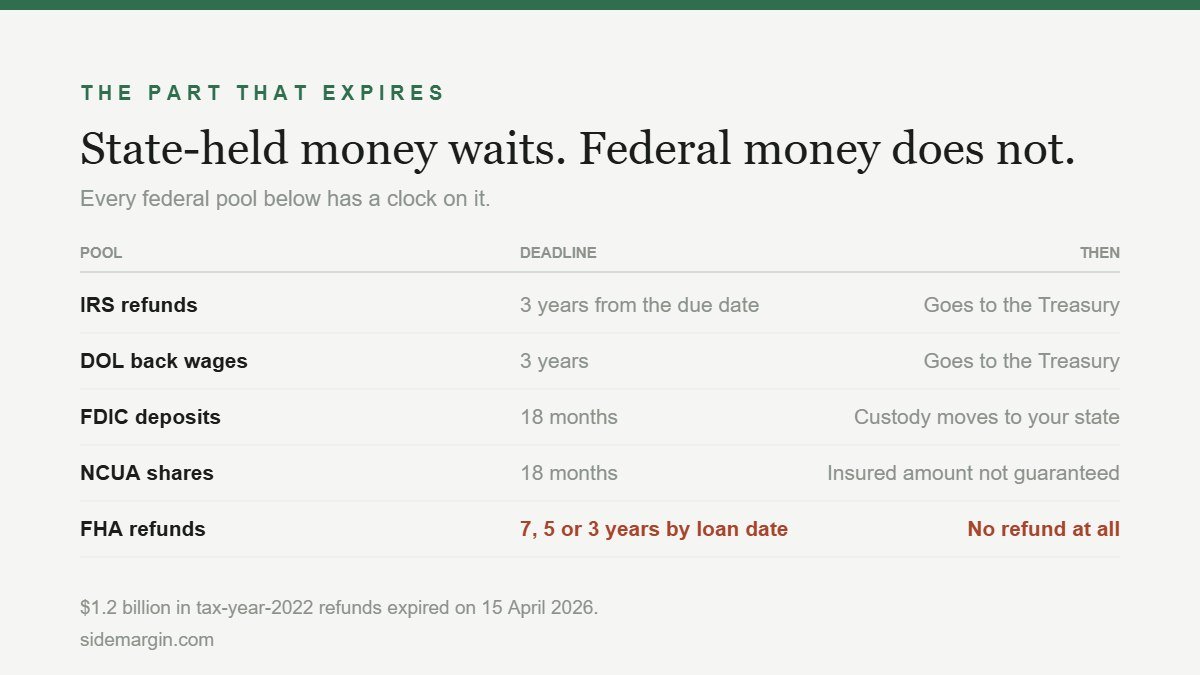
State-held property generally does not expire. New Jersey holds it “in perpetuity or until a valid claim is submitted.” New York says “the accounts never expire.” California lets an owner claim “at any time.”
The federal pools have deadlines.
| Source | Deadline | Then what |
|---|---|---|
| IRS refunds | 3 years from the return’s due date | “the money becomes the property of the U.S. Treasury” |
| DOL back wages | 3 years | Sent to the U.S. Treasury |
| FDIC insured deposits | 18 months | Custody moves to your state |
| NCUA shares | 18 months | Full insured amount no longer guaranteed |
| FHA refunds | 7, 5 or 3 years by loan date | No refund after that |
The FHA bands are worth spelling out: seven years for loans closed before 2001, five for loans closed later but endorsed before December 8, 2004, and three for anything endorsed after that.
In March 2026 the IRS announced roughly $1.2 billion in unclaimed refunds for the 2022 tax year, owed to more than 1.3 million people, with a median of $686 each. The deadline was April 15, 2026. It has passed, and that money is gone.
Check the federal sources first, because they are the only ones with deadlines.
You may not have to claim at all
Several states now match records automatically and pay the money out without any claim being filed.
- New York paid $48 million through more than 210,000 expedited payments, averaging $229 each. The cap was raised from $250 to $5,000 after the first year.
- Pennsylvania returns amounts up to $500 automatically. Nearly $50 million went back that way in the first year.
- Illinois has returned over $130 million automatically since 2018, to more than 870,000 people.
You still need to search, because these programs only catch what the state can verify electronically. If a check arrives unprompted from your state treasurer it may well be real, but confirm it on the state’s own site before you deposit it or reply.
How to claim
Expect to prove two things: that you are who you say you are, and that the property was yours.
- Identity. A driver’s license or passport, and usually a Social Security number.
- The link to the old address. Old bills, bank statements, or utility records showing you lived there.
- A name change, if relevant. A marriage certificate, divorce decree, adoption papers or court order.
- For a deceased relative. A death certificate, plus proof you are entitled to claim.
New York’s estate rules are typical. Under $1,000, New York may process a claim from the closest living relative, who then distributes the funds under state intestacy law. At $1,000 or more, you need a court-appointed representative. Whoever paid the funeral bill can be reimbursed up to $5,000.
New York will not tell you the amount before reviewing your claim, to prevent fraud. And newly transferred property can take about three months to appear in the search database, so a blank result today is not final.
Timing varies. NAUPA says “some states complete this process in less than 30 days.” New York asks claimants to allow up to 90 days for review, though it says most are paid within 30. Others give no estimate at all.
Finders, and what the law says about their fees
You may get a letter offering to recover money for a percentage. Finder agreements are lawful in many states, and several cap what a finder can charge.
| State | Fee cap | Other rules |
|---|---|---|
| California | 10% | Written full-disclosure contract required |
| Illinois | 10% | Agreement void within 24 months of transfer; finders must be licensed |
| New York | 15% | Notarized, with a warning in 12-point boldface type |
| Florida | 30% | Only on the state’s own forms |
New York and Illinois both require the finder to tell you in writing that you could have claimed the money yourself, for free. California requires a full-disclosure contract and tells owners plainly that they are not required to use one at all.
FDIC Consumer News makes the distinction. Some recovery firms do real work on genuinely complex cases. But anyone demanding money up front “probably only has the same list of unclaimed property available to everyone, for free.”
Scams, and the lookalike problem
The FTC published two warnings on this in 2026 alone.
In March it addressed unexpected calls about unclaimed funds. The test it gives is simple: “The government won’t call or text and ask you to pay them to search for unclaimed funds. And they won’t pressure you to respond right away.”
In July it flagged a specific version. A letter arrives on law firm letterhead saying someone with your surname died leaving a large life insurance policy, and you are the heir. The proposal is to split it. The real target is your Social Security number and bank details. The FTC’s rule: “Never send money or information to a stranger who promises big rewards.”
The tells are consistent: urgency, an upfront processing fee, a request for personal details, a link in an unexpected text, and a specific dollar figure quoted to sound credible.
Lookalike domains are the other risk. The official multi-state site is missingmoney.com. Sites exist with names one character away from it, and others built to look like official state databases. HUD makes the same point about its own refunds: “You do not need to pay another person or firm to assist you in collecting your refund.”
The safe habit: reach state databases through unclaimed.org and federal ones through usa.gov, rather than through a search result or a link someone sent you.
What it is realistically worth
States returned $4.49 billion to owners in the 2024 fiscal year. The median claim paid was $100. The average claim paid through missingmoney.com was $2,080.
A handful of large stock claims pull the average up. Half of all claims came in at $100 or less.
Treat it as a short administrative job rather than a windfall hunt. The searches are free.
Frequently asked questions
Is unclaimed money real or a scam?
The programs are real and run by state governments. The scams are the messages and websites built around them. If a search is free and run on a state or federal site, it is the real thing.
Does the state keep the money if I never claim it?
States hold it as custodians and keep trying to find owners, through free searches, public record matching and outreach. Several now return small balances automatically.
Can I claim a dead relative’s unclaimed money?
Yes, with the right paperwork. You need a death certificate and proof of your entitlement, usually as heir, executor or court-appointed representative. Thresholds differ by state.
Do I have to pay tax on it?
It depends what the money is. Returned wages are taxed as income and interest paid on the property is generally taxable, while a refunded deposit generally is not. The state will issue a tax form if it reports interest. Check with a tax preparer before you file.
How often should I check?
Once a year is plenty, and it is worth checking after you move, change your name, or settle a relative’s estate. Those are the moments property goes missing.
The bottom line
Start with the federal list at usa.gov, since only those have deadlines, then search every state you have lived in through unclaimed.org. Pay nobody, and expect about a hundred dollars rather than a windfall.
This is general information, not tax or legal advice.
More from Side Margin
Sources
- NAUPA, what is unclaimed property
- NAUPA, official state program directory
- NAUPA, claiming your property
- USAGov, unclaimed money from the government
- New York State Comptroller, required documentation
- New York State Comptroller, claims for deceased owners and estates
- IRS, unclaimed refunds for tax year 2022
- US Department of Labor, Workers Owed Wages
- FDIC, unclaimed deposits information
- HUD, FHA mortgage insurance refunds
- FTC, how to handle unexpected calls about unclaimed funds
- FTC, unclaimed life insurance money is a scam
- California State Controller, on locators and the 10 percent cap
- New York Abandoned Property Law section 1416
- New Jersey Treasury, unclaimed property FAQs
- New York State Comptroller, expedited payment program, April 2026
- New York State Comptroller, how to search and claim
- New York State Comptroller, property type and dormancy tables
- NAUPA and NAST, annual report release, October 2024
- PBGC, search for unclaimed retirement benefits
- Pennsylvania Treasury, Money Match results, February 2026
- Illinois Treasurer, Enhanced Money Match results
- Illinois Treasurer, unclaimed property finder licensing
- 74 Illinois Administrative Code 760.650, finder agreements
- Florida Statutes 717.135, recovery agreements
- NCUA, unclaimed deposits
- FDIC Consumer News, Lost and Found
- HUD, FHA homeowners fact sheet, refund time limits