
If your state cut its funding for Dolly Parton’s Imagination Library, the first thing to know is that your child’s books do not automatically stop.
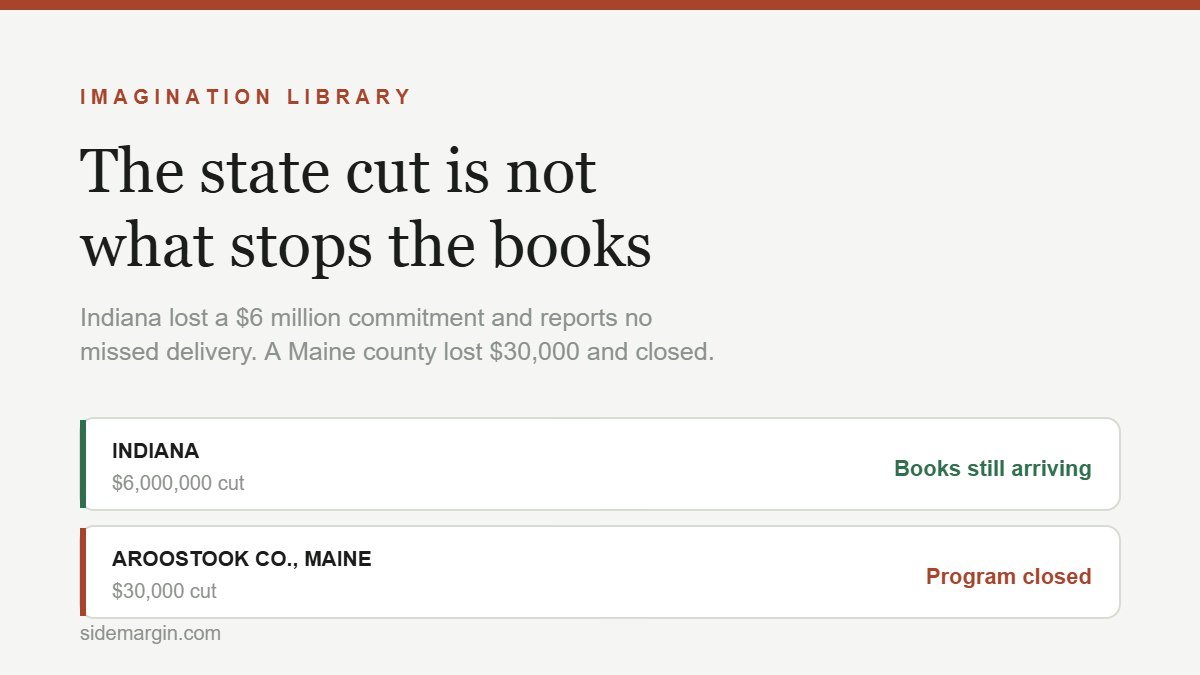
Indiana lost a $6 million state commitment and the governor’s office says no delivery lapsed. A county program in Maine lost about $30,000 a year and shut down completely. The Maine shortfall was a hundredth the size, and it was the one that ended the books.
Key takeaways
- In most states the cost is split, typically half from the state and half from a local partner. A few states funded the whole thing. That difference decides what a cut does.
- When a state withdraws, whether books keep arriving depends on whether the local partner can cover the gap.
- Indiana lost state funding and reports no interruption. Aroostook County, Maine, ended its program in June 2026.
- Missouri froze new enrollment on July 1, 2026, and a Dollywood Foundation regional director said in August that the remaining money keeps the program running as it is only until October 2026.
- The person to contact is your local affiliate, not the Dollywood Foundation.
Checked against Dollywood Foundation, state agency and local news sources on September 1, 2026.
What Imagination Library funding actually pays for
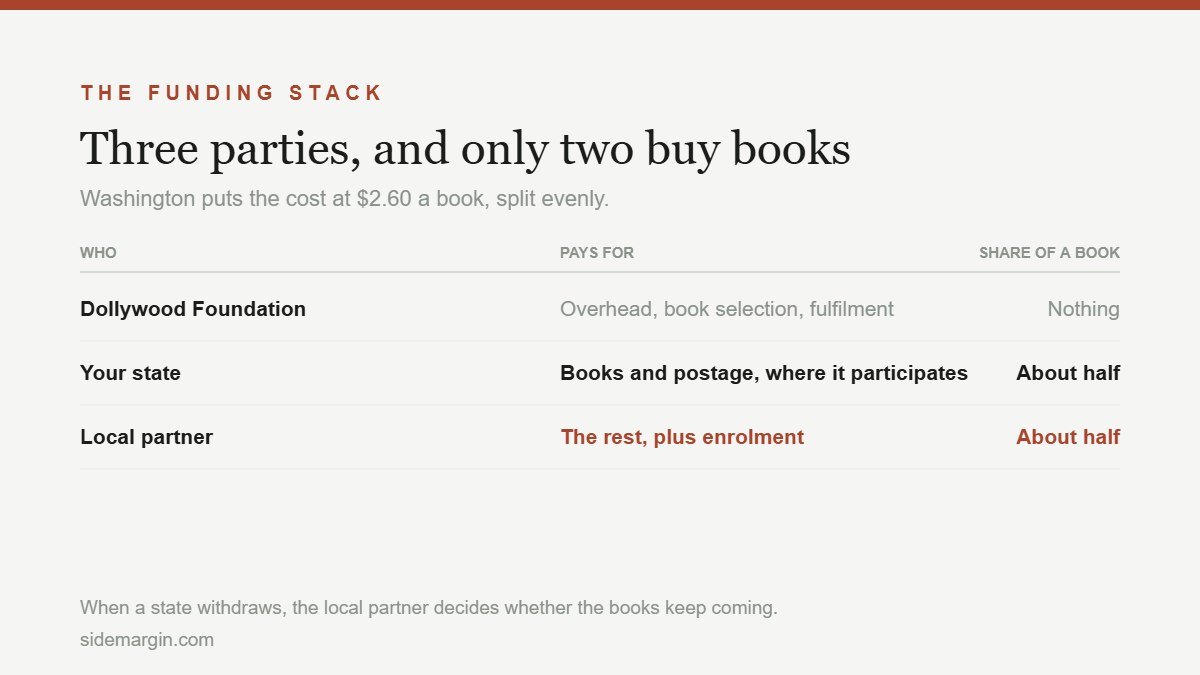
A Program Partner is the local organization that pays for your child’s books and runs enrollment in your area. A state match is the share of that cost a state government agrees to cover. Three parties share the work, and they do not share it evenly.
- The Dollywood Foundation handles the parts you never see. Its support page lists “overhead, selection of books, database, publisher negotiations, and fulfillment.”
- The state, in states that participate, most often pays about half the cost of books and postage. Missouri funded the full cost, which is why its cut stopped new sign-ups directly rather than being absorbed locally.
- The local partner pays the rest and signs children up. The same page says plainly: “The local programs secure the funding for the cost of books and postage.”
The money for books and postage comes from the local program, not from the Foundation. That is not a criticism of it. It explains why a national organization cannot simply write a check when a state walks away, because the money for books was always local.
Washington’s education department put a figure on it: $2.60 per book, split evenly between the state and local partners.
Imagination Library funding, state by state
| Where | What changed | Books still arriving? |
|---|---|---|
| Indiana | $6 million two-year commitment cut | The governor’s office says no lapse |
| Missouri | About $6 million down to about $2 million | For now, no new sign-ups |
| Washington | $7 million request left out of the budget | Yes, on stopgap money |
| Aroostook County, Maine | Local partner lost state support | No, ended June 2026 |
| Kentucky | Cut proposed, then reversed | Yes, match restored |
The comparison that matters. Indiana lost a $6 million two-year commitment, about $3 million a year, and the governor’s office says no delivery lapsed. Aroostook County lost roughly $30,000 a year, about one hundredth as much, and every child stopped receiving books. Indiana’s local partners raised replacement money. Aroostook County’s could not.
Indiana lost $6 million and reports no missed book
Indiana had funded the program with $2 million in the 2023-24 state budget and $4 million in 2024-25, a $6 million two-year commitment, according to Chalkbeat Indiana. Lawmakers cut it out of the following budget entirely in 2025. Newsweek put the number of enrolled children at 152,105, about 37 percent of children under five in the state.
Then private money replaced it. First Lady Maureen Braun started a fundraising drive. CenterPoint Energy gave $500,000, and by March 2026 the campaign had reached 90 percent of a two-year goal. By April 2026 the program covered all 92 counties.
Griffin Reid, press secretary for Gov. Braun, told Chalkbeat Indiana there had been no lapses in book delivery since the cuts. Read that carefully. It is the governor’s office assessing its own decision, and no independent delivery count has been published.
Missouri is the one with a date on it
Missouri is the state where a parent needs to pay attention right now. Funding dropped from roughly $6 million to roughly $2 million. New enrollment stopped on July 1, 2026. A baby born in Missouri this summer cannot sign up. Children already enrolled keep receiving books “as funding allows.”
In late August 2026 Michelle Anthony, a regional director for the Dollywood Foundation, told KOMU the money on hand would keep the program running as it is until October 2026. The state education department has said it could look at local or private partnerships. As of the start of September, no replacement funding has been announced.
If you have a child enrolled in Missouri, act before October rather than during it. Your local partner is the one who will know before you do.
Washington has been rescued twice and is still not fixed
Washington asked for $7 million for its two-year budget. The version released in April 2025 contained none of it. That broke a commitment made in a 2022 state law, which had set up a 50-50 match. About 121,000 children and 46 local partners were affected.
State Superintendent Chris Reykdal then put limited discretionary agency funds into the program for one year. The announcement noted the $12 billion shortfall legislators faced that session.
On July 31, 2026, the Imagination Library of Washington announced grants from the Roots & Wings Foundation and the JTMF Foundation that it expects will eventually restore access for about 40,000 children, taking statewide enrollment above 100,000. That is a projection, not a completed restoration, and permanent state funding has not returned.
Aroostook County, Maine, shows what happens when nobody steps in
This one is often described as Maine ending its program. It was not a statewide program and the state did not run it. United Way of Aroostook County ran it, at a cost of about $60,000 a year, and covered roughly half of that itself. When state support went away, the other half had nowhere to come from.
The executive director, Sarah Duncan, put it plainly: “With the loss of half of that funding, it just isn’t sustainable.” The program had been sending about 2,000 books a month to children in the county. Those stopped after June 2026. The United Way replaced it with something smaller, aiming to get four books to every baby born in the county.
That is the clearest example of the rule. The state’s decision was identical in kind to Indiana’s. The outcome was the opposite, because the local partner could not raise the difference.
Kentucky proposed a cut and then reversed it
In early March 2026, Republican Sen. Michael Nemes filed an amendment that would prohibit Kentucky’s general fund from being used for the program. A separate budget proposal would have dropped the state share from half to a third. Book Riot reported that the smaller share would have shut down nearly 80 percent of county programs within a year.
Neither happened. On March 31, 2026, lawmakers restored the full dollar-for-dollar match in House Bill 500. It covers more than 138,000 children in all 120 counties, and the amended language also aims to reach more low-income families. These decisions do get reversed, which is worth knowing if yours is still being argued about.
Which situation are you in
The rule above only helps if you turn it into a question for your own local partner. There are three cases.
Your state never funded the program
Your risk was never a state budget. Ask your local partner what share of its book budget comes from grants and how long those grants run. A program funded by one multi-year grant is in a different position from one funded by an annual fundraiser.
Your state cut, and your books still arrive
Somebody covered it. The question is whether that money repeats. Washington’s first rescue was one year of discretionary agency funds, and its second is described as expected rather than delivered. Ask your partner whether the replacement money is recurring or one-time, and what happens at the end of it.
Your books have stopped
Go to the affiliate, not the Foundation, and ask two things: whether your child is still enrolled, and whether a neighboring county’s program accepts your address. Boundaries are drawn by local partners, so they do not always follow the lines you would expect.
How to check whether your child is still enrolled
- Count the months. Books arrive monthly. One late book is normal. Two missed months in a row is a signal.
- Find your local program. The Foundation’s program finder searches by map, by local champion, or by ZIP code, and returns the contact details of the people who actually pay for your child’s books.
- Contact that affiliate. The Foundation’s own guidance is that if your child stopped receiving books, you need to reach out to your local Imagination Library affiliate. It is the only party that knows your enrollment status.
If no program covers your area, the finder lets you leave contact details. The Foundation’s wording is that you will be notified when the program becomes available, which is not the same as a place being held for your child.
Our guide to signing up covers eligibility and the enrollment form itself.
If your program has closed
There is no national substitute that mails a book a month to your door. There are smaller things that work.
- Ask your pediatrician about Reach Out and Read. It builds books into well-child visits and operates at more than 6,200 sites in all 50 states. You get the book at the appointment rather than in the post.
- Ask your public library what replaced it. Aroostook County’s United Way built a smaller newborn book programme after its Imagination Library closed, and arrangements like that are rarely announced beyond local media. This is worth a phone call rather than a web search.
- Look at Reading Rockets. It keeps a directory of free-book sources that is broader than any one program.
What the Foundation has said
On the Indiana cut, Jeff Conyers, the Foundation’s vice chair and president, said the program “unites us all” regardless of politics. On Washington, he said the close of the budget session “does not prevent Washington’s leaders from taking action to fund its portion of Dolly Parton’s Imagination Library as promised to the state’s children and families.”
Since Dolly Parton’s death on August 25, 2026, the Foundation has declined to discuss state funding. Its statement reads: “At this time, The Dollywood Foundation is not commenting on questions related to statewide funding for Dolly Parton’s Imagination Library. Our focus remains on honoring Dolly’s legacy by continuing the work she cared so deeply about, working alongside our partners to inspire a love of reading and ensure children continue receiving the gift of books.”
One correction is worth making, because it has been repeated widely. Headlines in February 2025 said Dolly Parton urged Indiana’s governor not to cut the funding. She did not. The statement came from Conyers, and Parton made no personal comment on the Indiana budget.
Where new money is coming from
Two days after Parton’s death, three New Hampshire senators said they would file an Imagination Library Act in September 2026 to fund the program statewide. One is a Republican and two are Democrats. NHPR reported an estimate of up to $750,000 a year once it is fully phased in over five years. New Hampshire currently has programs only in Barrington, Durham, Nashua and the North Country. As of September 1, 2026, no bill number exists and it has not been filed.
Kentucky’s restoration and New Hampshire’s proposal are the honest counterweight to the cuts, but they are not symmetrical. Kentucky only restored a match it already had. New Hampshire’s money would be genuinely new, and it is still a proposal.
Common questions
Will my child be dropped without warning?
Not usually. Notice comes from the local partner, and small nonprofits do not always have a mailing list that reaches every family. In Aroostook County, WAGM reported the closure in late June 2026, the same month the program ended. For most parents, the signal is simply that the books stop.
Can I pay for my own child’s books?
Not directly. Donations go to a local program, which then covers children in its area rather than a named child. If you want to help, the local partner is again the place to go.
Does the program still exist after Dolly Parton’s death?
The Foundation’s own statement describes continuing the work with its partners. What is unsettled is state funding, and that was unsettled well before August.
My state is not on the list. Am I safe?
Not necessarily, and this is the point of the whole article. A local partner can run out of money in a state that never cut a cent. The list above covers state-level decisions. Your enrollment depends on a smaller organization than that.
The bottom line
Stop asking whether your state cut funding. Ask who your local Program Partner is and whether it covered the gap. That is one phone call, and it is the only answer that applies to your address.
More from Side Margin
Sources
- Imagination Library support, why the Foundation does not fund local programs
- Imagination Library support, I have stopped receiving books
- Imagination Library, find my program
- Chalkbeat Indiana, coverage in all 92 counties
- WFYI, Indiana fundraising nears 90 percent of goal
- St. Louis Public Radio, Missouri budget cuts
- ABC 17, Missouri cannot accept new enrollees
- KOMU, Missouri education department on the program
- Imagination Library of Washington, state budget shuts out funding
- Imagination Library of Washington, philanthropic support
- Washington OSPI, superintendent funds the program
- WAGM, Aroostook County program ending
- WKYT, Kentucky amendment filed
- WKYT, Kentucky lawmakers restore funding
- Book Riot, state funding for the Imagination Library
- Newsweek, state cuts to the reading program
- Fox News, the February 2025 statement
- NHPR, New Hampshire statewide proposal
- Reach Out and Read, family resources
- Reading Rockets, in search of free books