
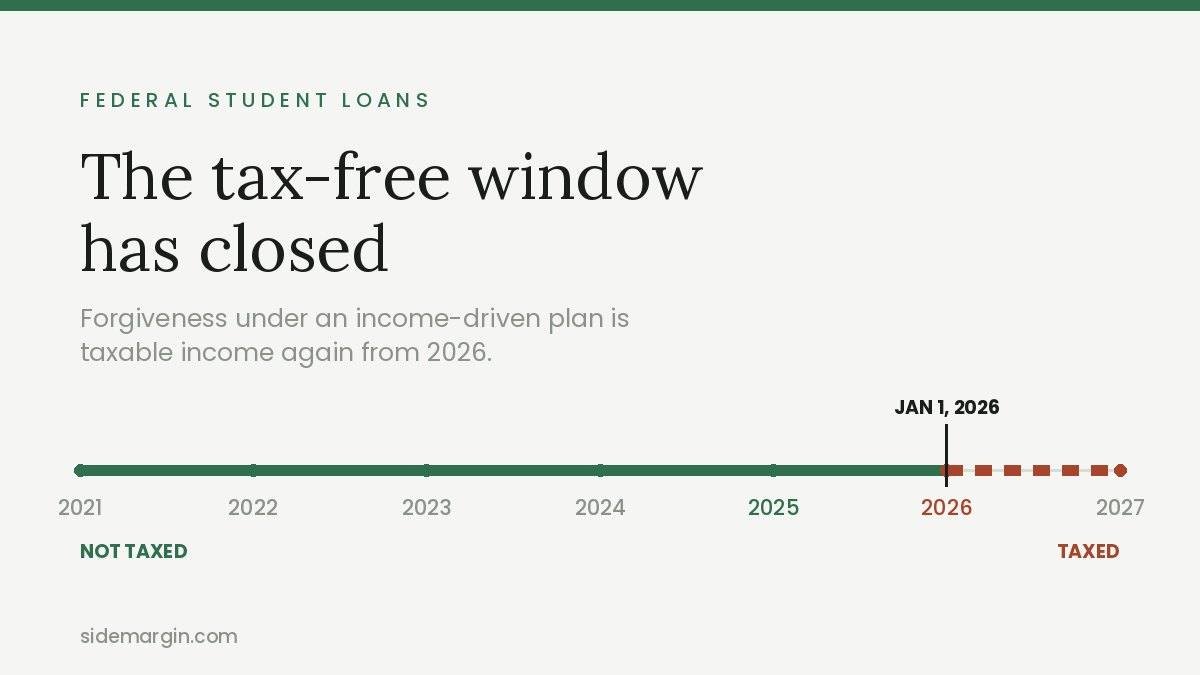
Is student loan forgiveness taxable in 2026? Yes. If your federal student loans are forgiven under an income-driven plan in 2026, the forgiven balance counts as income on your federal tax return. A tax break that made this forgiveness tax-free ran out on January 1, 2026, and Congress has not brought it back. Public Service Loan Forgiveness is the big exception: it is still tax-free.
Key takeaways
- The tax break covered loans discharged on or before December 31, 2025. It has expired.
- Forgiveness under IBR, PAYE or ICR in 2026 is generally taxable income at the federal level. RAP forgiveness would be taxable under today’s rule too, but the first RAP forgiveness is 30 years away.
- PSLF, Teacher Loan Forgiveness, and discharge for death or total and permanent disability are still not taxed.
- Your state may tax the forgiven amount too, and some states taxed it even during the tax-free years.
- If you owed more than you owned right before the loan was forgiven, the insolvency rule may cut the tax bill.
Fact-checked against IRS, Federal Student Aid, and US Code sources on September 1, 2026.
This is general information, not tax advice. A tax professional who can see your actual numbers is worth the fee here.
Why is student loan forgiveness taxable again from January 1, 2026
Normally, debt that someone cancels for you counts as income. You did not pay it, so the government treats it as money you gained. That has been the rule for a long time.
The American Rescue Plan Act carved out an exception for student loans. For a few years, forgiven federal student debt was left out of your income. That carve-out had an end date built into it, and the date has now passed.
The IRS puts it plainly. Its page on canceled debt lists “Certain student loan discharges after December 31, 2020, and before January 1, 2026” among the amounts left out of income. The window closed. The IRS last reviewed that page on May 14, 2026.
The Taxpayer Advocate Service, an independent office inside the IRS, said the same in March 2026: “If your federal student loan balance is forgiven under an income-driven repayment plan in 2026 or later, the amount forgiven is generally treated as taxable income.”
The Education Department’s Federal Student Aid office agrees. For 2021 through 2025 discharges it says you will not owe federal tax. For 2026 and after, it warns that the discharged balance “might increase your taxable income and could result in a tax bill at both the federal and state levels.”
When is student loan forgiveness taxable, and when is it not
Not all forgiveness works the same way. The difference is which section of the tax code grants it.
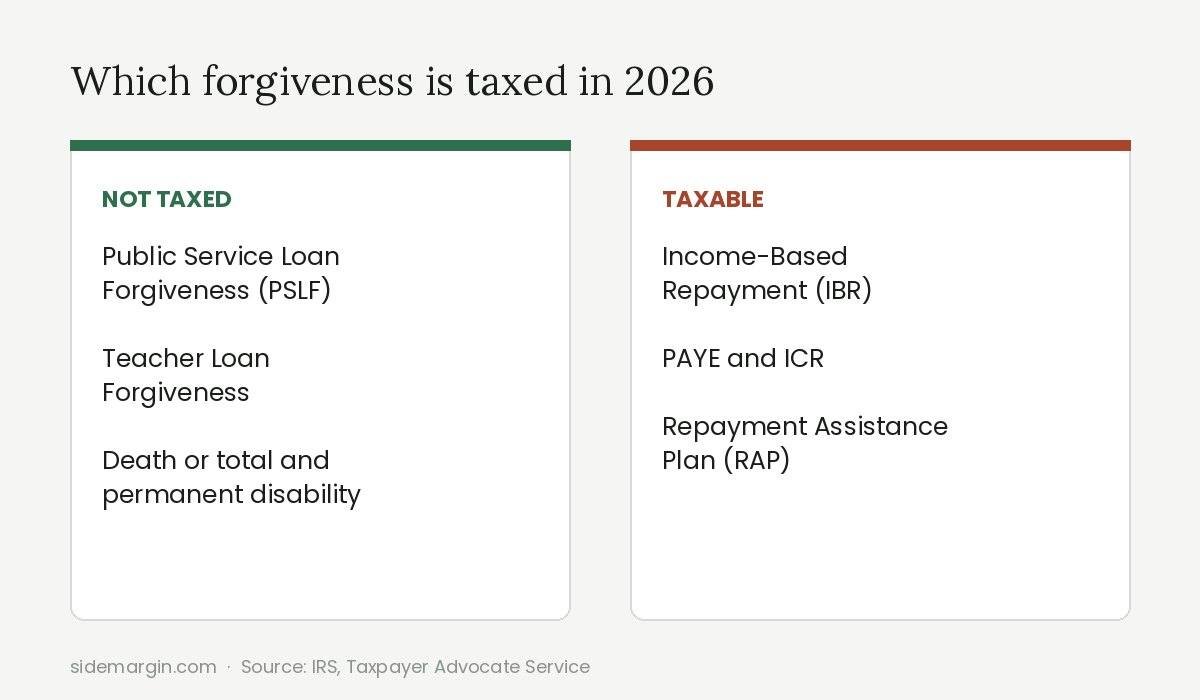
| Type of forgiveness | Federal tax treatment |
|---|---|
| Income-Based Repayment (IBR) after 20 or 25 years | Taxable |
| Repayment Assistance Plan (RAP) after 30 years | Taxable |
| PAYE or ICR forgiveness | Taxable |
| Public Service Loan Forgiveness | Not taxed |
| Teacher Loan Forgiveness | Not taxed |
| Death or total and permanent disability discharge | Not taxed |
RAP only opened on July 1, 2026, so its 30-year forgiveness is decades away for anyone starting now. It is in the table because RAP is the plan most new borrowers will be sitting on when that day arrives. Its treatment that far out is whatever the law says then; the table reflects the rule as written today.
Public Service Loan Forgiveness is a program that wipes the remaining balance after 120 qualifying payments while you work for a government or nonprofit employer. Its tax treatment sits in a different part of the law, and that part did not expire. The Taxpayer Advocate Service lists PSLF, Teacher Loan Forgiveness and death or disability discharge as forgiveness that does “not create a tax liability.”
The split, then: forgiveness you earn by working in public service is untaxed, and forgiveness you reach by paying for two or three decades is taxed.
What this could cost
The forgiven balance gets added to your income for that year. It is not a separate bill with its own rate. It stacks on top of your salary, which can also push part of your income into a higher bracket.
Take a rough example. Say $40,000 is forgiven and your marginal federal rate is 22 percent, used purely as an illustration rather than as a 2026 bracket. The added federal tax is roughly $8,800. Add state income tax where your state taxes it, and the real figure climbs.
Two details make it worse than that sketch suggests. First, a large forgiven balance can lift you into a higher bracket, so the top slice may be taxed above 22 percent. Second, higher income for the year can reduce credits and deductions that phase out as income rises.
The timing is also awkward. Forgiveness arrives at the end of a 20-, 25- or 30-year plan, in one lump, in a single tax year. There is no way to spread the income across years.
The insolvency rule that can cut the bill to zero
There is a long-standing rule for canceled debt that has nothing to do with student loans specifically, and it can matter a great deal here.
Insolvency, for tax purposes, means your debts were larger than everything you owned right before the debt was canceled. IRS Publication 4681 states the test directly: “You were insolvent immediately before the cancellation to the extent that the total of all of your liabilities was more than the FMV of all of your assets immediately before the cancellation.”
If that describes you, the publication says: “Don’t include a canceled debt in income to the extent that you were insolvent immediately before the cancellation.” You claim it by attaching Form 982 to your return and checking the box on line 1b.
The test is a single moment, immediately before the cancellation, not the whole year. It is measured with a worksheet that compares all your liabilities against the fair market value of all your assets. And it only helps to the extent you were insolvent, so a partial gap gives partial relief.
The version of Publication 4681 available while writing this was the 2025 edition, prepared for 2025 returns. The insolvency rule is old and stable, but check the current edition before you rely on the details.
Two IRS pages give different start dates, and the law settles it
Worth flagging, because you may see both numbers quoted. The IRS topic page describes the exclusion as covering discharges “after December 31, 2020.” The Taxpayer Advocate Service says it applies “only if your student loans were forgiven after December 31, 2021, and on or before December 31, 2025.”
The statute settles it. The American Rescue Plan wrote the exclusion into section 108(f)(5) of the tax code under the heading “Special rule for discharges in 2021 through 2025,” and the operative sentence covers any discharge “after December 31, 2020, and before January 1, 2026.” The Act’s own effective-date clause matches: “The amendment made by this section shall apply to discharges of loans after December 31, 2020.”
So the IRS topic page has it right and the Taxpayer Advocate page is a year off on the start. Discharges during 2021 were covered, which is also what Federal Student Aid says. Both pages agree on the part that matters now: the exclusion closed with discharges on or before December 31, 2025.
One reason this is confusing to look up: the 2025 reconciliation law rewrote section 108(f)(5) entirely. Look at the current tax code today and you will find a permanent death-and-disability rule sitting at that number, not the expired student loan exclusion. The Code’s own amendment note records it: Pub. L. 119-21 “amended par. (5) generally.” You have to read the older edition to see the original text.
Do not forget state tax
State treatment is separate from federal treatment. Federal Student Aid noted that even during the tax-free years, “some states may still treat the discharged amount as income.”
Now that the federal exclusion is gone, states that follow federal rules will generally tax the forgiven amount as well. Federal Student Aid names the nine with no state income tax: “If you live in Alaska, Florida, Nevada, New Hampshire, South Dakota, Tennessee, Texas, Washington, or Wyoming—which have no state income tax—you won’t owe state taxes on your discharged federal student loans.” Rules differ, and some states have changed theirs in recent years, so check your own state’s revenue department rather than a national summary.
What you can actually do
- Find out when your forgiveness date lands. Log in at studentaid.gov and check your payment count. If forgiveness is years away, this is a planning problem, not a this-April problem.
- Check whether you qualify for PSLF instead. If you work for a government or nonprofit employer, PSLF gets there faster and is not taxed. Ten years of payments instead of twenty or twenty-five, with no tax bill at the end.
- Save toward the bill if forgiveness is close. A rough estimate is your marginal rate times the balance you expect to be forgiven.
- Plan for estimated payments, not just savings. Forgiveness arrives with no withholding attached to it. If you expect to owe, quarterly estimated payments during the year of forgiveness can head off an underpayment penalty on top of the tax. Ask a preparer about the safe-harbor rules based on your prior year’s tax.
- Look at insolvency if your finances are tight. If your debts exceed your assets at the moment of forgiveness, Form 982 may reduce or remove the tax.
- Talk to a tax preparer in the year it happens. Not before, not after. The rules may change again, and the year of forgiveness is when the details matter.
If you are still deciding which repayment plan to be on, we covered that separately in our guide to the SAVE plan ending and how RAP works. Tax treatment is one input into that choice, not the whole of it.
Frequently asked questions
Is student loan forgiveness taxable in 2026?
Under income-driven plans, yes. The federal exclusion covered discharges through December 31, 2025 and has expired. PSLF remains untaxed.
Will I get a tax form for forgiven student loans?
Canceled debt is normally reported to you and to the IRS on Form 1099-C. Whether one is issued in a given case depends on the lender and the type of discharge, so do not treat the absence of a form as proof that nothing is owed.
Is PSLF taxable?
No. The Taxpayer Advocate Service lists Public Service Loan Forgiveness among the discharges that do not create a tax liability.
Could Congress bring the tax break back?
It could. Bills to restore the exclusion have been introduced in past Congresses. As of September 1, 2026, none has become law. Congress replaced that subsection in the 2025 reconciliation law rather than extending it. Plan for the rule as it stands rather than for a rescue, and check the date on anything you read about this.
Does this apply to private student loans?
Private loans do not have income-driven forgiveness. If a private lender settles or cancels part of a balance, that cancellation is generally taxable under the ordinary canceled-debt rules, and the insolvency exclusion may apply there too.
The bottom line
So, is student loan forgiveness taxable? For income-driven plans, yes: the tax-free window closed on January 1, 2026. If your forgiveness lands in 2026 or later, budget for a tax bill in that year, check whether PSLF is open to you instead, and look at the insolvency rule if your debts outweigh what you own. Articles written before 2026 still say this is tax-free. They are out of date.
More from Side Margin
Sources
- IRS, Topic no. 431, Canceled debt — is it taxable or not? (page last reviewed May 14, 2026)
- Taxpayer Advocate Service, What to know about student loan forgiveness and your taxes (March 23, 2026)
- IRS, Publication 4681, Canceled Debts, Foreclosures, Repossessions, and Abandonments (2025 edition)
- Federal Student Aid, FAQs about income-driven repayment plans
- Title 26 of the US Code, section 108(f)(5), Special rule for discharges in 2021 through 2025 (2023 edition, as added by Pub. L. 117-2 § 9675)
- Federal Student Aid, Repayment plans
- Title 26 of the US Code, section 108(f)(5), Discharges on account of death or disability (current text, as amended by Pub. L. 119-21)