
The most useful fact about how to dispute a medical bill is one almost nobody is told: at a nonprofit hospital you have roughly 240 days from your first bill to apply for financial assistance, and reporting you to a credit bureau before assessing your eligibility is a violation of federal tax regulations. That is not a favour you are asking for. It is a condition of the hospital’s tax exemption.
Roughly 20 million Americans, about one in twelve adults, owe medical debt of more than $250, totalling at least $220 billion. Most of the advice written for them is vague. This is the specific version: what to ask for, what the deadlines are, and where your actual leverage comes from.
Key takeaways
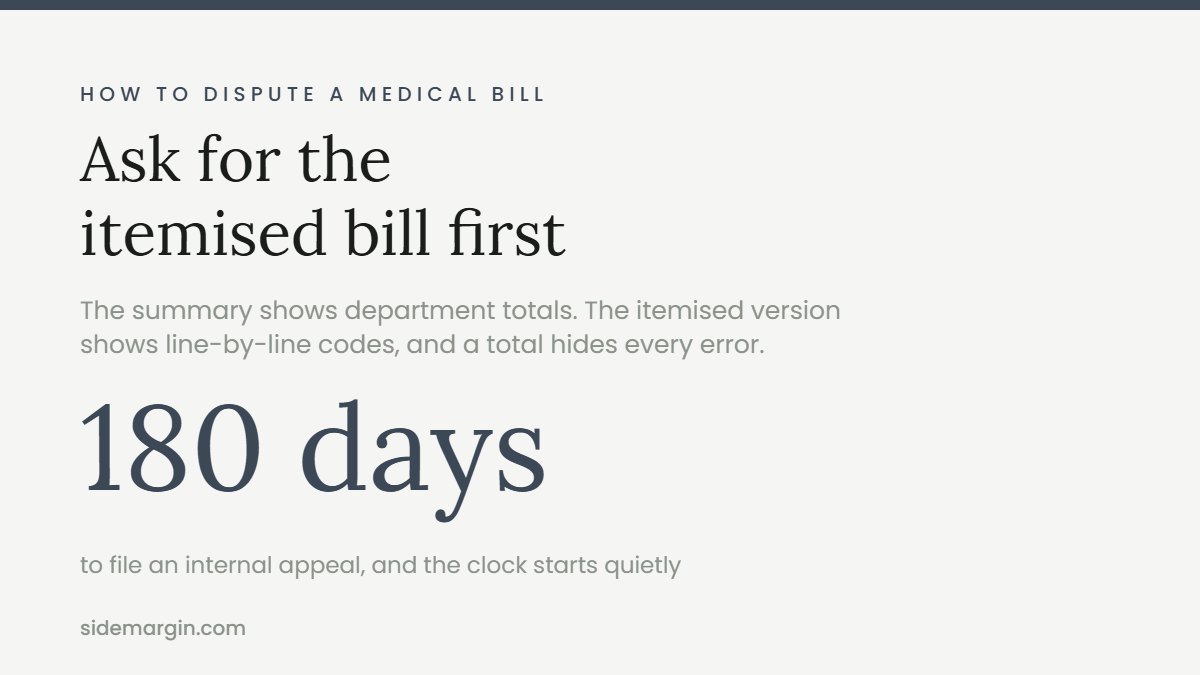
- Ask for the itemised bill first, always. The summary bill shows department totals. The itemised version shows the line-by-line codes, and you cannot find an error in a total.
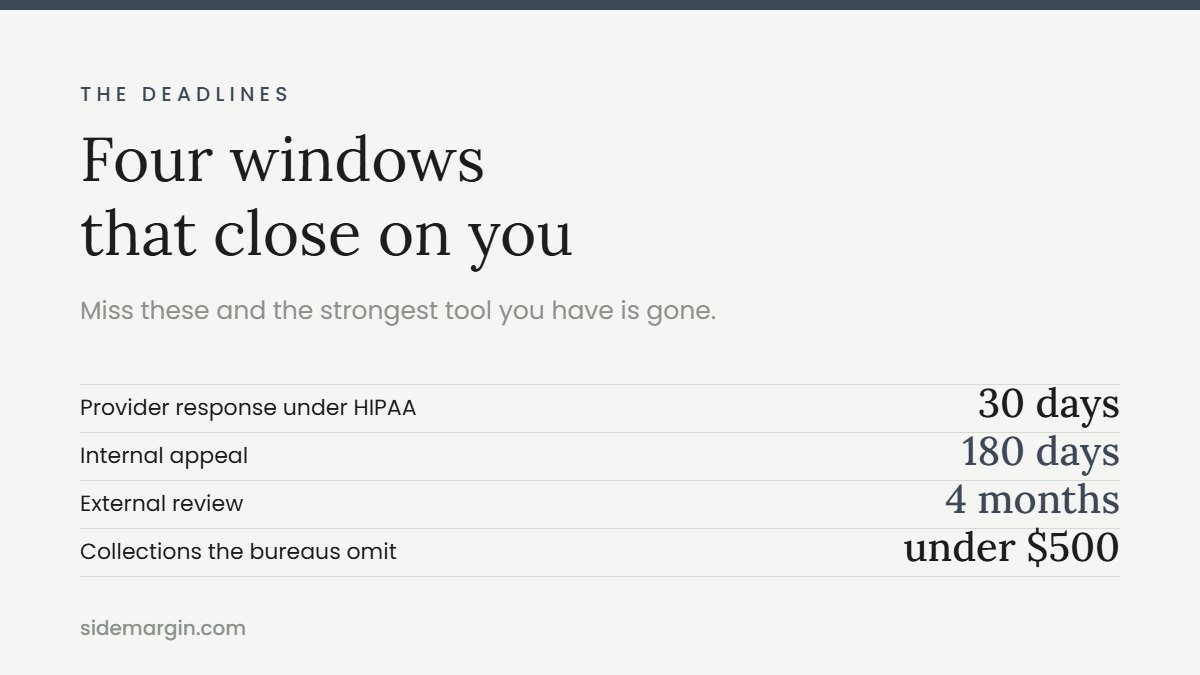
- HIPAA’s right of access covers billing records, not just clinical ones. The provider has 30 days to respond.
- Nonprofit hospitals must limit what they charge you if you qualify for financial assistance, to “not more than the amounts generally billed” to insured patients.
- Internal appeal: 180 days. External review: 4 months. Miss those windows and the strongest tool you have closes.
- The self-pay discount is a published number. Every US hospital must publish its “discounted cash price” under federal price transparency rules. You can look it up and quote it back.
- Medical debt can go on your credit report again. The CFPB rule banning it was vacated in July 2025, and in October 2025 the CFPB said state bans are preempted too.
- What still protects you is a voluntary bureau policy. Paid medical collections and those under $500 are not reported, because the bureaus choose not to, and they could reverse that.
- Never make a partial payment on an old debt without checking the statute of limitations. It can restart the clock.
How to dispute a medical bill, step one: get the itemised bill
What arrives in the post is usually a summary: “Pharmacy $4,812. Laboratory $2,140. Room and board $6,300.” You cannot audit that. The itemised statement lists every charge with its billing code, and that is the document errors live in.
Your right to it depends on who is paying.
On Medicare, it is a statutory right. Under 42 U.S.C. 1395b-7(b), “An individual may submit a written request to any physician, provider, supplier, or any other person … for an itemized statement for any item or service provided”, and the provider must furnish it “Not later than 30 days after the date on which a request … has been made”. Failure carries “a civil money penalty of not more than $100 for each such failure”.
Everyone else relies on HIPAA, and it works better than people assume. The usual belief is that HIPAA covers clinical records only. It does not. The “designated record set” at 45 CFR 164.501 expressly includes “The medical records and billing records about individuals maintained by or for a covered health care provider”. Under 45 CFR 164.524 you have “a right of access to inspect and obtain a copy” of that set, and the provider “must act on a request for access no later than 30 days after receipt”, with one 30 day extension available. They may charge “a reasonable, cost-based fee” for copying.
One honest limit: HIPAA gets you copies of records that exist. It does not compel a provider to build a new breakdown that they do not already hold. In practice this is rarely an obstacle, because the itemised detail exists in the billing system by definition.
Some states go further. New York’s Patients’ Bill of Rights says plainly: “You have a right to receive an itemized bill and explanation of all charges.”
Step two: read the codes
Every line on an itemised bill carries a code. CMS explains the two systems: HCPCS Level I “Comprised of Current Procedural Terminology (CPT), a numeric coding system maintained by the American Medical Association”, five digits long. Level II is “a standardized coding system that is used primarily to identify products, supplies, and services not included in the CPT codes, such as ambulance services or durable medical equipment”, one letter plus four digits.
You do not need to become a coder. You need to check a small number of things that are visible to anyone.
- Dates. Charges on days you were not there. Charges on the day you were discharged for a full day’s room and board.
- Quantities. Units are a common error. Two doses billed as twenty. This is the single most productive thing to check.
- Duplicates. The same code twice on the same day.
- Things that did not happen. A procedure you do not recognise, a consultation with a specialist you never met, anaesthesia for a procedure done under local.
- Routine supplies billed separately. Gloves, gowns and standard room items are usually meant to be included in the room rate.
The CFPB has warned specifically about several of these as potential Fair Debt Collection Practices Act violations, saying that “Companies cannot attempt to collect on medical bills that have already been paid by the consumer, insurance, or a government program” and that “Debt collectors must not attempt to collect medical debts unless they are substantiated”.
Step three: the insurance appeal, and its deadlines
If the problem is that your insurer denied or underpaid rather than that the provider overcharged, you have a two stage process with hard deadlines. These are the numbers to write down.
| Stage | Your deadline | Their deadline |
|---|---|---|
| Internal appeal | 180 days from the denial notice | 15 days for prior authorisation, 30 days for services already received, 72 hours for urgent care |
| Appeal decision | 30 days pre-service, 60 days post-service | |
| External review | 4 months from the final determination | 45 days standard, 72 hours expedited |
The external review is the underused one and it is the strongest. An independent reviewer, not your insurer, decides. And, in HealthCare.gov’s words, “Your insurer is required by law to accept the external reviewer’s decision.”
Where the federal government administers the process it is run by MAXIMUS Federal Services, reachable on 1-888-866-6205. Many states run their own; your denial letter has to tell you which applies.
Two practical notes. Ask your doctor for a letter of medical necessity before you file, because clinical reasoning from a clinician carries far more weight than the same argument from you. And appeal in writing even if you also call, because the 180 days is measured against a written record.
Step four: charity care, which is not charity
This is the most valuable and least used tool on the page. Nonprofit hospitals, which is most US hospitals, have obligations under section 501(r) of the tax code as a condition of tax exemption. They are not discretionary.
Every such hospital must have a written Financial Assistance Policy setting out “The eligibility criteria for financial assistance and whether such assistance includes free or discounted care”, “The basis for calculating amounts charged to patients” and “The method for applying for financial assistance”. It must “make the FAP, FAP application form, and plain language summary of the FAP widely available on a Web site” and provide paper copies free on request.
Then the limitation on charges at 26 CFR 1.501(r)-5. A hospital must limit what it charges a person eligible for assistance to “not more than the amounts generally billed to individuals who have insurance covering such care”, and “must charge a FAP-eligible individual less than the gross charges for any medical care”. The gross charge is the inflated list price that exists mainly as a negotiating fiction. If you qualify, the hospital may not bill it to you.
And the collections rules at 26 CFR 1.501(r)-6, which is the part to quote if you are being chased. A hospital must not engage in “extraordinary collection actions” against you “before the hospital facility has made reasonable efforts to determine whether the individual is eligible for assistance”. Those actions expressly include “Selling an individual’s debt to another party”, “Reporting adverse information about the individual to consumer credit reporting agencies”, denying medically necessary care pending payment, and legal process such as liens, garnishment or civil actions.
The two deadlines that matter:
- 240 days. The hospital may not set a financial assistance application deadline earlier than “240 days after the date that the first post-discharge billing statement for the previously provided care was provided”.
- 30 days. You must receive written notice “at least 30 days before first initiating one or more” extraordinary collection actions.
Almost nobody uses this. The nonprofit Dollar For reports that 52% of patients did not receive information about financial assistance from their hospital, and that 51% of those potentially eligible never apply. Eligibility frequently extends well above the poverty line: California, for example, raised its threshold to 400% of the federal poverty level.
Step five: negotiate from a published number
Most negotiation advice amounts to “ask nicely for a discount”. There is a better version, and it rests on a federal rule almost no patient knows about.
Under 45 CFR Part 180, every US hospital must publish its discounted cash price, defined as “the charge that applies to an individual who pays cash (or cash equivalent) for a hospital item or service”. It must also publish the gross charge, payer-specific negotiated charges, and the de-identified minimum and maximum negotiated charges, all with billing codes.
That means the self-pay discount is not a favour. It is a published price with a code attached, and you can find it before you ring. The conversation changes completely when you open with “your machine-readable file lists the discounted cash price for CPT 45378 as $X” rather than “is there anything you can do?”
Other things worth knowing. Ask about a payment plan before you ask for a discount, because interest-free plans are common and a plan in good standing usually stops collections activity. Get any agreement in writing before you pay anything. And be cautious with medical billing advocates: they typically charge a share of what they save, but I could not find a current authoritative fee survey, so ask for the fee structure in writing before engaging one.
Where medical debt and credit reports stand right now
This has changed twice in two years and most of what is written about it online is out of date. As of today the position is this: medical debt is reportable on credit reports under federal law.
- The CFPB finalised a rule banning medical debt from credit reports on 7 January 2025.
- That rule was vacated on 11 July 2025 by a federal court in Texas. Notably, the CFPB itself had joined the industry plaintiffs in asking the court to strike down its own rule. No appeal has been filed and the case has been dormant since.
- On 28 October 2025 the CFPB went further, issuing an interpretive rule holding that the Fair Credit Reporting Act “generally preempts State laws that touch on broad areas of credit reporting”, reversing its own 2022 position that had supported state authority.
- A collections trade group sued Colorado over its state ban on 5 November 2025. No ruling as of today.
So what actually protects you? Not a regulation. A voluntary policy the three bureaus adopted in 2022 and 2023, which the vacatur never touched. Equifax states the current position: medical collections “with an initial reported balance of under $500” were removed in April 2023, “Any medical collection debt that a consumer has paid in full is no longer included”, and the waiting period before unpaid medical collections of $500 or more appear went from six months to one year. Together those changes removed “nearly 70 percent of the total medical collection debt tradelines”.
The practical version: an unpaid medical collection of $500 or more, over a year old, can appear on your report today. Paid ones and sub-$500 ones do not, because the bureaus choose not to report them, and that is a policy they could change. Sixteen states restrict it, and whether those laws survive the preemption argument is now a live question in court.
One rule that has not changed and catches people every year. The CFPB warns that “Making a partial payment or acknowledging you owe an old debt, even after the statute of limitations expired, may restart the time period.” Most states run three to six years. And the limitations period is an affirmative defence: a collector suing on a time-barred debt is violating the FDCPA, but “a court may still award a judgment against you if you don’t show up and raise the statute of limitations as a defense.” If you are sued, turn up.
How to dispute a medical bill: the order to do it in
- Do not pay anything yet. Paying converts a disputed bill into a settled one.
- Request the itemised bill in writing. Cite HIPAA’s right of access, or the Medicare statute if it applies. Thirty days.
- Get your EOB from the insurer and lay the two side by side. The gaps between them are where the argument is.
- Check dates, quantities, duplicates and services you do not recognise.
- If the insurer is the problem, file the internal appeal. 180 days, in writing, with a letter of medical necessity.
- If that fails, file for external review. Four months. The decision binds your insurer.
- Ask the hospital for its Financial Assistance Policy and application. 240 days from your first bill.
- Look up the published discounted cash price before you negotiate anything.
- Get every agreement in writing before any money changes hands.
If the bill came from an out-of-network provider working inside an in-network facility, or from an emergency room, stop here and read surprise medical bills and the No Surprises Act first. In that situation federal law may cap what you owe outright, which is a much stronger position than disputing line items.
And if the underlying issue is that your plan does not cover what you assumed, the place to fix that is next autumn, with the open enrollment checklist and a clear head about the out-of-pocket maximum.
Legal position current as of 17 September 2026. The status of medical debt on credit reports is actively litigated and may change. This is general information, not legal or financial advice. For a specific dispute, a legal aid organisation or a state consumer protection office can help.
Sources
- 45 CFR 164.524, HIPAA right of access
- 45 CFR 164.501, designated record set including billing records
- Social Security Act section 1806, itemized statements for Medicare beneficiaries
- CMS, HCPCS coding system
- HealthCare.gov, internal appeals and deadlines
- HealthCare.gov, external review
- 29 CFR 2590.715-2719, internal claims and appeals and external review
- IRS, requirements for 501(c)(3) hospitals under section 501(r)
- 26 CFR 1.501(r)-4, financial assistance policy requirements
- 26 CFR 1.501(r)-5, limitation on charges and amounts generally billed
- 26 CFR 1.501(r)-6, extraordinary collection actions and the 240 day window
- 45 CFR Part 180, hospital price transparency and the discounted cash price
- CMS, Hospital Price Transparency
- CFPB, Regulation V medical debt rule and its current status
- CFPB interpretive rule, Fair Credit Reporting Act preemption of state laws, 90 FR 48710
- Georgetown Health Care Litigation Tracker, Cornerstone Credit Union League v. CFPB
- Equifax, current medical collection reporting policy
- Equifax, Experian and TransUnion, removal of medical collections under $500
- Commonwealth Fund, state action on medical debt, January 2026
- CFPB, statute of limitations on old debts
- CFPB, on double billing and inflated charges in medical debt collection
- Peterson-KFF, the burden of medical debt in the United States
- Dollar For, on charity care awareness and application rates
- California HCAI, Hospital Fair Billing Program
- New York Patients’ Bill of Rights