
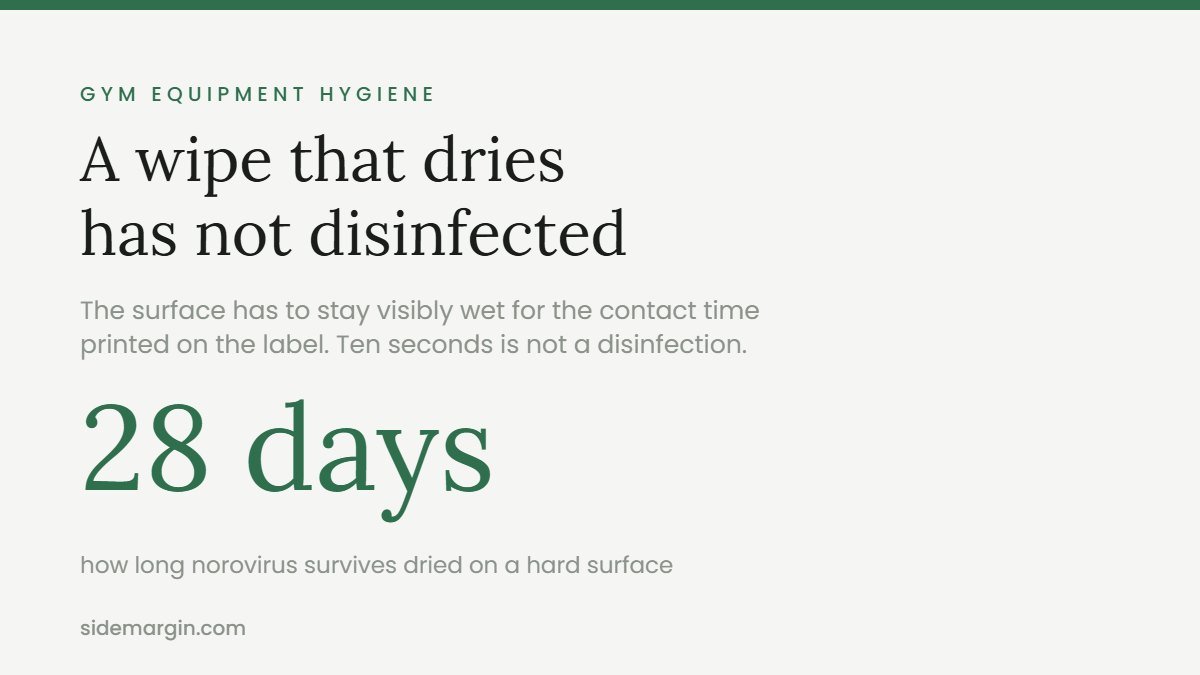
The wipe dispenser on the gym wall is doing less than you think. Most gym wipes are alcohol or quaternary ammonium based, and gym equipment hygiene has one awkward fact at its centre: neither of those kills the two organisms most worth worrying about on a shared surface. The CDC says so directly about norovirus. “Hand sanitizer does not work well against norovirus.”
Good gym equipment hygiene is not a reason to stop going to the gym. It is a reason to understand what a two second wipe actually accomplishes, which organisms survive it, and the one sequencing rule that makes the difference between cleaning and theatre.
Key takeaways
- Clean first, then disinfect. Disinfectant applied over visible soil or sweat does not work. The CDC’s own guidance specifies a cleaning step to remove material, then a disinfection step.
- Contact time is the number nobody reads. The surface has to stay visibly wet for the time on the label. A wipe that dries in ten seconds has not disinfected anything.
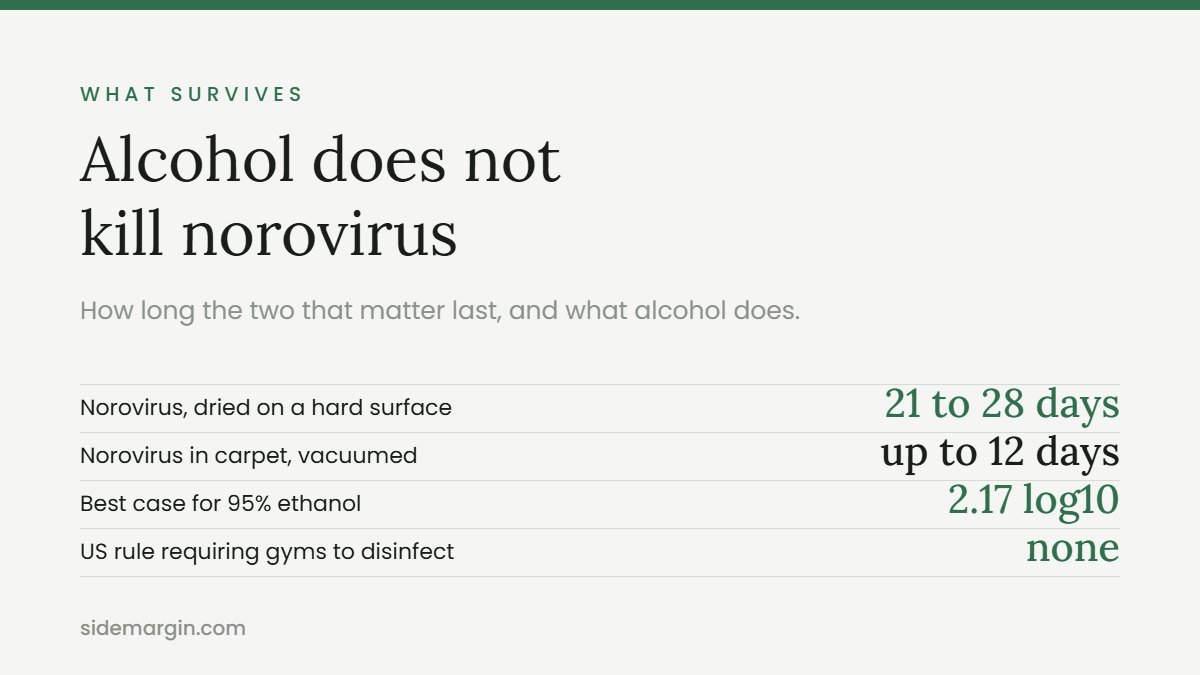
- Alcohol does not kill norovirus or C. difficile spores. Even 95% ethanol managed a maximum mean reduction of only 2.17 log10 in the CDC’s evidence review.
- Norovirus survives 21 to 28 days dried on a surface, and up to 12 days in carpet despite regular vacuuming.
- EPA List G covers norovirus. List K covers C. difficile. A product on neither can be excellent and still useless against those two.
- No US federal rule requires a gym to disinfect equipment for the next user. OSHA’s bloodborne pathogens standard protects staff, and even then only conditionally.
- Your hands matter more than the machine. Nothing gets in through intact skin on your palm. It gets in when you touch your face.
Gym equipment hygiene starts with what survives on a shared surface
The usual framing is that gyms are covered in bacteria, which is true, boring and mostly harmless. The useful question is narrower: which organisms persist long enough on a hard surface to reach the next person, and do ordinary cleaning products kill them?
| Organism | Survival on surfaces | Killed by alcohol? | EPA list |
|---|---|---|---|
| Norovirus | 21 to 28 days dried; up to 12 days in carpet | No | List G |
| C. difficile spores | Effectively indefinite. Viability falls only 0.5 log in 14 months | No | List K |
| E. coli | Months | Generally yes | |
| Shigella | Months | Generally yes | |
| Hepatitis A | About 2 months | Poorly |
The survival figures come from a systematic review of how long hospital pathogens persist on inanimate surfaces, which remains the standard reference. The C. difficile figure is from a 2023 review of environmental control in healthcare, and it is the one that surprises people: spores on an environmental surface lose only half a log of viability over fourteen months. They are not waiting you out. They are indifferent to you.
Two honest caveats before anyone panics. These figures come from healthcare settings where the organisms are present in quantity. A commercial gym is not a hospital ward, and the mere survival of an organism is not the same as an infectious dose reaching you. What the table tells you is not that your gym is dangerous. It tells you which products are capable of dealing with what, which is a different and more useful thing.
The one rule that matters: clean, then disinfect
If you take one thing from this article, take this. The CDC’s norovirus infection control evidence review describes the effective approach as “a two step process, a cleaning step to remove gross fecal material, followed by a 5000-ppm hypochlorite product with a one minute contact time”.
Substitute sweat, chalk, hand cream or sunscreen for the first part and the principle is identical. Organic material physically shields organisms from disinfectant. Spraying a disinfectant onto a soiled surface mostly disinfects the soil. This is why hospital cleaning protocols always have two steps and why the single swipe with one wipe that most of us do at the gym is, technically, the first step only.
The practical version, which takes about fifteen seconds:
- First wipe to remove. Take a wipe, clean the contact surfaces, throw it away. This one is doing mechanical removal, not chemistry.
- Second wipe to disinfect. A fresh wipe, same surfaces, leave them wet.
- Walk away and let it dry. The label’s contact time assumes the surface stays visibly wet for that long. If you wipe it dry with a towel, you have cancelled the step you just did.
That last point is the most commonly broken rule in every setting where disinfection happens, gyms included. Contact time is not a suggestion. It is the entire basis on which the product was tested and registered.
How to read a disinfectant label
The EPA maintains pathogen-specific lists of registered antimicrobial products, and they are the fastest way to find out whether something does what you need.
| EPA list | What it covers | Why it matters at a gym |
|---|---|---|
| List G | Norovirus (tested against feline calicivirus) | The main stomach bug that spreads on surfaces |
| List H | MRSA and VRE | Skin and soft tissue infections |
| List K | C. difficile spores | The hardest thing on this page to kill |
| List N | SARS-CoV-2 | Respiratory, mostly airborne rather than surface |
| List S | Bloodborne pathogens: HIV, hepatitis B, hepatitis C | The list that matters if there is blood |
For norovirus specifically, the CDC’s prevention guidance recommends “a chlorine bleach solution with a concentration of 1,000 to 5,000 ppm”, left in place “for at least 5 minutes”. Its infection control review notes that 6,000 ppm free chlorine with fifteen minutes of contact time achieved a 3 log10 reduction of human norovirus, which gives you a sense of how stubborn it is.
One useful alternative worth knowing about: hydrogen peroxide and peroxyacetic acid formulations are described in the 2023 C. difficile review as “rapidly sporicidal and are also effective against Candida auris, healthcare-associated pathogens (HAPs), norovirus and other viral pathogens, including corona viruses”. Quaternary ammonium compounds and accelerated hydrogen peroxide handle a lot of things but are not sporicidal. If you keep a wipe in your gym bag, an accelerated hydrogen peroxide product is a better general-purpose choice than an alcohol one.
Who is actually responsible for this
Here is the part most people assume wrongly. In the United States there is no federal standard requiring a gym, a studio or an event organiser to decontaminate shared equipment for the benefit of the next person who touches it.
What exists is the OSHA bloodborne pathogens standard, 29 CFR 1910.1030, and it is a worker protection rule. An OSHA interpretation letter addressing fitness centres directly states that “Fitness center employees normally are not considered to have ‘occupational exposure,’ and they are not covered by the standard unless they are trained in first aid and designated as responsible for rendering first aid.” Where the standard does apply, soiled items “must be placed and transported in specially marked bags that also prevent leakage.”
Read that carefully. The federal rule in this space protects the staff member who cleans up. It does not create a duty toward the member who uses the bench next. That duty, where it exists at all, comes from state and local health codes, the facility’s own policy, and ordinary negligence law.
Contrast that with swimming, which is regulated because the exposure is shared water. Under CDC guidance, a formed stool in a pool requires free chlorine at 2 ppm held for 25 to 30 minutes. A diarrhoeal incident triggers hyperchlorination for between 8.5 and 28 hours depending on the concentration used, because Cryptosporidium is “an extremely chlorine-tolerant parasite”. A pool closes. A gym floor gets a mop.
That gap between the two sectors is exactly what became visible when a competitive fitness event had to improvise a response in front of an audience, which is covered in the HYROX Beijing piece. The organisers there ended up replacing the course carpeting, which on the published evidence about norovirus persistence in carpet was the right call.
What to actually do, ranked by how much it helps
Ranked honestly, which means the boring one is first.
- Wash your hands with soap and water before you leave, and do not touch your face while you train. Nothing on this page gets through the intact skin of your palm. It gets in at your mouth, nose or eyes. Soap and water beats sanitiser for norovirus specifically, because sanitiser barely touches it.
- Use two wipes, and let it dry. One to remove, one to disinfect, then leave it. Fifteen seconds.
- Put a towel between you and the upholstery. Benches, mats and pads hold moisture in a way a steel bar does not. A barrier is more reliable than a wipe on a porous surface.
- Cover any open cut before you train. This is the one genuine skin-level risk and it is completely avoidable with a waterproof dressing.
- Do not train with a stomach bug, and give it 48 hours after symptoms stop. Norovirus shedding continues after you feel better. This single habit protects more people than every wipe in the building.
- Do not put your phone or your water bottle on the equipment. They go home with you and then to your face. The machine does not.
What the evidence does not say
Being straight about the limits of this is more useful than overclaiming, and there are three places where the confident internet advice runs ahead of the published evidence.
Nobody has measured how much infection actually starts on gym equipment. Swab studies find organisms on barbells and treadmill handles, which is unsurprising, because swab studies find organisms on everything. Finding an organism is not the same as demonstrating transmission, and I could not locate a study that traces a defined outbreak to commercial gym equipment. Where transmission at exercise events has been documented, it has been through shared water rather than shared metal. The CDC recorded 22 campylobacteriosis cases after a 2012 obstacle race in Nevada, with an odds ratio of 19.4 for swallowing muddy course water.
Infectious dose figures are shakier than they look. You will see it written that eighteen norovirus particles are enough to infect you. That number is repeated everywhere and I could not stand it up against a primary source. What a CDC human challenge study does show is that infection occurred at the lowest dose tested, which is the honest way to put it. It is a very low dose. Precisely how low is not settled.
Athlete’s foot and ringworm are a different problem with a different answer. Those are fungal and they travel on wet floors, not on the leg press. Footwear in the changing room and drying properly afterwards does far more than any surface wipe. That is a separate subject and it deserves a separate look at the evidence rather than a confident paragraph here.
Worth adding, because it is the part that costs money rather than comfort: if a skin infection does send you to urgent care, an out-of-network doctor working inside an in-network facility is exactly the situation federal law now covers. What that protection reaches and what it does not is set out in the guide to surprise medical bills.
Gym equipment hygiene: what to ask your gym
If you want to know whether a facility is serious rather than decorative about this, three questions will tell you nearly everything, and none of them are confrontational.
- “What product is in the wipe dispensers, and what is its contact time?” Staff who know the answer work somewhere with a real protocol. The contact time also tells you what the product can realistically claim.
- “Is it on EPA List G?” If the answer is yes, they have thought about norovirus. If the answer is a blank look, they have not.
- “What happens if someone is sick on the floor?” A facility with a written procedure will describe it. One without will describe a mop.
None of this should stop anyone training. The health benefit of going to the gym vastly outweighs the surface risk, and that is not a close call. The point is simply that the fifteen second version of cleaning is meaningfully better than the two second version, costs nothing, and the difference is entirely in the sequence rather than the effort.
One last practical note. If you have decided the facility is not up to standard and you want out, gym contracts are among the harder consumer agreements to exit cleanly, and the method matters. The cancellation guide covers what actually works.
Guidance current as of 17 September 2026, from CDC, EPA and OSHA published sources. This is general information, not medical advice. If you have an open wound, a spreading skin infection or a persistent gastrointestinal illness, speak to a clinician rather than a blog.
Sources
- CDC, Preventing norovirus, including bleach concentrations and contact time
- CDC, Norovirus infection control guideline evidence review
- Kramer, Schwebke and Kampf, How long do nosocomial pathogens persist on inanimate surfaces? BMC Infectious Diseases
- Carling, Parry and Olmstead, Environmental approaches to controlling Clostridioides difficile infection, 2023
- EPA, Selected registered disinfectants and the pathogen lists
- EPA List G, products effective against norovirus
- EPA List K, products effective against C. difficile spores
- OSHA, Bloodborne Pathogens standard 29 CFR 1910.1030
- OSHA, standard interpretation on fitness centres and laundry
- CDC, Fecal incident response guidelines for aquatic facilities
- CDC, Model Aquatic Health Code