
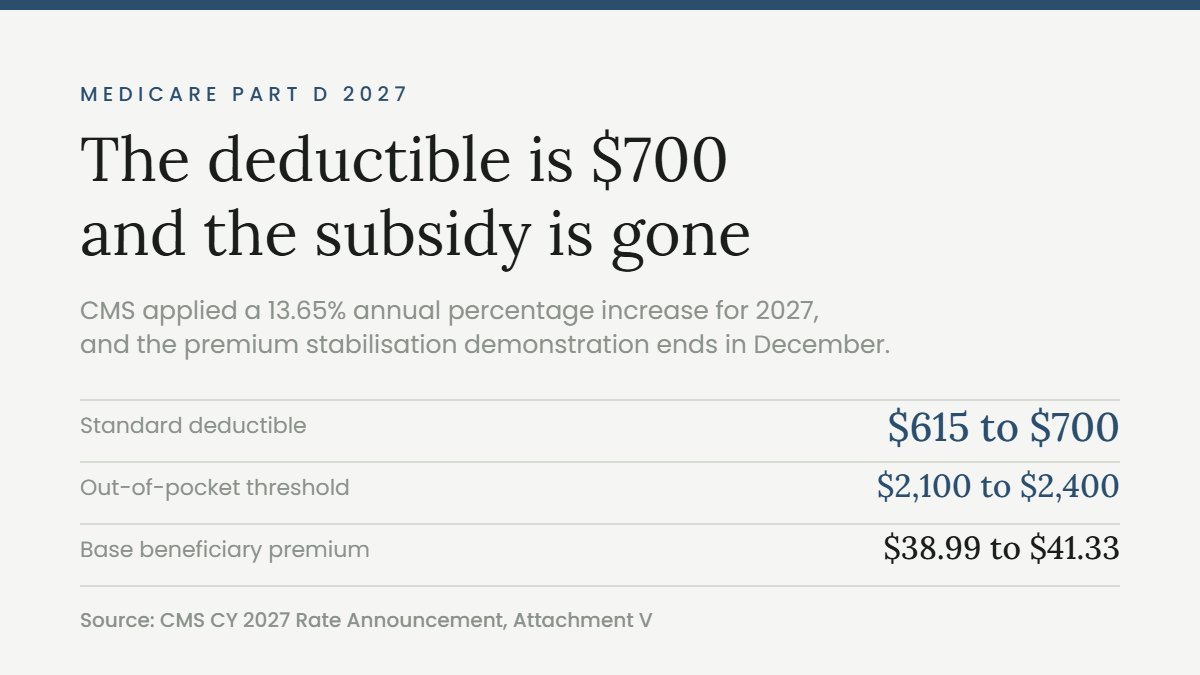
If you take prescription drugs on Medicare, the Medicare Part D plans you can choose for 2027 changed in two ways that pull in opposite directions. The protection got better: the cap on what you pay out of pocket rose to $2,400, and a second round of negotiated drug prices starts on 1 January. The price got worse, because the federal subsidy that has been quietly holding standalone drug plan premiums down for three years ends on 31 December 2026.
Almost every guide to the Annual Enrollment Period tells you to compare plans. Very few explain why the numbers you are comparing moved, which is the part that tells you where to look.
Key takeaways
- The 2027 standard deductible is $700, up from $615. The out-of-pocket threshold is $2,400, up from $2,100. Both come straight from CMS Attachment V.
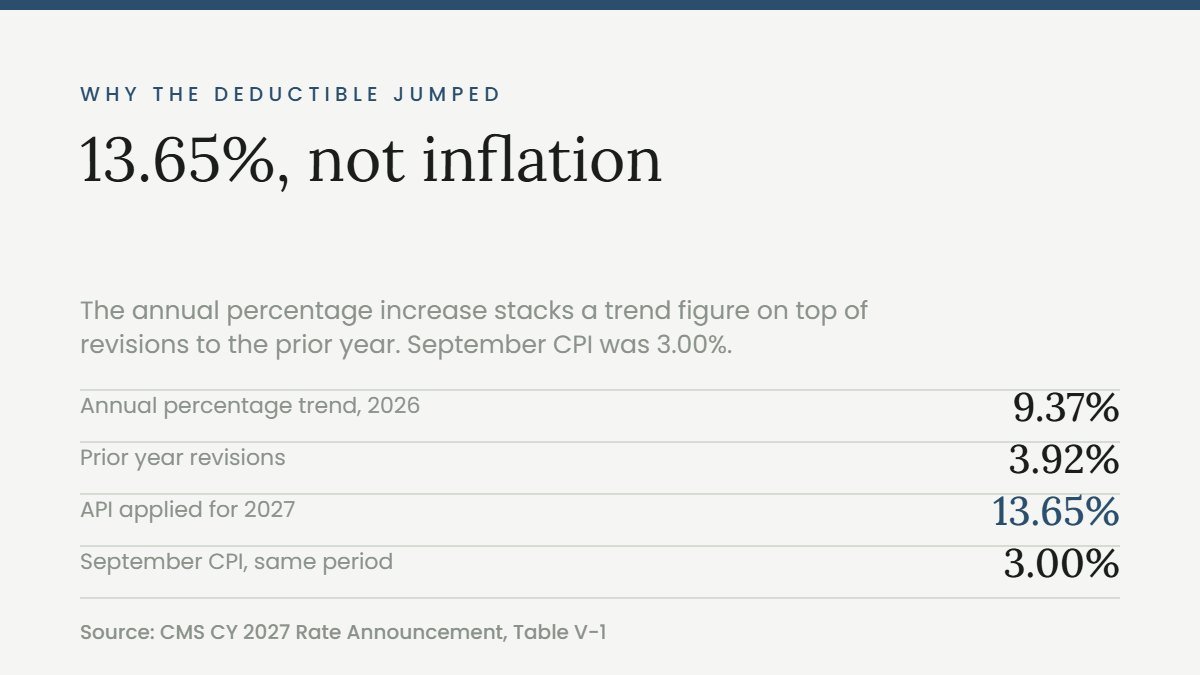
- Those jumps are not inflation. The annual percentage increase CMS applied for 2027 is 13.65%, because a 9.37% trend was stacked on a 3.92% prior year revision.
- The premium stabilisation demonstration ends after 2026. CMS is explicit: it will “return the program to operating under traditional market conditions in CY 2027.” That demonstration was cutting average standalone premiums by about $16 a month this year.
- The late enrolment penalty quietly rises every single year, even if your months never change, because it is a percentage of a base premium that went from $38.99 to $41.33.
- Fifteen more drugs get negotiated prices on 1 January 2027, including Ozempic, Rybelsus and Wegovy. If you take one, the plan comparison you did last year is worthless.
The 2027 Medicare Part D numbers, and where they come from
CMS publishes the defined standard benefit parameters in Attachment V of the annual Rate Announcement. Most consumer coverage quotes the figures without the table they sit in, which matters because the table also shows the mechanism.
| Parameter | 2026 | 2027 |
|---|---|---|
| Standard benefit deductible | $615 | $700 |
| Out-of-pocket threshold | $2,100 | $2,400 |
| Base beneficiary premium | $38.99 | $41.33 |
| National average monthly bid | $239.27 | $296.05 |
The deductible and the threshold are not set by judgement. CMS multiplies the prior year figures by an annual percentage increase, and for 2027 that increase is 13.65%. The same table shows how it was built: a 9.37% annual percentage trend for 2026, plus 3.92% of prior year revisions. September CPI over the same period was 3.00%.
That gap is the whole explanation for why your deductible rose $85 in a year when general inflation was around three percent. Drug spending trend, not consumer prices, drives this number, and the revision component means a bad estimate in one year lands in the next year’s deductible.
The national average monthly bid rose from $239.27 to $296.05, a 23.7% increase. That is the number plans themselves submitted, and it is the clearest signal of what happens next.
The subsidy that was holding Part D premiums down is ending
This is the part almost nobody connects, and it is the single most useful thing to understand before you compare Medicare Part D plans for 2027.
When the Inflation Reduction Act redesigned Part D, standalone drug plans faced a much larger share of catastrophic costs. CMS responded with a voluntary Part D Premium Stabilisation Demonstration, which did two things: it knocked a flat amount off the base beneficiary premium, and it capped how much any individual plan could raise its premium year over year.
It worked. The demonstration reduced average standalone plan premiums by roughly $26 a month in 2025 and about $16 a month in 2026, at a cost to taxpayers of about $9.8 billion across the two years.
It is over. CMS states it plainly in the 2027 bid announcement: “CMS will discontinue the demonstration at the end of CY 2026 to return the program to operating under traditional market conditions in CY 2027.”
Two consequences follow. First, the year-over-year premium cap goes away, so a plan that was legally prevented from raising your premium by more than a set amount is no longer prevented. Second, the artificial discount on the base premium disappears at the same time. If your standalone drug plan premium looks worse than any increase you remember, this is why, and it is not specific to your plan.
Choice is also narrowing. The number of standalone drug plans has fallen for three consecutive years, and the average beneficiary went from 14 plan choices in 2025 to 11 in 2026.
The late enrolment penalty gets more expensive without you doing anything
The Part D late enrolment penalty is widely described as a one-off consequence of signing up late. It is not. It is a permanent surcharge that is recalculated every year, and it goes up on its own.
Medicare states the formula directly: the penalty is 1% of the national base beneficiary premium, multiplied by the number of full uncovered months, rounded to the nearest ten cents and added to your monthly premium.
Read that again with the 2027 base premium in hand. The base was $38.99 in 2026 and is $41.33 in 2027. Someone who went 24 months without creditable coverage pays 24% of the base. That is $9.40 a month in 2026 and $9.90 a month in 2027, for exactly the same 24 months of history. Medicare says so openly: “The ‘national base beneficiary premium’ may go up each year, so your penalty amount may also go up each year.”
The penalty never expires. There is one way to avoid it entirely, and it is worth knowing precisely: months covered by creditable coverage never count against you, no matter how many years pass. Employer or union retiree drug coverage, TRICARE and VA coverage typically qualify, and the sponsor must tell you annually in writing whether your coverage is creditable. The clock only starts after a gap of 63 days or longer.
Keep those annual creditable coverage letters. They are the evidence that stops a penalty being assessed.
Fifteen more drugs get negotiated prices on 1 January 2027
The first ten Medicare-negotiated prices took effect on 1 January 2026. The second group of fifteen takes effect on 1 January 2027, which is the plan year you are choosing right now.
The 2027 list is: Austedo, Breo Ellipta, Calquence, Ibrance, Janumet, Linzess, Ofev, Otezla, Ozempic, Rybelsus and Wegovy (negotiated as one), Pomalyst, Tradjenta, Trelegy Ellipta, Vraylar, Xifaxan and Xtandi.
The negotiated maximum fair price applies across every Part D plan, not just some. That has a practical consequence people miss: if one of these drugs is the reason you picked your current plan, the reason may have evaporated. Plans differentiate themselves on the prices they negotiate, and on a drug where the price is now set federally they cannot. Re-run the comparison with 2027 data rather than assuming last year’s winner still wins.
The comparison mistake that costs the most
Medicare’s Plan Finder ranks plans by combined premium and drug cost once you enter your medications and your pharmacies. The expensive errors are both errors of omission.
Leaving a drug off the list. Consumer Reports ran the same comparison twice, once omitting a single medication. The plan showed an annual cost of $250.80 with the drug left out and $759.60 with it added. One omission, a $509 error, and nothing on screen warns you.
Not checking which pharmacy is preferred. Preferred and standard pharmacies inside the same plan carry different cost sharing by design. In one worked example the identical drug list cost $276.60 a year at a preferred pharmacy and $513.00 at a standard one, same plan, same drugs. A pharmacy that is preferred under one plan is frequently standard under another, so this has to be checked per plan rather than once.
Enter every medication with its exact dose, enter the pharmacies you would actually use, and compare total annual cost rather than the monthly premium. The cheapest premium and the cheapest year are routinely different plans.
The Medicare Prescription Payment Plan, and when it backfires
Every Part D plan must offer this option. It spreads your out-of-pocket drug costs into interest-free monthly instalments across the rest of the calendar year instead of charging you at the counter.
Medicare is unusually blunt that it is not a discount: “This payment option might help you manage your expenses, but it doesn’t save you money or lower your drug costs.”
It helps one specific person: someone who hits a large cost early in the year, typically a January fill that consumes the whole $700 deductible at once, and would rather spread that over twelve months. Medicare says it is most useful if “you decide to participate in this payment option early in the calendar year (like before September).”
The trap is the reverse case. Join in November and your balance is divided across the one or two months left in the year, which is a lump sum with extra steps. Medicare warns that it “may not be the best choice for you if you sign up late in the calendar year (after September).” If you already receive Medicare Extra Help, Medicare says you probably will not benefit at all, because your copays are already capped at a few dollars.
One thing is genuinely unclear, and it is worth saying rather than guessing: Medicare’s own consumer pages do not state whether participation carries over automatically into the next plan year or has to be elected again. If you are in the programme now, ask your plan directly before January.
If a letter arrives in November, read it
People who receive Extra Help and never actively chose their own plan can be reassigned by CMS to a different drug plan. Reassignment happens when a plan leaves Medicare, or when it raises its premium above the regional low-income subsidy benchmark. The point is to protect the $0 premium.
These notices go out on blue paper in mid-November, with a second blue letter in early December confirming whether your current medications are on the new plan’s formulary. A tan notice means you are staying put but facing a premium increase. The deadline to act is 31 December, and doing nothing means the reassignment takes effect on 1 January.
One distinction decides whether this applies to you. If you chose your own plan, you are not reassigned, even if its premium rises above the benchmark. You keep the plan and you pay the difference. With the stabilisation demonstration ending, more plans are likely to cross that benchmark this year than in recent ones.
What to do, in order
- Find your Annual Notice of Change. It should have arrived by 30 September. The premium, the deductible and the formulary are the three lines that matter.
- Re-run Plan Finder with 2027 data, every drug, every dose, your actual pharmacies. Do not reuse last year’s result.
- Check whether any of your drugs is on the 2027 negotiated list. If so, the plan ranking probably moved.
- Check whether you qualify for Extra Help before you pay a premium you do not have to. The income and resource limits are higher than most people assume.
- Decide by 7 December. After that the next chance to change a standalone drug plan is limited, and the details are in the Medicare open enrollment guide.
One last thing, because it catches people who are otherwise doing everything right. If you are weighing a Medicare Advantage plan with drug coverage against Original Medicare plus a standalone plan, understand the Medicare Part C one-way door before you move. Leaving Medicare Advantage later is not symmetrical with joining it, and drug coverage is rarely the part of that decision that hurts.
And if money is tight, the Medicare Savings Programs sit alongside Extra Help and are applied for on much the same evidence.
Figures current as of 16 September 2026, from the CMS CY 2027 Rate Announcement and the July 2026 Part D bid fact sheet. The 2027 Part D income-related adjustment brackets have not been published yet and are expected in mid-November, which is after enrolment opens.
Sources
- CMS, Announcement of CY 2027 Medicare Advantage Capitation Rates and Part D Payment Policies, Attachment V
- CMS, Medicare Part D 2027 National Average Monthly Bid Amount Information, 28 July 2026
- Medicare.gov, Part D late enrollment penalty
- CMS, Creditable Coverage
- Medicare.gov, Medicare Prescription Payment Plan
- CMS, Reassignment to a new Medicare drug plan
- KFF, Key Facts About Medicare Drug Price Negotiation
- KFF, on the end of the Part D premium stabilisation demonstration
- Consumer Reports, How to Find the Best Medicare Part D Drug Plan