
The Obamacare income limits for 2027 coverage are easy to state and easy to get wrong, because the number that matters is not what you earn today. It is what you will have earned by 31 December 2027, and you have to guess it in November 2026.
That guess used to be forgiving. A law signed on 4 July 2025 removed the cushion, starting with the tax year that began this January. Almost nobody has connected that change to the income estimate people are about to type into healthcare.gov.
Key takeaways
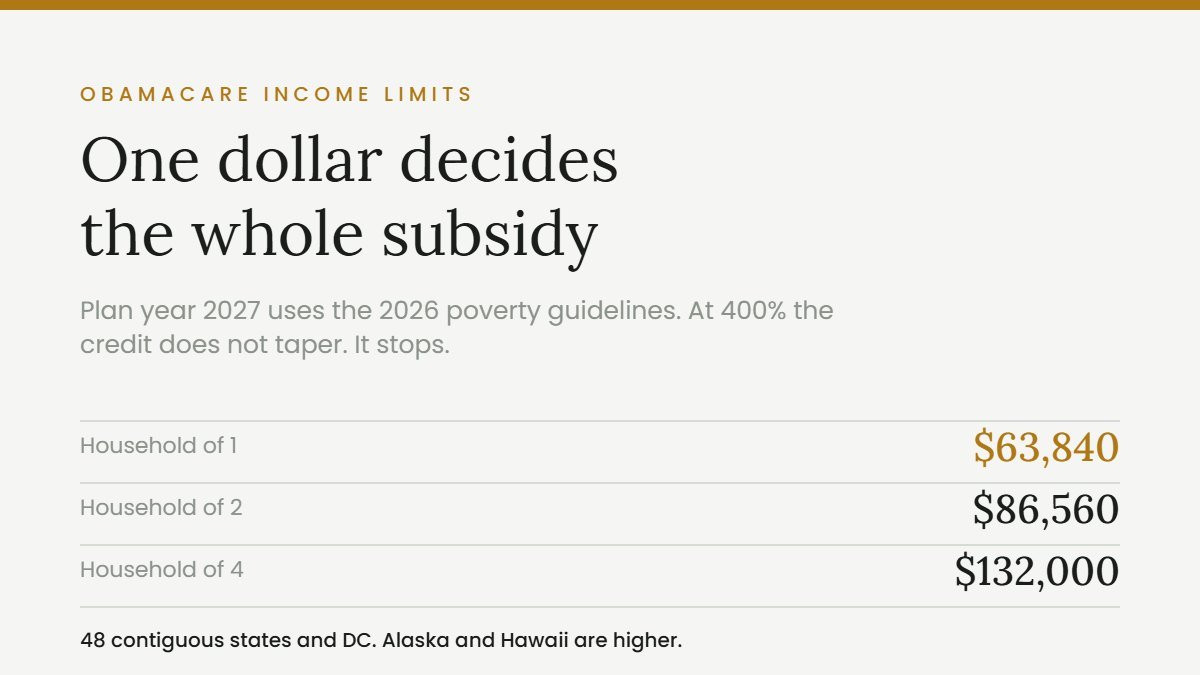
- For 2027 coverage, the cliff is $63,840 for one person and $132,000 for a household of four. Plan year 2027 uses the 2026 poverty guidelines, not 2027 ones.
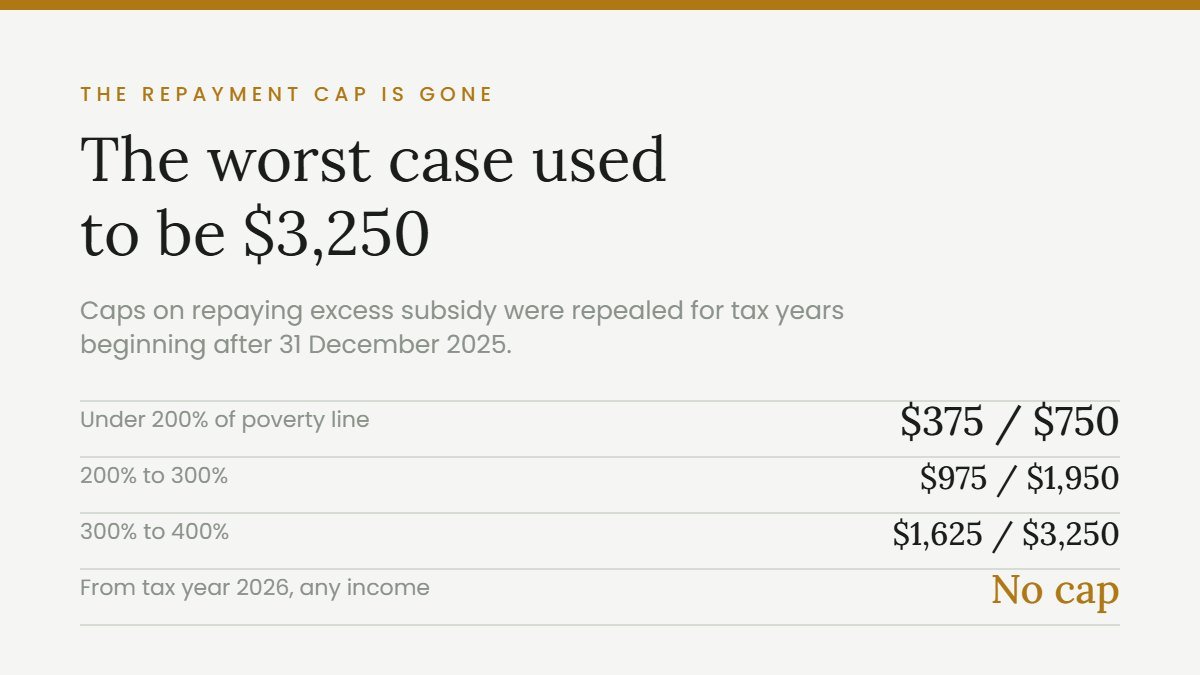
- The caps on repaying excess subsidy are gone. They were repealed by Public Law 119-21, section 71305, effective for tax years beginning after 31 December 2025.
- The repeal did not invent unlimited repayment. People over 400% always faced it. The repeal extended it down to every income level.
- The worst case under the old rules was $3,250. There is now no worst case, because the amount you can owe equals the whole subsidy you received.
- Your first exposure is the return you file in early 2027, for tax year 2026. It is already running.
- Obamacare income limits are measured on modified adjusted gross income, which is not your take-home pay and not the number on your payslip.
The 2027 Obamacare income limits, in dollars
Marketplace eligibility for a plan year uses the poverty guidelines in effect when open enrollment opens. Open enrollment for 2027 opens on 1 November 2026, so 2027 coverage runs on the 2026 guidelines. Here they are for the 48 contiguous states and the District of Columbia.
| Household size | 100% of poverty line | 400% (the cliff) |
|---|---|---|
| 1 | $15,960 | $63,840 |
| 2 | $21,640 | $86,560 |
| 3 | $27,320 | $109,280 |
| 4 | $33,000 | $132,000 |
| 5 | $38,680 | $154,720 |
| 6 | $44,360 | $177,440 |
| 7 | $50,040 | $200,160 |
| 8 | $55,720 | $222,880 |
The 400% column is the one people mean when they say Obamacare income limits. Three other lines on the same scale change what you get rather than whether you get it:
| Threshold | 1 person | Family of 4 |
|---|---|---|
| 138%, Medicaid in expansion states | $22,025 | $45,540 |
| 250%, cost sharing reductions end | $39,900 | $82,500 |
| 400%, all credits end | $63,840 | $132,000 |
The 250% line is the one people forget. Cost sharing reductions cut your deductible and out of pocket maximum, they only attach to silver plans, and they stop dead at 250%. Someone at 245% of the poverty line on a silver plan is holding a meaningfully different product from someone at 255% holding the same plan name.
What changed for the Obamacare income limits in July 2025
When you buy a marketplace plan, the subsidy is usually paid in advance, monthly, directly to your insurer, based on the income you estimated. At tax time you reconcile: your actual income is compared with your estimate on Form 8962, and if you were paid too much you repay the difference.
Until tax year 2025, that repayment was capped for anyone under 400% of the poverty line. The caps sat in section 36B(f)(2)(B) of the tax code and looked like this:
| Income (% of poverty line) | Single | Everyone else |
|---|---|---|
| Under 200% | $375 | $750 |
| 200% to under 300% | $975 | $1,950 |
| 300% to under 400% | $1,625 | $3,250 |
| 400% or more | No limit | |
Public Law 119-21, section 71305, struck subparagraph (B). The provision was enacted on 4 July 2025 and applies to taxable years beginning after 31 December 2025. Section 36B(f)(2) now says only that your tax is increased by the amount of the excess. There is no limitation clause left in it.
The IRS states it without hedging: there is no repayment cap for tax years after 2025, and you must repay the full amount by which your advance payments exceeded your actual credit. The excess is added to your total tax liability, which reduces your refund or increases your balance due.
The part almost everyone gets backwards
Look at the bottom row of that table again. “400% or more: no limit” already existed. Unlimited repayment is not new. It has been the rule for people above the cliff since 2014.
What the repeal did was extend that existing rule downward, to every income level. The population newly exposed is not high earners. It is the gig worker at 180% of the poverty line whose December was better than expected, the person who picked up overtime, the freelancer whose invoice cleared in the wrong year.
And the exposure is now unbounded in a way that planning cannot fix, because what you can owe equals the subsidy you actually received, and that scales with your age and where you live. A couple in their sixties in a high cost rating area can receive well over $2,000 a month in advance credits. Under the old rules, if they finished the year at 380% of the poverty line and had estimated 340%, the most they could owe was $3,250. Under the current rules, if they finish at 401%, they owe all of it. That is a five figure bill generated by one dollar of income.
What those limits do to the premium itself, including the 15% median increase insurers filed for 2027, is covered in the ACA subsidy guide.
What you pay at each point on the scale
The Obamacare income limits decide eligibility. A second table, set by the IRS every year, decides the amount. For 2027 it is in Revenue Procedure 2026-26, and it works by naming the share of your income you are expected to pay for the benchmark silver plan in your area. The credit covers whatever that plan costs above that share.
| Income (% of poverty line) | Your expected share, 2027 |
|---|---|
| Under 133% | 2.15% |
| 133% to under 150% | 3.23% rising to 4.30% |
| 150% to under 200% | 4.30% rising to 6.78% |
| 200% to under 250% | 6.78% rising to 8.66% |
| 250% to under 300% | 8.66% rising to 10.22% |
| 300% to 400% | 10.22% |
| Over 400% | Everything |
Two things fall out of this that make the Obamacare income limits behave differently from most tax thresholds.
First, the credit is bigger where plans cost more and where you are older, because it is the gap between the benchmark premium and your expected share. Two people with identical income can have very different amounts at risk in reconciliation. That is why there is no single answer to “how much could I owe”.
Second, every other income threshold in the tax code phases out. This one does not. Going from 399% to 401% of the poverty line does not taper your credit. It deletes it. Combined with the repayment repeal, the same single dollar now both removes the subsidy and makes the whole year’s advance payments repayable.
A worked example of the Obamacare income limits
Take a self employed single person who estimated $52,000 for 2026 and received $420 a month in advance credits, so $5,040 across the year. In December a client pays two overdue invoices and the year closes at $64,200.
- Under the 2025 rules: at 300% to 400% of the poverty line the cap was $1,625 for a single filer. Over 400%, no cap. At $64,200 they are over the cliff, so they owed the full $5,040. The caps never protected this person.
- Under the 2026 rules, if the invoices had landed differently and the year closed at $60,000, they are at roughly 376% of the poverty line. In 2025 their repayment would have been capped at $1,625. In 2026 there is no cap, and the excess is repayable in full.
That is the change in one sentence: the person who was under the cliff used to be protected, and is not any more.
Which income the Obamacare income limits actually measure
The marketplace uses modified adjusted gross income for the whole tax household, not gross pay and not taxable income after deductions. In broad terms it is adjusted gross income plus three things that are added back: tax exempt interest, the untaxed portion of Social Security benefits, and excluded foreign earned income.
Some consequences that catch people out:
- A Roth conversion is income. Converting in December can push you over the cliff for a year you have already lived.
- Capital gains are income. Selling a stock or a second property counts, in the year the sale closes.
- Untaxed Social Security still counts here, even though it does not count on your tax return.
- It is household income, not yours. A spouse’s bonus or a dependent’s earnings above their filing threshold can move you across a line you were nowhere near on your own.
- Standard and itemised deductions do not reduce it. The number sits above them.
The levers that genuinely lower it are the ones that operate before adjusted gross income is struck: traditional 401(k) and IRA contributions, HSA contributions, and for the self employed, the deductible half of self employment tax, self employed retirement plan contributions and the self employed health insurance deduction.
Two of those levers have rules of their own. The 2027 HSA contribution limits are already final, and if you are self employed, your quarterly estimated tax payments are worked out from the same income figure.
What to do about it
- Estimate high, not low. Under-estimating now means repaying later with no ceiling. Over-estimating means a smaller advance credit and a refund of the difference when you file. The two errors are no longer symmetrical, and they used to be.
- Report income changes to the marketplace during the year, not at tax time. The advance credit is recalculated from that point forward and the reconciliation shrinks. This is the single most effective thing on this list and it is free.
- If you are within about 10% of the cliff, decide in November how you will stay under it, and keep the contribution room to do it. Deciding in December is late. Deciding in April is impossible.
- Check the whole household’s numbers, not just yours. The Obamacare income limits are household limits and a dependent’s summer job can move them.
- Time discretionary income events deliberately. A Roth conversion, a property sale or an option exercise is a choice about which tax year the money lands in, and now also a choice about your subsidy.
One thing that did not change
If your advance credit turns out to have been too small, you still get the difference back when you file. The repeal was one directional: it removed the ceiling on what you can owe, not the floor on what you can be refunded. That is precisely why estimating on the high side is now the conservative choice.
And a caveat that applies to this entire article: the Obamacare income limits above assume the enhanced premium tax credits stay expired. Extending them has been live in Congress throughout 2026. If that happens before January, the 400% cliff is the first thing to go, and the repayment exposure described here changes shape with it.
Current as of 13 September 2026. The 2026 Form 8962 and its instructions had not been published when this was written, so the repayment repeal above is cited to the statute and to IRS Fact Sheet 2025-10 rather than to the form.
Sources
- 26 U.S.C. 36B, with amendment notes for Pub. L. 119-21
- IRS Fact Sheet 2025-10, statutory revisions to premium tax credit reconciliation and eligibility
- IRS, Instructions for Form 8962, tax year 2025, repayment limitation table
- healthcare.gov, dates and deadlines
- IRS Revenue Procedure 2026-26, applicable percentage table for 2027
- Center on Budget and Policy Priorities on the repayment cap repeal