
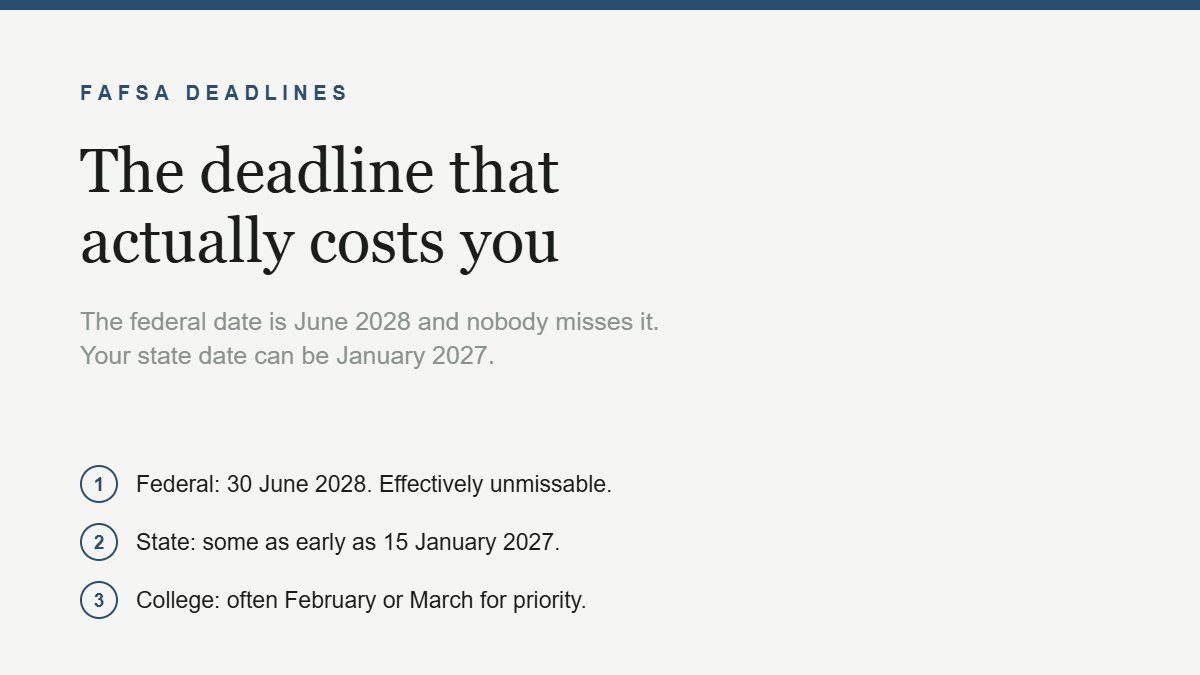
The federal FAFSA deadline for the 2027–28 school year is 11:59 p.m. Central on 30 June 2028. That is the date everyone quotes, and it is the one that matters least. By the time it arrives the school year it pays for is already over.
The deadlines that actually cost families money sit as much as eighteen months earlier, and thirteen state programs do not have a date at all. They pay out until the money is gone.
There is also something happening right now that almost nobody outside financial aid offices knows about: you can file the 2027–28 FAFSA today, three weeks before it officially opens, and it counts.
There are three FAFSA deadlines, not one
This is where most of the confusion starts. Federal Student Aid publishes three separate sets of dates and they behave completely differently.
| Deadline | 2027–28 date | What happens if you miss it |
|---|---|---|
| Federal | 30 June 2028 | You lose federal aid for a year that has already finished. Effectively no one hits this. |
| State | Varies wildly. Some as early as 15 January 2027. Thirteen have no date and award until funds run out. | You lose state grant money. This is the expensive one. |
| College | Set by each school. Often February or March for priority consideration. | You drop out of the priority pool for the school’s own grants and work study. |
If you only remember one thing from this article, remember that the federal deadline is a formality and the state deadline is where the money goes.
You can file the 2027–28 FAFSA right now
The 2027–28 FAFSA is scheduled to open publicly on 1 October 2026. Education Secretary Linda McMahon “certified to Congressional leaders that the FAFSA will launch by October 1, 2026.”
But the Department of Education has been running the form in beta since 5 August 2026, and the second phase is open to the public.
Here is the part that matters. These are not practice runs. NASFAA reported on 26 August 2026 that “during this beta testing period, students and parents are submitting real 2027-28 FAFSAs, which will be sent to institutions indicated by the applicant.”
The Department’s own announcement confirms it. Beta applicants “can include up to 20 institutions’ school codes on the form” and schools receive “students’ official 2027–28 ISIRs, which institutions should use as the basis for packaging aid.” An ISIR is the record your college uses to build your aid package. If your school has one for you, you are in the queue.
- Beta 1 ran from 5 August with “17 organizations in seven states”, which submitted “almost 2,000 forms”.
- Beta 2 opened in late August. The Department’s wording: “Any student or parent will be able to request to participate.” It expects “tens of thousands of more FAFSAs to be submitted before the official October 1 launch date.”
You request access on StudentAid.gov. Given how much state aid runs first come first served, filing three weeks early is not a small edge.
One honest caveat. A beta is a beta. If something goes wrong with your form you are further from a settled system than a filer in November will be. Anyone with a straightforward situation should file now. Anyone with a complicated one, an unusual family structure or an amended tax return, might reasonably wait for the public launch.
Why filing early is the whole game
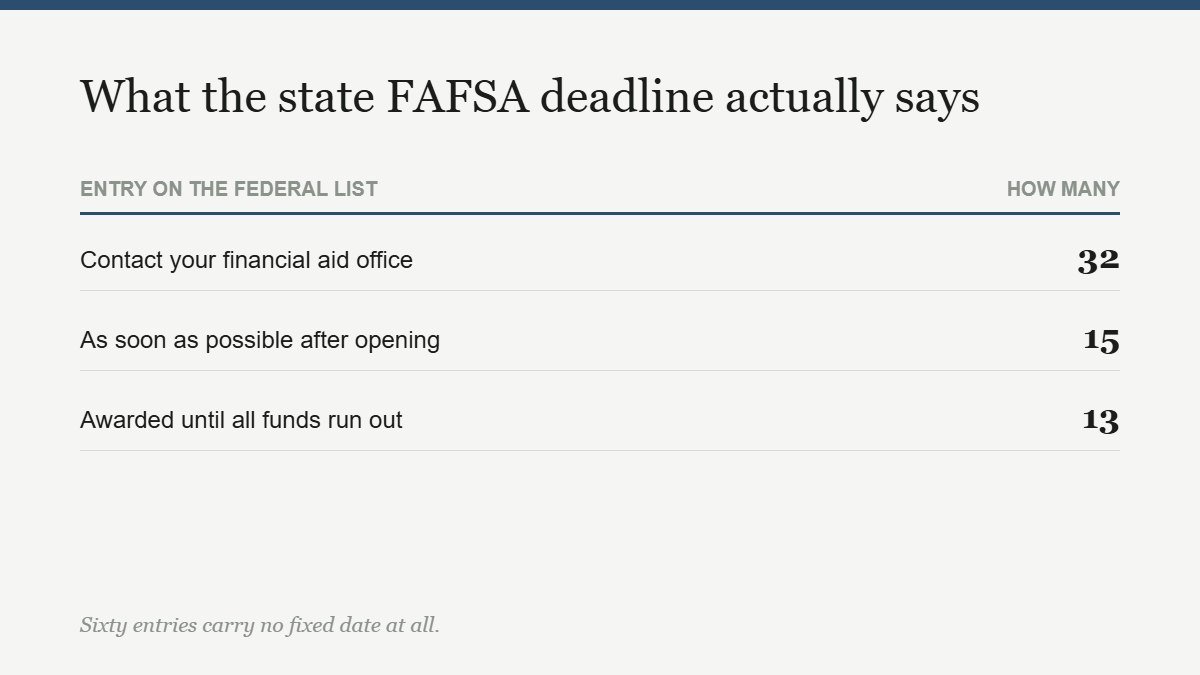
We read the full state deadline list Federal Student Aid publishes for 2027–28 and counted what the entries actually say. The pattern is stark.
| What the state entry says | How many entries |
|---|---|
| “Contact your financial aid office” (no published state deadline) | 32 |
| “As soon as possible” after the form opens | 15 |
| Awarded “until all funds” run out | 13 |
Alaska’s entry is typical of the shape: “Apply using the FAFSA form as soon as possible after Oct. 1, 2026. Aid is awarded until all funds run out.”
Read that as what it is. For those programs the deadline is not a date on a calendar. It is the moment the money runs out, and nobody announces it in advance. A family that files in March may be past a deadline that a family filing in October cleared without noticing there was one.
Where states do publish hard dates, some are early. The 2027–28 listing includes deadlines falling on 15 January 2027, 1 February 2027 and 15 February 2027. That is roughly seventeen months before the federal deadline for the same award year.
Federal Student Aid’s own instruction on the state list is worth repeating: “Visit your state higher education agency’s website for the most up-to-date state deadline.” The national list is a starting point, not the authority.
The federal FAFSA deadline, for the record
Straight from Federal Student Aid, for 2027–28:
“The FAFSA form must be submitted by 11:59 p.m. Central time (CT) on June 30, 2028. Any corrections or updates must be submitted by 11:59 p.m. CT on Sept. 12, 2028.”
Note the correction window runs ten weeks past the submission deadline. If you filed on time and later discover an error, you have until September to fix it. People miss that and assume a mistake is fatal.
Ask your college what “deadline” means to them
This is a small question that changes the date you need to work to, and Federal Student Aid raises it directly:
“You may also want to ask about the school’s definition of an application deadline. For example, the deadline could be the date your FAFSA form is processed…”
Submitted and processed are not the same day. If your school counts processed, you need to file with days to spare, not hours. One phone call settles it.
What to have ready before you start
- An FSA ID for the student and one for each contributor. Parents need their own. Create these first, because they can take a day or more to verify.
- Social Security numbers for everyone on the form.
- Tax information, which the form now pulls directly from the IRS once each contributor consents. Consent is not optional. Without it the form cannot be processed.
- Records of untaxed income and current balances of cash, savings and investments.
- Your list of schools. You can add up to twenty codes.
If you only do one thing this week, do the FSA IDs. Every year a chunk of families miss early state deadlines waiting on a parent account that was never created.
Frequently asked questions
When does the 2027–28 FAFSA open?
Publicly on 1 October 2026, and the Education Secretary has certified that date to Congress. Beta access is open now to any student or parent who requests it on StudentAid.gov, and beta submissions are processed as real applications.
Does filing early get me more money?
Not from the federal government. Pell Grant and federal loan amounts do not depend on when you file. What those loans cost you later does depend on the repayment plan you end up on, and on whether any forgiveness you eventually receive is taxable. It can matter a great deal for state grants and for your college’s own funds, because those pools are finite and thirteen state entries award until the money runs out.
I missed my state FAFSA deadline. Is it worth filing?
Yes. Federal aid is unaffected, your college may still have money, and some state programs have more than one deadline for different awards. Missing one date does not close the others.
Do I have to file every year?
Yes. Each award year needs its own FAFSA. The 2027–28 form covers the school year starting in autumn 2027.
My family earns too much to qualify. Should I bother?
File anyway. Unsubsidized federal loans do not have an income test, many colleges require a FAFSA on file before they will consider you for their own merit aid, and some state scholarships use it too. It costs nothing to submit.
The bottom line
Ignore 30 June 2028. Find your state’s actual deadline on your state higher education agency’s site, ask your college whether it counts submitted or processed, and file as close to the opening as you can manage. The form is already accepting real submissions, so for most families the honest answer to “when is the FAFSA deadline” is “you can do it this week.”
This is general information, not professional advice. State and college deadlines change, and the beta period may have ended by the time you read this. Confirm dates with Federal Student Aid and your state higher education agency.
Sources
- Federal Student Aid, FAFSA Application Deadlines, federal and state deadlines for 2027–28
- NASFAA, ED Opens Second Phase of 2027-28 FAFSA Beta Testing, 26 August 2026
- Federal Student Aid Knowledge Center, 2027-28 FAFSA Beta Testing Plan, updated 25 August 2026
Fact-checked against these sources in September 2026.