
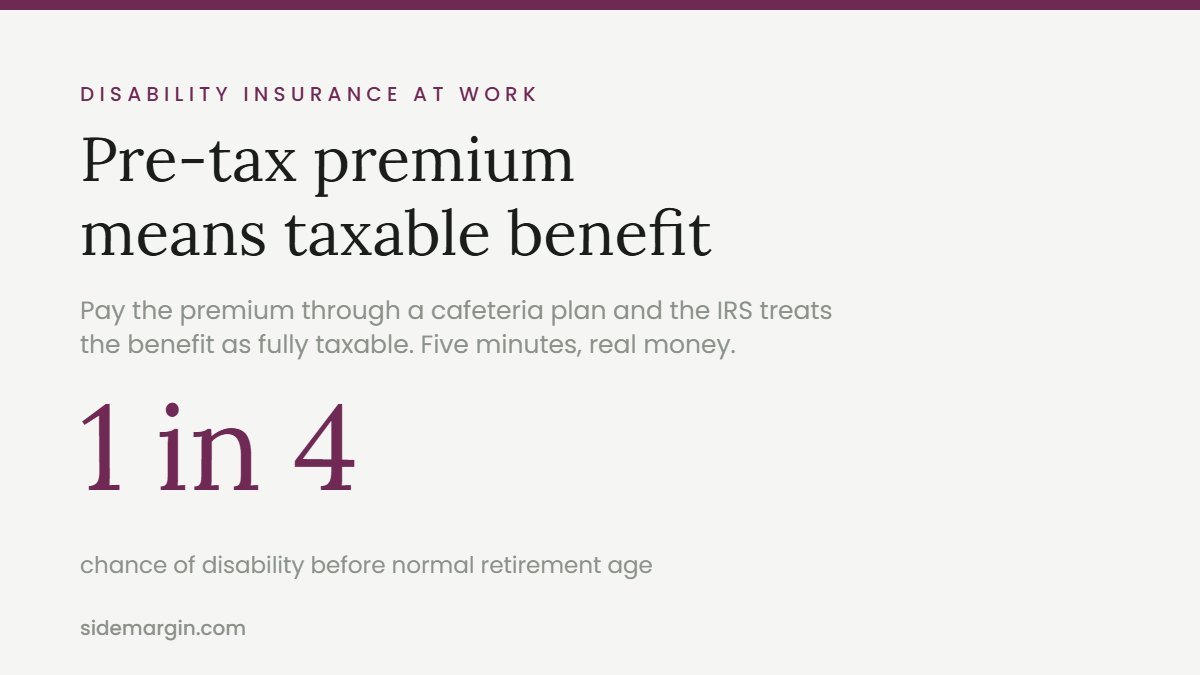
There is a box on your benefits enrollment form that decides whether the biggest cheque your insurance will ever write you arrives taxed or untaxed. Most people tick it without reading it, because ticking “pre-tax” saves a few dollars a month. If your employer pays the premium, or you pay it through a cafeteria plan with pre-tax dollars, disability insurance at work pays a fully taxable benefit. If you pay it with after-tax dollars, the benefit is tax free.
That single box is what disability insurance at work turns on, and it is a five minute decision that can be worth thousands in a year you cannot work. It is also, by some distance, the most under-explained item in the entire open enrollment packet.
Key takeaways
- Pre-tax premium means taxable benefit. The IRS is explicit that premiums paid through a cafeteria plan without being included in your income “are considered paid by your employer, and the disability benefits are fully taxable.”
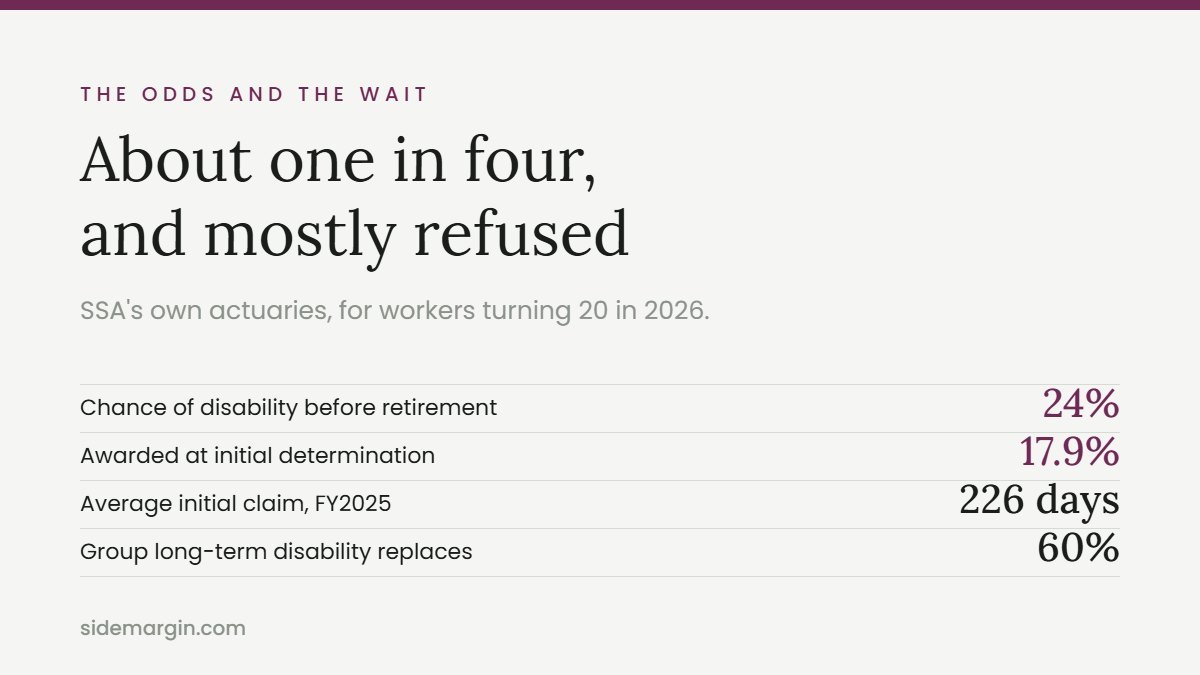
- SSA’s own actuaries put the risk at about 1 in 4. For workers turning 20 in 2026, the probability of becoming disabled before normal retirement age is 24%.
- Social Security is slow and mostly says no. Only 17.9% of disabled-worker applications are awarded at the initial determination, and initial claims took an average of 226 days in FY2025.
- Group long-term disability typically replaces 60% of pay, starting after a 90 day waiting period.
- The definition tightens at month 24. Most group policies cover “your own occupation” for two years, then switch to “any occupation”, which is a far harder standard.
- It is not portable. COBRA covers health, dental and vision. It does not cover disability. What you sometimes get is a conversion right, not a continuation.
- Just 55% of employees can say whether their employer even offers it.
The tax rule, in the IRS’s own words
This deserves the whole rule quoted, because the fourth sentence is the one almost nobody covers and it is the one that costs money.
You must report as income any amount you receive for your disability through an accident or health insurance plan paid for by your employer.
If both you and your employer have paid the premiums for the plan and you pay for your share of accident or health insurance on an after-tax basis, only the amount you receive for your disability that’s due to your employer’s payments is reported as income.
If you pay the entire cost of a health or accident insurance plan on an after-tax basis, don’t include any amounts you receive for your disability as income on your tax return.
If you pay the premiums of a health or accident insurance plan through a cafeteria plan, and you didn’t include the amount of the premium as taxable income to you, the premiums are considered paid by your employer, and the disability benefits are fully taxable.
Work through what that means with numbers. Say your long-term disability premium is $25 a month and you earn $80,000. Paying it pre-tax in a 22% bracket saves you roughly $66 a year in federal tax.
Now suppose you are disabled for two years. A 60% benefit on $80,000 is $48,000 a year. Taxed at 22%, that is roughly $10,560 a year in tax, or about $21,000 over the two years, on money you are living on precisely because you cannot earn. The pre-tax election saved you $132 over those two years of premiums.
Those figures are my own arithmetic on round numbers and your bracket, state tax and benefit would all change them. The ratio is the point. You are trading a certain small saving for a large contingent cost, at the exact moment you can least absorb it.
Some employers offer a “gross-up” election, where the premium your employer pays is added to your taxable income as imputed income. The effect is the same: you paid tax on a small amount now so the benefit arrives tax free later. If your enrollment form offers it, that is what it is for.
Short term and long term, and what the numbers look like
The Bureau of Labor Statistics defines short-term disability as providing benefits “for non-work-related illnesses or accidents on a per-disability basis, typically for a 6-month to 12-month period”. Long-term disability provides “a monthly benefit to eligible employees who, because of a non-work-related illness or injury, are unable to work for an extended length of time”, and “Most participants have a waiting period of 3 to 6 months, or until sick leave or short-term disability benefits end, before long-term disability benefits begin.”
Rather than quote averages from a survey that is now over a decade old, here is what real contract language looks like. This is from a published group long-term disability certificate issued by The Standard.
| Provision | What the certificate says |
|---|---|
| Benefit amount | “66⅔ percent of the first $12,000 of your insured predisability earnings” |
| Plan maximum | $8,000 per month |
| Waiting period | “benefits become payable after you have been continuously disabled for 90 days” |
| Maximum benefit period | Disabled before 62: to age 65, to Social Security Normal Retirement Age, or 3 years 6 months, whichever is longer |
Note the plan maximum. At $8,000 a month, the 66⅔% replacement rate stops applying above about $144,000 of salary. High earners are the group most likely to assume they are covered and least likely to be covered proportionally.
Access is uneven. In March 2025, short-term disability was available to 31% of workers at private firms with fewer than 100 employees, 53% at firms of 100 to 499, and 68% at firms of 500 or more.
Own occupation versus any occupation
This is where most group long-term disability claims are terminated, and the mechanism is written into the contract rather than hidden.
From the same certificate: for the waiting period and “the first 24 months for which LTD benefits are paid, you are considered disabled when you are unable … to perform with reasonable continuity the material duties of your own occupation.”
After 24 months, “you will be considered disabled if you are unable … to perform with reasonable continuity the material duties of any occupation.”
Consider a surgeon who develops a hand tremor. She cannot operate, so under “own occupation” she is disabled. At month 24 the test becomes whether she can do any occupation for which she is reasonably fitted. She can teach, consult or review records. Under the second definition she may no longer qualify, and the benefit stops.
That is not an insurer behaving badly. It is the policy working as written. But it means the two year mark is a scheduled re-adjudication, and anyone relying on group cover should know it is coming. A policy that keeps the own-occupation definition for the full benefit period costs more and is usually only available on an individual policy.
Why Social Security is not the backstop people think
The “1 in 4 workers will become disabled” line gets repeated constantly in insurance marketing, usually without a source. It turns out to be true, and it comes from the Social Security Administration’s own actuaries rather than from an insurer.
SSA Actuarial Note 2026.6, for workers reaching age 20 in 2026, puts the probability of becoming disabled between 20 and normal retirement age at 24%. The probability of dying over the same span is 13%. You are roughly twice as likely to be disabled before retirement as to die before it, and almost everyone insures the second risk and not the first.
What SSDI actually delivers, from SSA’s own statistics on applications filed in 2023:
| Stage | Share of applications awarded |
|---|---|
| Initial determination | 17.9% |
| Reconsideration | 0.9% |
| Hearing level or above | 0.3% |
| Final award rate | 21.5% |
Two caveats matter here. The reconsideration and hearing figures are understated because 186,886 applications from that cohort were still pending when the data was published, and SSA says so itself. And SSA separately publishes an “allowance rate” measured only against medical decisions, which was 45.6%. Those are different denominators, not contradictory numbers, and marketing material tends to quote whichever is more alarming.
Then there is time. From SSA’s own performance report:
| Measure | FY2024 | FY2025 | FY2027 target |
|---|---|---|---|
| Initial claim, average processing time | 231.1 days | 226.2 days | 140 days |
| Hearing decision, average processing time | 342 days | 284 days | 240 days |
| Pending initial claims | 1,177,974 | 885,180 | 600,000 |
An initial decision takes roughly seven to eight months. If you are denied and appeal to a hearing, you are looking at well over two years from application to outcome, with no income from that source in the meantime. SSA is improving, and the trend in that table is genuinely in the right direction, but the gap between “I stopped working” and “a cheque arrived” is measured in seasons.
That gap is the entire argument for having private disability cover, and it comes from the government’s own numbers rather than an insurer’s brochure.
One related point on the Social Security side, since people often conflate the two. SSDI benefits are adjusted each year by the same cost of living increase applied to retirement benefits, which is announced in October and explained in the Social Security COLA guide. That adjustment protects the purchasing power of a benefit you are already receiving. It does nothing about the seven months you spend waiting for the first one.
What happens when you leave
A widespread and expensive misconception: COBRA does not cover disability insurance. COBRA applies to health, dental and vision, runs 18 months after most terminations and 36 months after events like divorce or death, gives you at least 60 days to elect, and costs up to 102% of the plan’s full cost. None of that touches your disability cover.
Group long-term disability is generally not portable. Some certificates include a conversion provision allowing you “to obtain LTD conversion insurance after the termination of your insurance”, but that is a new, more expensive policy with a short election window, not a continuation of what you had.
The practical implication is uncomfortable but simple. If you are the main earner and you develop a condition that would make you uninsurable, your coverage is tied to staying at that employer. An individual policy bought while you are healthy is the only version that follows you, and it is priced on your age and health at the time you buy it, which means it only gets more expensive.
Disability insurance at work: what to do this enrollment window
- Find out whether your premium is pre-tax or after-tax. It is on your pay stub or in the benefits portal. If it is pre-tax and an after-tax or gross-up option exists, take it.
- Find the benefit percentage and the monthly cap. If you earn more than the cap divided by the percentage, you are underinsured proportionally.
- Read the elimination period. 90 days is common. Work out how you would live for three months without pay, because that is what it means.
- Find the own-occupation period. If it is 24 months, treat month 24 as a scheduled review rather than a surprise.
- Check whether short-term disability exists at all and whether it is bridged by sick leave. Fewer than a third of workers at small firms have it.
- Check whether buy-up coverage is offered. Many employers offer a base level free and a higher tier you can elect, and the buy-up is frequently cheap.
- If you are self-employed or your employer offers nothing, price an individual policy now rather than later. Age and health only move one way.
Only 55% of employees can even say definitively whether their employer offers disability insurance, according to LIMRA survey work, and fewer than half say they understand the benefit. That gap is the reason this item is worth more attention than the health plan comparison that eats the whole enrollment window.
The other decisions, ranked by what they are actually worth, are in the open enrollment checklist. If a high deductible plan is part of your setup, the FSA versus HSA comparison is the companion piece, and an HSA balance is one of the few assets that keeps working if your income stops.
Figures current as of 17 September 2026. Probability data is from SSA Actuarial Note 2026.6. Award rates cover applications filed in 2023. Processing times are from SSA’s FY2025 to FY2027 Annual Performance Report. Contract language is from one published group certificate and yours will differ. This is general information, not tax, legal or insurance advice.
Sources
- IRS, Life insurance and disability insurance proceeds
- IRS Publication 525, Taxable and Nontaxable Income
- SSA Actuarial Note 2026.6, Disability and Death Probability Tables
- SSA, Annual Statistical Report on the SSDI Program, outcomes of applications
- SSA, FYs 2025 to 2027 Annual Performance Report
- BLS, National Compensation Survey glossary of employee benefit terms
- BLS, Employee Benefits in the United States, March 2025
- The Standard, group long term disability certificate (own occupation, waiting period, conversion)
- Department of Labor, An Employee’s Guide to Health Benefits Under COBRA
- LIMRA, Disability Insurance Awareness Month 2025