
Most people spend less than an hour on the only financial decision their employer makes them repeat every year. In a 2024 survey of 2,011 privately insured adults, half spent under an hour choosing a health plan, nearly a third spent under thirty minutes, and 24% of people in traditional plans took no action at all and were automatically re-enrolled in whatever they had. This open enrollment checklist is built around the handful of decisions where that costs real money.
Family coverage now costs $26,993 a year in total, of which the average worker pays $6,850. That is a car. Spending twenty minutes on it is not a proportionate amount of attention, and the reason people do it is that benefits portals are built to make re-electing last year’s choices the path of least resistance.
Key takeaways
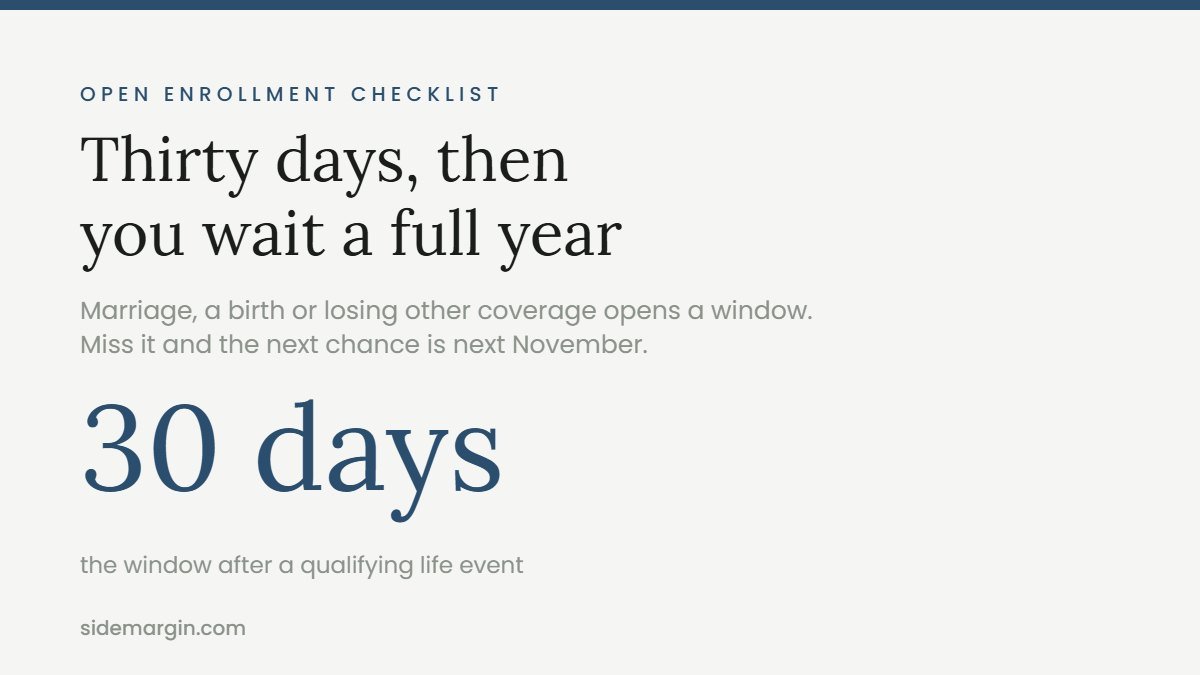
- The 30 day clock is the most consequential number in employee benefits and almost nobody knows it. Miss it after a marriage, birth or loss of other coverage and you wait a full year.
- A qualifying life event does not reopen the whole menu. IRS rules only let you make the change that logically follows from the event. Divorce lets you drop your ex-spouse, not your children.
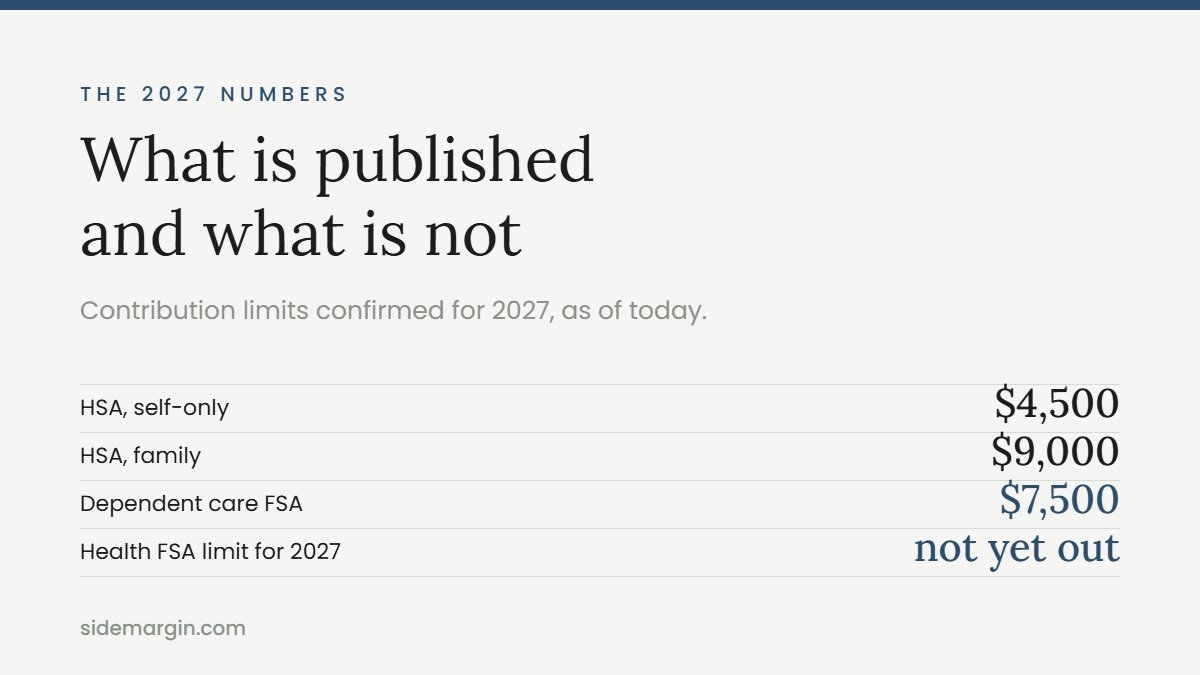
- 2027 HSA limits are published: $4,500 self-only and $9,000 family. The 2027 health FSA limit is not out yet and is expected in mid-October.
- The dependent care FSA limit is now $7,500, up from $5,000 where it had sat since 1986. It is not indexed and your employer has to have adopted it.
- Your plan can offer a grace period or a carryover, but not both. Find out which one before you decide how much to put in an FSA.
- Paying your disability premium pre-tax quietly makes the benefit taxable. That is the highest-value five minutes in the whole enrollment window.
- The average single deductible is $1,886, and 34% of covered workers now face $2,000 or more. The premium is no longer the number that decides which plan is cheaper.
When your open enrollment checklist has to be done
Most employers run open enrollment in October or November for a plan year starting 1 January. Survey data from the International Foundation of Employee Benefit Plans found 34% start in October and 43% in November, with 52% giving employees a two week window, 24% three weeks and 17% four weeks.
That survey is from 2020 and the pattern has not obviously changed, but treat it as a rule of thumb rather than a fact about your employer. The one genuinely fixed anchor is the federal government’s own schedule: Federal Benefits Open Season for plan year 2026 ran 10 November to 8 December 2025. The dates for the 2026 season have not been posted yet.
Two weeks is not much time to read a plan document you have never read, which is the real reason people default. The fix is to do the reading before the window opens rather than during it.
What you can and cannot change later
This is the rule that traps people, and it is worth understanding precisely rather than vaguely. Your elections under a Section 125 cafeteria plan are irrevocable for the plan year unless a specific listed event happens. The governing regulation is 26 CFR 1.125-4.
The qualifying events fall into six buckets: HIPAA special enrollment rights, a change in status, a court order, gaining or losing Medicare or Medicaid, a significant change in cost or coverage, and FMLA leave.
“Change in status” is the big one, and the regulation lists it out. Legal marital status covers “marriage; death of spouse; divorce; legal separation; and annulment.” Number of dependents covers “birth; death; adoption; and placement for adoption.” Employment status covers “termination or commencement of employment; a strike or lockout; a commencement of or return from an unpaid leave of absence; and a change in worksite.” Dependents ageing off or losing student status counts, and so does “A change in the place of residence of the employee, spouse, or dependent.”
Then comes the part everyone misses. The consistency rule at (c)(3) says a change is only permitted if it “is on account of and corresponds with a change in status that affects eligibility for coverage.” The regulation’s own example: on divorce, cancelling coverage for anyone other than the ex-spouse “fails to correspond with that change in status.”
So a qualifying event is a key to one specific door, not to the building. If you get married in March and want to switch plans because you have decided you picked the wrong one, the marriage does not authorise that.
| Event | How long you have |
|---|---|
| Marriage, birth, adoption, placement for adoption | 30 days |
| Losing eligibility for other coverage | 30 days |
| Losing Medicaid or CHIP coverage | 60 days |
| Becoming eligible for Medicaid or CHIP premium assistance | 60 days |
The Department of Labor states the first two plainly: enrollment must be requested “within 30 days after losing eligibility for coverage or after a marriage, birth, adoption, or placement for adoption.” Thirty days after a birth is a period during which nobody is thinking about benefits portals, which is precisely why it catches people.
The health plan decision, done properly
Here is what the average looks like now, from the most recent employer survey, covering 1,862 firms.
| 2025 averages | Single | Family |
|---|---|---|
| Total annual premium | $9,325 | $26,993 |
| What the worker pays | $1,440 | $6,850 |
| Worker share | 16% | 26% |
| Average general deductible | $1,886 |
Comparing plans by premium alone stopped working years ago. With 34% of covered workers facing a single deductible of $2,000 or more, and a third now in a high deductible plan, the premium is often the smaller half of what you will actually pay.
The right comparison takes three numbers per plan and about ten minutes with a calculator:
- Annual premium. Your per-paycheck contribution multiplied by the number of paychecks. This is your floor: you pay it whether you see a doctor or not.
- Your realistic spending. Not last year’s claims exactly, but your standing costs: prescriptions, therapy, a specialist you see quarterly, a procedure you already know is coming.
- The out-of-pocket maximum. Your ceiling in a bad year. This is the number that matters most and the one people look at least, because the difference between a good year and a catastrophic one is entirely contained in it. The distinction between this and the deductible is explained in the deductible versus out-of-pocket maximum guide.
Run each plan at both ends. A high deductible plan with a large employer HSA contribution frequently wins in a quiet year and in a disastrous one, and loses only in the middle. Whether it fits you is mostly a cash flow question, and the trade-offs are laid out in FSA versus HSA.
The tax-advantaged accounts
Only 3% of working Americans understand the full benefits of an HSA, according to a Voya survey, and among people who actually own one the figure was 4%. That is a striking gap for an account with a triple tax advantage.
| Limit | 2026 | 2027 |
|---|---|---|
| HSA contribution, self-only | $4,400 | $4,500 |
| HSA contribution, family | $8,750 | $9,000 |
| HSA catch-up, age 55 and over | $1,000 | $1,000 |
| HDHP minimum deductible, self-only | $1,700 | $1,750 |
| HDHP out-of-pocket maximum, self-only | $8,500 | $8,700 |
| Health FSA | $3,400 | not published yet |
| Health FSA carryover | $680 | not published yet |
| Dependent care FSA | $7,500 | $7,500 |
Three things about that table are worth saying out loud.
The 2027 health FSA number genuinely is not out. The IRS publishes it in a revenue procedure that usually lands in mid-October. If your enrollment window opens before that, you may be asked to elect against a limit that has not been announced. Elect the 2026 figure and check whether your plan lets you top up.
The dependent care jump is the biggest change in years. The statutory limit went from $5,000, where it had been since 1986, to $7,500, under a provision of the July 2025 tax law effective for tax years beginning after 31 December 2025. It is not indexed for inflation, so it will stay at $7,500 until Congress moves it again. Crucially, the law raised the ceiling. It did not force employers to adopt it, and nondiscrimination testing gets harder at the higher number, so plenty of plans cap below the maximum. Check your plan document, not the IRS figure.
Grace period or carryover, never both. IRS Publication 969 is explicit that a plan “can provide for a grace period of up to 2½ months after the end of the plan year”, or a carryover of unused amounts, but not both. Which one you have changes the right FSA election by hundreds of dollars.
One under-used option: if you are on a high deductible plan with an HSA, a limited-purpose FSA lets you pay dental and vision costs with pre-tax money without destroying your HSA eligibility. Most people do not know their employer offers one.
The five minute items worth more than the hour you spend on the health plan
These get skipped every year and two of them are close to free money.
- Check how your disability premium is paid. If the premium comes out pre-tax, the benefit is fully taxable. If you pay it with after-tax dollars, the benefit is tax-free. Many employers default to pre-tax, which saves you a few dollars a month and can cost you thousands in a year you cannot work. Some offer a gross-up election. This is covered properly in disability insurance at work.
- Do the dental arithmetic rather than assuming. Only 2.9% of people in employer dental PPOs ever reach their annual maximum, which means the cap most people complain about is irrelevant to them and the real question is whether the premium beats the cost of two cleanings. The worked numbers are in is dental insurance worth it.
- Update your beneficiaries. It takes two minutes, it overrides your will, and it is the single most common expensive oversight in employee benefits.
- Check whether life insurance is enough and whether it is portable. Employer life cover is usually one or two times salary and usually ends when the job does.
- Look at what is bundled in for free. Employee assistance programmes, legal plans, telehealth and identity protection are frequently already paid for and almost never used.
If you are leaving, or might
Three rules worth knowing before you need them.
COBRA runs 18 months after a termination other than for gross misconduct, or after a reduction in hours, and 36 months for divorce, death, Medicare entitlement or a dependent ageing off. Your plan “must give you at least 60 days to choose whether or not to elect COBRA coverage”, and the premium “cannot exceed 102 percent of the cost to the plan”. That 102% is the whole cost, not just the share you were paying, which is why the first COBRA invoice is such a shock.
COBRA covers health, dental and vision. It does not cover disability insurance. Group long-term disability generally is not portable at all. What you sometimes get instead is a conversion right with a short election window and a higher price.
Your HSA is yours. IRS Publication 969 puts it simply: “An HSA is ‘portable.’ It stays with you if you change employers or leave the work force.” An FSA balance, by contrast, generally does not.
The open enrollment checklist
- Find out your exact window dates and put the last day in your calendar with a three day warning.
- Pull last year’s actual spending from your insurer’s site. Not your memory. The numbers are always different.
- Compare every plan at both ends: premium only in a quiet year, and premium plus out-of-pocket maximum in a bad one.
- Confirm your doctors and prescriptions are in network and on formulary for next year, not this year. Networks change on 1 January.
- Decide HSA or FSA deliberately, and check whether your plan has a grace period or a carryover.
- Check the disability premium tax treatment. Five minutes, potentially thousands.
- Run the dental numbers instead of re-electing it because it was there last year.
- Update beneficiaries on every account, including the ones you forgot you had.
- Save a PDF of your final elections. When a claim is denied in April, the confirmation you saved in November is the thing that settles it.
One last thing, because it is the most expensive gap in the whole system. Choosing well does not protect you from a bill that should never have been sent. If one arrives anyway, start with how to dispute a medical bill, because the leverage you have is considerably greater than most people realise.
Limits and rules current as of 17 September 2026. The 2027 HSA and HDHP figures are from IRS Revenue Procedure 2026-24. The 2027 health FSA limit has not been published and is expected in mid-October 2026. Premium and deductible averages are 2025 figures from the most recent employer survey. This is general information, not tax or legal advice.
Sources
- IRS Revenue Procedure 2026-24, 2027 HSA and HDHP limits
- IRS Revenue Procedure 2025-32, 2026 health FSA limit and carryover
- IRS Publication 969, HSAs and other tax-favored health plans
- 26 CFR 1.125-4, permitted election changes
- 26 U.S.C. 129, dependent care assistance exclusion at $7,500
- Department of Labor, HIPAA portability FAQs and the 30 day special enrollment window
- Department of Labor, CHIPRA special enrollment rights
- Department of Labor, An Employee’s Guide to Health Benefits Under COBRA
- KFF, 2025 Employer Health Benefits Survey, summary of findings
- EBRI and Greenwald, 2024 Consumer Engagement in Health Care Survey
- Voya, on re-electing the same plan and HSA understanding
- IFEBP, typical open enrollment length and timing
- OPM, Federal Benefits Open Season dates for plan year 2026
- NADP, 2025 Dental Benefits Report on plan design and annual maximums