
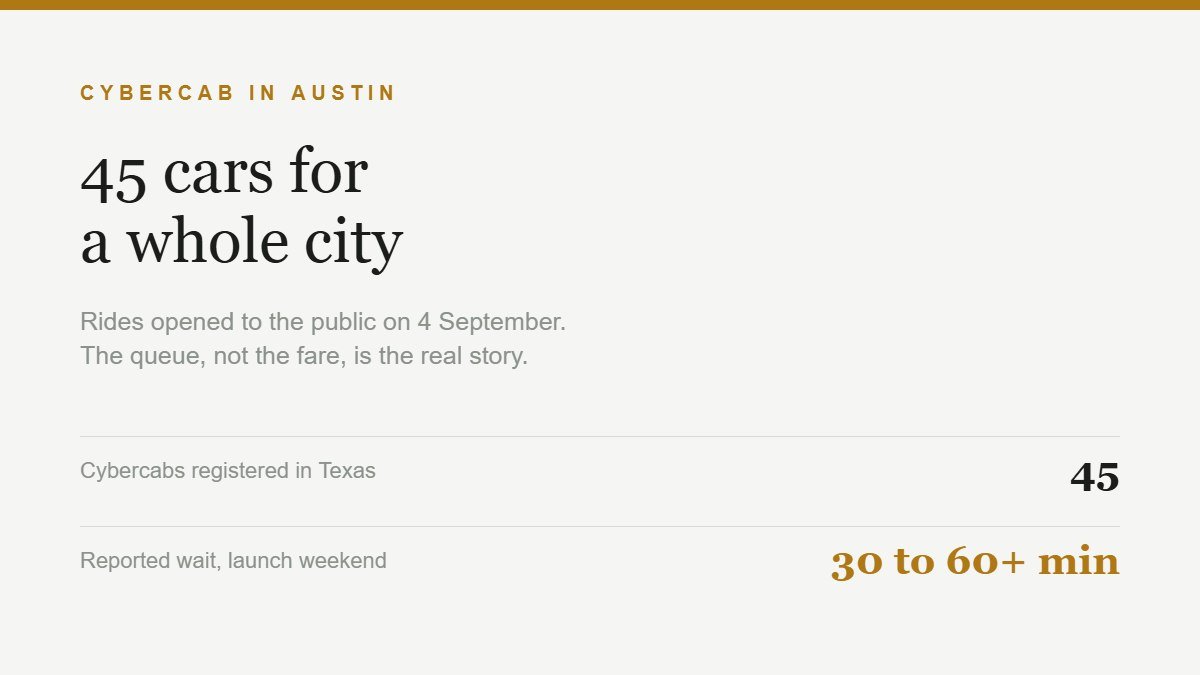
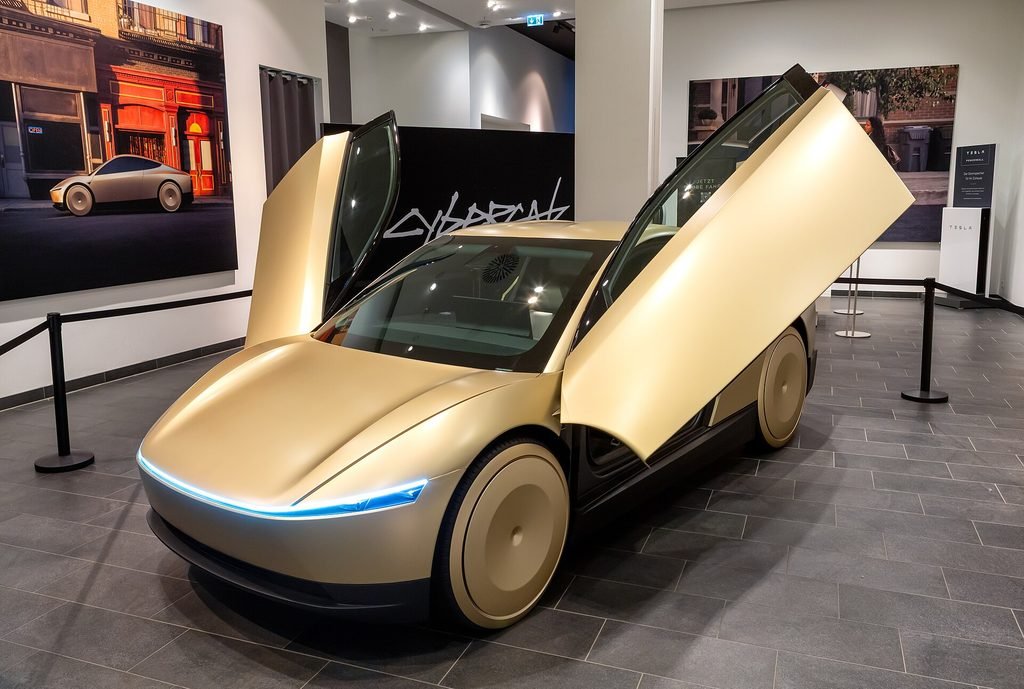
Tesla opened Cybercab rides to the public in Austin on the evening of Friday 4 September 2026. It is a two-seat car with no steering wheel, no pedals and no mirrors, and you order it from an app the way you would order an Uber.
The obvious question is Cybercab vs Uber on price. The honest answer, one week in, is that nobody can tell you yet, and the reason why is more interesting than a number would have been.
Key takeaways
- Two independent Cybercab vs Uber price checks in the same week pointed in opposite directions. One found Tesla more expensive than Uber, the other found it much cheaper.
- Every fare figure in circulation is an app quote. We could not find a single reporter who has booked, ridden and paid for a Cybercab.
- Tesla calls the current pricing an introductory program and executives have described dynamic pricing that rises with demand. Today’s prices are not a steady state.
- The best-evidenced finding is not price, it is waiting. There are 45 Cybercabs for the whole Austin metro, and waits of 30 minutes to over an hour were reported by three separate observers.
- The federal safety regulator opened an audit of the Cybercab the day public rides began.
What actually launched, and when
Two dates get mixed up in coverage, so it is worth separating them.
| Date | What happened |
|---|---|
| Wednesday 3 September 2026 | Invitation-only launch event at ACL Live in downtown Austin. Rides that evening were for invited guests. Reporters were turned away. |
| Friday 4 September 2026, 5pm CT | Cybercab rides opened to the general public. |
Tesla’s AI chief Ashok Elluswamy told Reuters at the event, of the service, “It’s open to the entire public.” There is no waitlist and no invite code. What limits you is whether a car is available.
The vehicle is the two-seat Cybercab. Elon Musk described it in the launch video as “the first car that is specifically built for unsupervised full self-driving.” It has no steering wheel, no pedals, no mirrors and no rear window. Reuters reported that Cybercab rides were available only in some parts of Austin, meaning a smaller area than Tesla’s Model Y robotaxis cover.
Cybercab vs Uber on price, and why it has no clean answer
Tesla has not published a fare table. There is no per-mile rate and no base fare on its website. What its support page says is:
“Initially, as part of our introductory program, we will charge a simple, affordable rate plus applicable taxes and fees for all rides within the available service area.”
And: “The price estimate will be displayed in the Robotaxi app before you confirm your ride.”
So everything the public knows about pricing comes from people opening the app and screenshotting what it said. Two such checks were made in the same week, and they disagree completely.
| Austin American-Statesman | Independent creator | |
|---|---|---|
| When | 3 and 4 September | 5 September |
| Route | Montopolis to ACL Live, then a 2.5 mile trip down South Congress | The Domain to UT Austin |
| Tesla | $19.58 (Model Y robotaxi), then $12.15 | $14.87 Cybercab, $19.68 Model Y |
| Uber | $12.96, then $7.96 | About $25 UberX |
| Verdict | Tesla more expensive | Tesla cheaper |
Different routes, different times of day, different surge conditions. Both are honest observations and they cannot both be generalised. The Statesman itself noted that the comparison represents only snapshots in time, and that ride-hailing prices move constantly with demand, traffic and weather.
Two caveats matter more than the numbers.
These are quotes, not receipts. A price displayed in an app before you confirm is not proof of what was charged. We could not find any reporter who completed and paid for a Cybercab ride and published the total.
Tesla says the pricing is introductory. Reuters reported that executives at the launch described dynamic pricing that would rise with demand, and promised a first-class experience at coach price. Whatever the app quotes today, it is explicitly a starting position.
For scale, Musk suggested in October 2024 that robotaxi rides might eventually cost around 30 to 40 cents a mile. A 2.5 mile trip at $12.15 works out closer to $4.86 a mile. Short trips carry a base fare so per-mile maths overstates the gap, but the distance between the aspiration and the current app is large.
Cybercab vs Uber on waiting time, the number that is actually solid
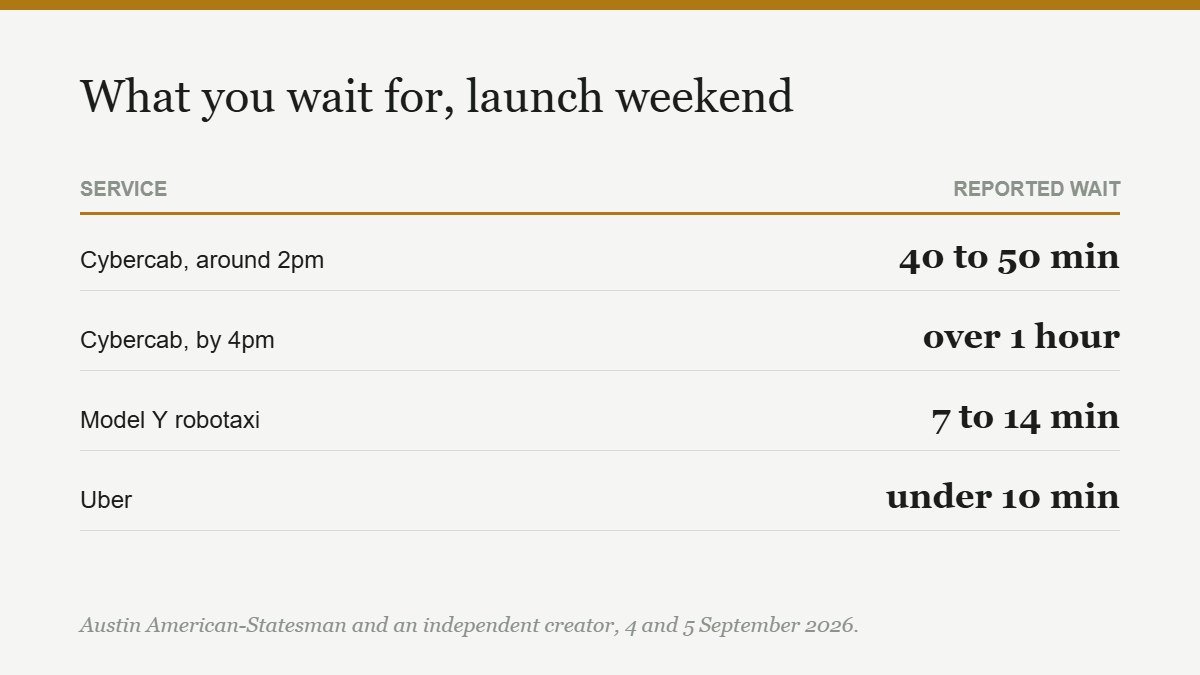
On waiting time the Cybercab vs Uber gap is not close, and here the evidence lines up rather than conflicting. Three separate observers, at different times and on different routes, all found the same thing.
| Service | Reported wait |
|---|---|
| Cybercab, around 2pm on 4 September | 40 to 50 minutes |
| Cybercab, by 4pm on 4 September | More than an hour |
| Cybercab, 5 September | About 30 minutes |
| Model Y robotaxi | 7 to 14 minutes |
| Uber | Under 10 minutes, often 2 to 8 |
The explanation is simple arithmetic. Reuters reported that as of the evening before launch there were 45 Cybercabs registered in Texas, against roughly 375 Tesla Model Y robotaxis and 988 Waymo vehicles. Forty-five cars cannot serve a metro area quickly, and the novelty is pulling demand toward them specifically.
One practical rule from Tesla’s own support page, worth knowing before you book: “Your vehicle will wait at the pickup location for seven minutes. If you have not arrived within this time, your ride may be canceled.” After waiting an hour, you get seven minutes.
How to actually get one
Tesla’s support page sets out the steps: “1. Open the Robotaxi app. 2. Enter a destination within the displayed service area. 3. Review the estimated ride fare and wait time and confirm your ride. 4. Once confirmed, you will receive a notification that your vehicle is on its way.”
You need a Tesla Account to sign in, and Tesla notes you should create one before trying to log into the Robotaxi app. You do not need to own a Tesla.
The service is not Austin-only. Tesla’s page states: “Currently, we provide service in limited areas of Miami, Orlando and Tampa, Florida and Austin, Dallas, and Houston, Texas.” Cybercabs specifically, though, are an Austin thing for now.
The age rules are different for the two vehicles
This one catches families out, and it is buried in the support pages.
| Vehicle | Minimum age for an accompanied minor |
|---|---|
| Cybercab | 13 |
| Model Y robotaxi | 8 |
Tesla’s wording for the stricter case: “For Cybercab vehicles, minors aged 13-17 are permitted to ride if accompanied by an adult. Guests under the age of 13 are not permitted to ride in a Cybercab vehicle.” If you are travelling with a younger child, the Cybercab is not an option and the Model Y is.
Where Waymo fits into Cybercab vs Uber
Waymo has been driving in Austin longer and has more cars there, roughly 300. But there is a structural quirk that makes most online comparisons meaningless.
In Austin you cannot hail a Waymo in the Waymo app. Waymo’s own page says: “Ride with Waymo only on Uber in Austin.” You request an UberX, Uber Electric, Uber Comfort or Uber Comfort Electric, and you may be matched with a Waymo instead of a human driver.
Which means a Waymo in Austin costs whatever the Uber tier you booked costs. There is no separate Waymo fare. Any article comparing Waymo prices against Uber prices in Austin is comparing a thing to itself.
The other visible difference: Waymo uses ordinary cars that still have a steering wheel and pedals, with nobody in the driver’s seat. The Cybercab has no controls at all.
The regulator opened a file on day one
This is the part with the strongest sourcing in the whole story, and it is worth knowing before you ride.
On 3 September 2026, hours after the first Cybercabs carried passengers, the National Highway Traffic Safety Administration opened Audit Query AQ26002 through its Office of Defects Investigation, covering roughly 1,000 Cybercab vehicles. The agency says it will evaluate “the technical data and processes Tesla relied upon to self-certify compliance for a vehicle lacking traditional human controls.”
NHTSA Administrator Jonathan Morrison said: “NHTSA fully supports the safe development and deployment of automated vehicles. But as the federal regulator, we need to ensure that all of our laws are followed.”
In plain terms, US vehicle safety standards were written assuming a car has a steering wheel and pedals. Tesla certified a car that has neither. NHTSA is asking how that certification was reached. Separately, the Department of Transportation has proposed removing manual-control requirements for self-driving vehicles, so the standard being audited may itself change.
On the wider fleet, NHTSA crash reporting showed 14 crashes involving Tesla robotaxis in Austin between the June 2025 launch and mid-February 2026, with minor injuries in two earlier incidents. Those are Model Y robotaxis, not Cybercabs, and the fleet was small, so the rate is not a reliable long-run figure. No Cybercab-specific incident has been reported in the first week.
Texas legalised commercial driverless operation under Senate Bill 2807, which took effect on 1 September 2025, with authorisation requirements enforceable from 28 May 2026. Operators self-certify against conditions including that the vehicle is “Capable of achieving a minimal risk condition if a failure…occurs”, and must give state police a plan for how emergency services should interact with the vehicle.
Frequently asked questions
Is anyone in the car with you?
The Cybercab seats two and has no driver position, so there is nowhere for a safety monitor to sit and no controls to take over. We have not found a Tesla statement saying so in those words. Separately, Tesla’s fleet does use remote operators, which is documented in federal crash reports involving teleoperators in earlier incidents.
Will this make Uber cheaper?
Nothing in the current evidence supports that yet. Cybercab vs Uber is not a fight over supply at this scale: forty-five vehicles is not enough to move prices in a metro area, and Tesla’s own pricing is described as introductory rather than competitive. It is a reasonable long-run question and a premature short-run one.
Can I take luggage or a car seat?
It is a two-seater built as a lounge rather than a taxi. Tesla has not published luggage capacity or a car seat policy that we could verify, and the age floor of 13 makes the car seat question largely moot. Check the app before relying on it for an airport run.
Is it worth trying?
As a novelty, on a day when an hour of waiting does not matter, that is a personal call. As transport, the wait times mean it is not currently a substitute for a normal ride-hail. The Model Y robotaxi is the same technology with far shorter waits.
The bottom line
A week after launch, the interesting fact about Cybercab vs Uber is not the price. It is that the price is unknowable from public information, that the company describes it as introductory, and that the practical experience is dominated by a fleet of 45 cars trying to serve a city.
If you want to try one, download the Robotaxi app, book early in the day, and expect to wait. If you want to get somewhere, take the Model Y robotaxi or an Uber. And treat any single fare figure you see quoted, including the ones above, as one snapshot on one route at one moment.
Sources
- Tesla — Robotaxi support page
- NHTSA — Investigation into Tesla Cybercab self-certification, Audit Query AQ26002
- Reuters — Tesla starts Cybercab rides in Austin, drawing US safety agency interest
- Austin American-Statesman — Tesla Cybercab or Uber, how fares compared on launch day
- Waymo — Waymo on Uber
- Texas Department of Motor Vehicles — Automated Vehicles Regulatory Program
- CBS News — Tesla robotaxi crashes reported to NHTSA
- Electrek — NHTSA investigation into Cybercab certification
Fact-checked against these sources on 9 September 2026. Prices, wait times and service areas change constantly. Check the app before you travel.