
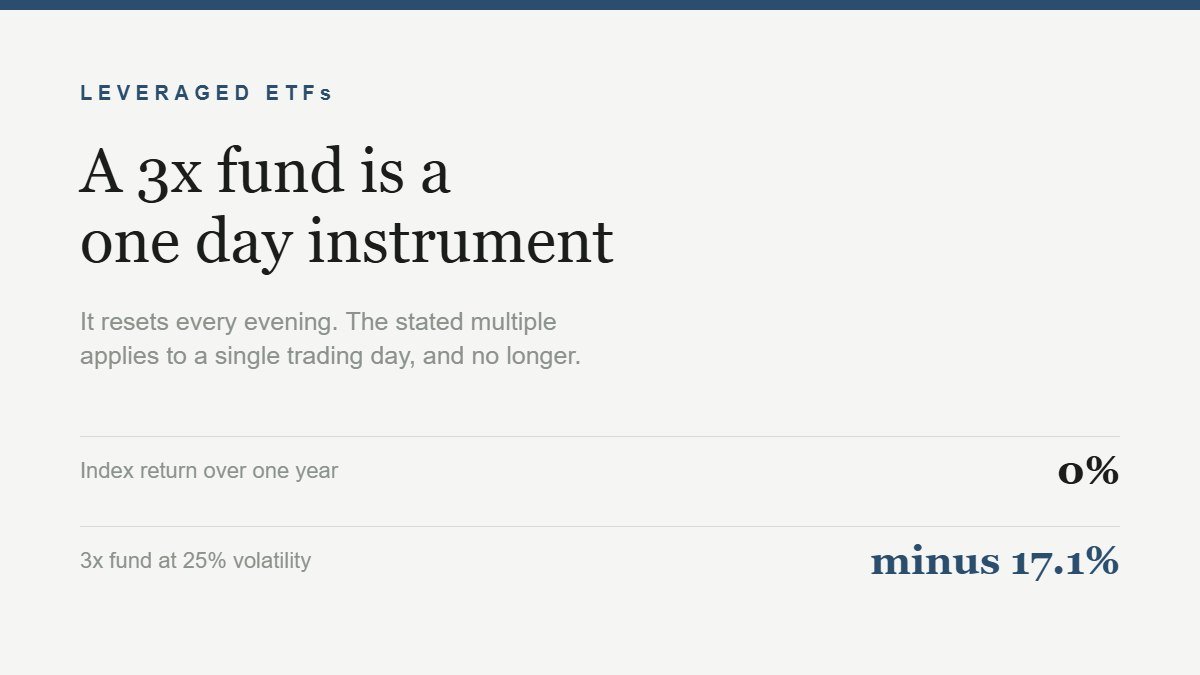
A 3x leveraged ETF does exactly one thing. It aims to return three times what its index does in a single trading day. Not over a week. Not over a year. One day, close to close, then it resets and starts again.
That single sentence explains almost every surprise people get with these funds, and it is written plainly in documents the fund companies publish themselves. Below: what the issuers say, the leveraged ETF arithmetic that makes a flat market cost you money, the thing most articles get wrong about it, and what has actually happened to funds like these.
Key takeaways
- A leveraged ETF resets every day. Its stated multiple applies to one trading day only, and the issuers say so in the prospectus.
- Because of that reset, an index can finish flat while the fund finishes down. That is arithmetic, not a fee.
- The drag comes from volatility, not from the passage of time. In a calm rising market the same mechanism can work in your favour, and the fund’s own paperwork shows it.
- Direxion’s prospectus for SOXL states that a flat index with 25% annualised volatility would be expected to leave the fund down 17.1% over a year, before fees.
- The issuer can change the deal. Direxion cut ten of its funds from 3x to 2x in 2020, and SOXL’s bear sibling has done three reverse splits.
What a leveraged ETF actually promises
Start with the primary document rather than a summary of it. The investment objective in the summary prospectus for the Direxion Daily Semiconductor Bull 3X ETF, ticker SOXL, reads:
“The Fund seeks daily investment results, before fees and expenses, of 300% of the daily performance of the Index. The Fund does not seek to achieve its stated investment objective for a period of time different than a trading day.”
Read the second sentence again. It is not a risk warning buried in an appendix. It is part of the objective. The fund is not trying to give you 3x over a month and failing at it. It is not trying.
The same document adds: “The return for investors that invest for periods longer or shorter than a trading day should not be expected to be 300% of the performance of the Index.” And it describes the mechanic in one line: “At the close of the markets each trading day, Rafferty rebalances the Fund’s portfolio.”
The leveraged ETF arithmetic that catches people out
Here is the whole problem in two days of trading. Take an index at 100 and a 3x fund at 100.
| Start | Day 1: index +10% | Day 2: index −9.0909% | |
|---|---|---|---|
| Index | 100.00 | 110.00 | 100.00 |
| Fund’s daily move | +30.00% | −27.27% | |
| 3x fund | 100.00 | 130.00 | 94.55 |
The index ends exactly where it started. The fund ends down 5.45%.
Nothing went wrong. The fund delivered precisely 3x on Day 1 and precisely 3x on Day 2. The loss appears because the second day’s percentage is applied to a bigger number. Minus 27.27% of 130 is a larger fall than plus 30% of 100 was a rise.
Run that same round trip twenty times, forty trading days, and the index is still at 100.00 while the fund is at 32.57. A 67% loss with the index dead flat.
The SEC uses the same worked example in its investor bulletin, with a 2x fund, and closes it this way: “On both days, the leveraged ETF did exactly what it was supposed to do – it produced daily returns that were two times the daily index returns.” The fund working correctly and the holder losing money are not in tension.
The fund publishes a table of exactly how bad this gets
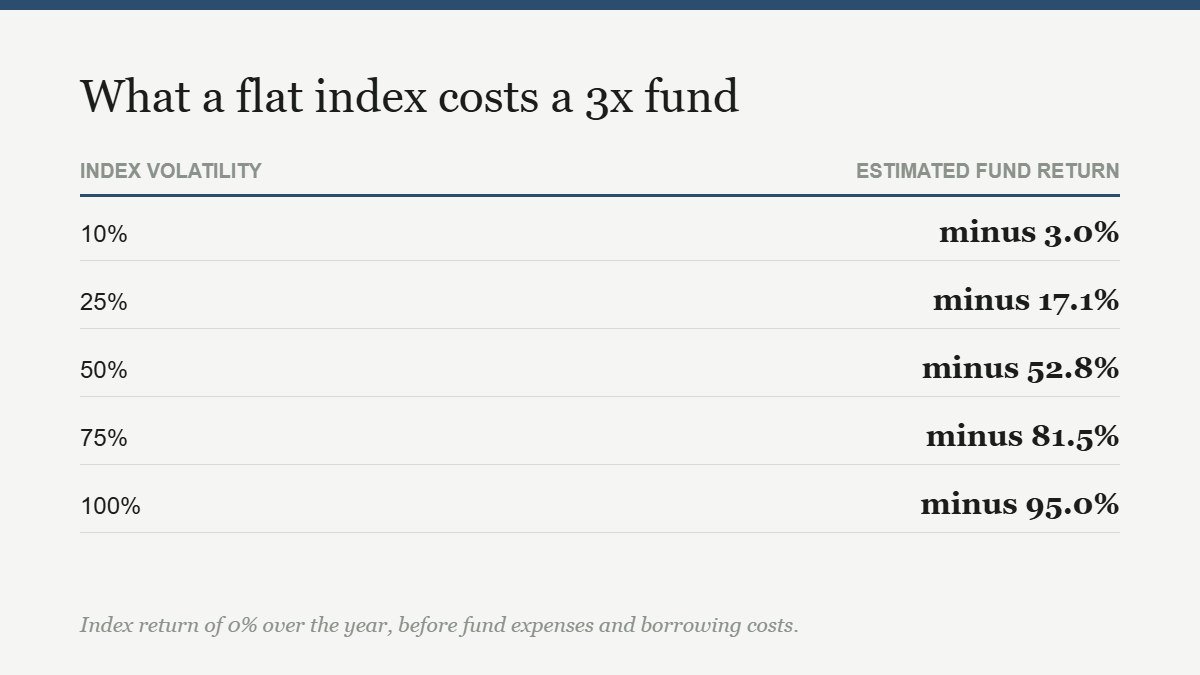
This is the part almost nobody reads, and it is the most useful page in the document. Direxion prints a grid showing estimated one-year fund returns for combinations of index return and index volatility. Here is the row where the index goes nowhere at all.
| Index return over one year | Index volatility | Estimated fund return |
|---|---|---|
| 0% | 10% | −3.0% |
| 0% | 25% | −17.1% |
| 0% | 50% | −52.8% |
| 0% | 75% | −81.5% |
| 0% | 100% | −95.0% |
Direxion states it in words too: “For instance, if the Index’s annualized volatility is 100%, the Fund would be expected to lose 95% of its value, even if the cumulative Index return for the year was 0%.”
For context on whether those volatility numbers are realistic, the same document gives the index’s own history: annualised volatility of 34.76% from April 2021 to the end of 2024, with a highest single calendar year of 44.38%.
You can reproduce that entire column yourself. The expected drag over a year is approximately exp(−[L(L−1)/2] × σ²) − 1, where L is the leverage and σ is annualised volatility. At L = 3 and σ = 0.25 that gives −17.1%, matching the published figure to the decimal. All five values in the table above come out exactly. If you ever want to sanity-check a leveraged product, that formula does it in one line.
The thing most leveraged ETF articles get wrong
You will read, constantly, that leveraged ETFs “always decay” and are mathematically doomed to go to zero if held. That is not correct, and the fund’s own paperwork is the evidence.
Direxion’s grid shades some cells red and some green. Its own description says green marks “those scenarios where the Fund can be expected to return more than 300% of the performance of the Index.” There are plenty of them. At 10% volatility with the index up 30%, the estimated fund return is 113.2%, against 90% for a straight 3x. At 10% volatility with the index up 60%, it is 297.5% against 180%.
Daily compounding is path dependent, not directionally negative. A steady climb with small daily moves compounds in the holder’s favour. A choppy market grinds them down. Direxion names the variable in order: “The impact of compounding becomes more pronounced as volatility and holding periods increase.” Volatility comes first.
So the accurate framing is that this is a volatility tax, not a time tax. Holding for a month in a calm market and holding for a month in a violent one are completely different propositions, and “decay” alone does not distinguish them.
Two related corrections while we are here.
You cannot lose more than you put in. These are registered funds, not margin. The prospectus’s own worst case is a total loss: “An investor could lose the full principal value of his/her investment within a single day if the Index loses more than 33% in one day.” Losing everything and owing money are different outcomes, and only the first one applies here.
The drag is not the expense ratio. Direxion’s table explicitly assumes zero fund expenses and zero borrowing cost, and still shows −17.1% at 25% volatility. Fees sit on top of that, separately.
Two issuers, the same mechanic, very different wording
This is worth noticing because it shapes how people behave.
Direxion, on SOXL: “The Fund does not seek to achieve its stated investment objective for a period of time different than a trading day.” Flat refusal.
ProShares, on TQQQ and UPRO: “While the Fund has a daily investment objective, you may hold Fund shares for longer than one day if you believe it is consistent with your goals and risk tolerance.” Followed by: “For any holding period other than a day, your return may be higher or lower than the Daily Target.”
Identical products, structurally. One tells you the fund is not built for it. The other tells you it is your call. If you have only ever read one issuer’s language, you may have a firmer or looser impression of the rules than the market as a whole supports.
What regulators say a leveraged ETF is for
The SEC’s investor bulletin, updated in August 2023, puts it this way: “While there may be trading and hedging strategies that justify holding these investments longer than a day, these are specialized products that generally are not suitable for buy-and-hold investors.”
FINRA’s 2022 explainer describes the reset: “The vast majority of geared ETPs have a daily leveraged or inverse objective and reset their exposure factors each day.” And it is careful not to overstate: “While it is not FINRA’s position that all leveraged and inverse ETFs are unsuitable for all retail customers, firms that recommend them must carefully consider their suitability for each customer.”
One point of precision that gets mangled a lot. FINRA’s strongest language, from Regulatory Notice 09-31, says these funds “typically are unsuitable for retail investors who plan to hold them for longer than one trading session, particularly in volatile markets.” That notice is guidance to broker-dealers about what they may recommend to clients. It is not a rule telling individuals what they may buy.
Direxion is blunter about the intended user than most fund documents are: “The Fund is not intended to be used by, and is not appropriate for, investors who do not intend to actively monitor and manage their portfolios.”
A leveraged ETF can change under you
This risk gets almost no coverage, and it is not hypothetical.
The leverage multiple can be cut. In March 2020, Direxion announced it was reducing ten of its funds from 300% exposure to 200%, effective that May, citing conditions in the energy and commodities markets. Anyone holding those funds owned a different product afterwards, through no decision of their own.
Reverse splits are routine. SOXS, the 3x bear fund on the same index as SOXL, has done three: 1-for-10 effective March 2022, 1-for-10 effective April 2024, and 1-for-20 effective March 2026. A reverse split does not itself cost you anything, but a fund needing repeated ones is telling you something about its price history.
Funds close. Direxion announced the closure of ten ETFs in March 2026, with a last trading date in April. Worth being accurate about the reason: the stated cause was an inability to attract enough assets, not losses.
One case that is always cited in this context and is usually cited wrongly: XIV, the product that collapsed overnight in February 2018 after an acceleration event was triggered. XIV was an exchange-traded note, not a fund, and it was −1x, not −3x. ETNs carry issuer acceleration triggers that ETFs do not have. It is a real cautionary tale about a different product.
SOXL, specifically
| Full name | Direxion Daily Semiconductor Bull 3X ETF |
| Index | NYSE Semiconductor Index, the thirty largest US listed semiconductor companies |
| Fund inception | 11 March 2010 |
| Expense ratio | 0.91% gross, 0.75% net |
| Worst quarter on record | −65.90%, quarter ended 30 June 2022 |
| Best quarter on record | +98.91%, quarter ended 30 June 2020 |
One historical detail worth knowing if you are comparing old performance charts: SOXL has not always tracked the same index. It moved from the PHLX Semiconductor Sector Index to the ICE Semiconductor Index on or about 25 August 2021. Long-run charts span two different underlyings.
And a pair of numbers that shows why single figures mislead. For periods ended 31 December 2024, the fund’s summary prospectus reported an average annual total return before taxes of 29.44% over ten years and −12.51% over one year. Both are accurate. Neither on its own describes the product.
Frequently asked questions
Is it true that you should never hold a leveraged ETF overnight?
No source says that. What the documents say is that the stated multiple applies to one day, and that longer holding periods produce returns that depend on the path the index took. The SEC allows that strategies justifying longer holds exist. The issuer and the regulators both point to active monitoring rather than a hard cutoff.
Does the decay mean these funds trend to zero?
Not automatically. In a low-volatility uptrend the compounding runs the other way and the fund can beat three times the index’s period return, which Direxion’s own table shows. What is true is that high volatility reliably costs the holder, and the cost rises roughly with the square of the daily move size.
Why does my broker make me sign something extra?
Because of the FINRA guidance above. The obligations fall on the firm recommending the product, so firms document that you understand what you are buying.
Is the expense ratio the main cost?
Not in a volatile market. At 25% index volatility the structural drag on a flat index is 17.1% a year before fees, against a net expense ratio of 0.75%. The fee is real but it is not the story.
The bottom line
A 3x leveraged ETF is a one-day instrument that people routinely hold for months, and the gap between those two facts is where the losses live. The mechanism is not hidden, disputed or complicated. It is printed in the prospectus, quantified in a table the fund publishes itself, and reproducible with one formula.
Before buying any leveraged product, the two things worth reading are the investment objective, which is usually two sentences, and the volatility grid, which is usually one page. Between them they tell you more than any article will.
This article explains how these products work. It is not investment advice, and nothing here is a recommendation to buy or sell anything. We are not licensed financial advisers. Figures are drawn from fund documents on the dates stated and change over time.
Sources
- US Securities and Exchange Commission — Updated Investor Bulletin: Leveraged and Inverse ETFs
- FINRA — The Lowdown on Leveraged and Inverse Exchange-Traded Products
- FINRA — Regulatory Notice 09-31
- Direxion Shares ETF Trust — SOXL summary prospectus (SEC Form 497K)
- Direxion — Daily Semiconductor Bull and Bear 3X ETFs product page
- ProShares — TQQQ fund page
- Direxion — Changes to the objectives of ten leveraged funds, March 2020
- Direxion — Reverse split announcement, February 2026
- Credit Suisse AG — Announcement of the event acceleration of its XIV ETNs
Fact-checked against these sources in September 2026.