
The Social Security COLA 2027 figure has not been announced. It cannot be, because the number depends on inflation data that does not exist yet. The announcement is expected on or about October 14, 2026, and the increase first appears in January 2027 payments. Anyone quoting you a 2027 figure today is guessing.
Key takeaways
- The figure is set by July, August and September inflation data. As of September 1, only July is published.
- Expect the announcement on or about October 14, 2026. It has slipped before.
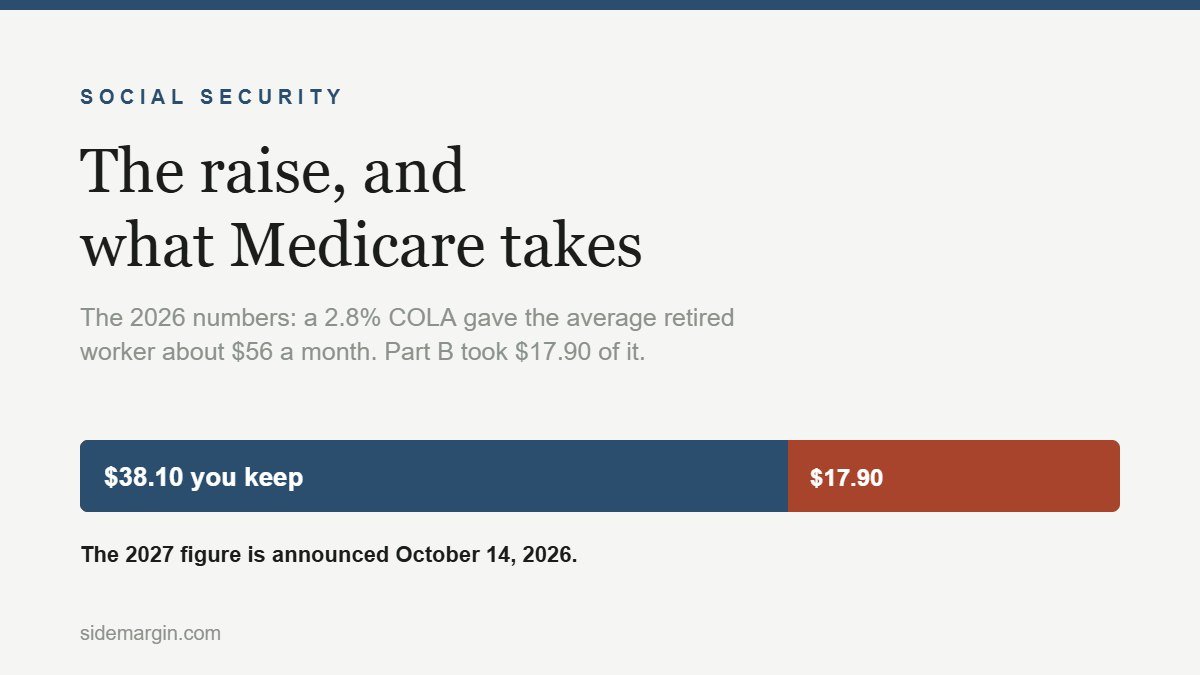
- The 2026 COLA was 2.8 percent, worth about $56 a month to the average retired worker.
- The Medicare Part B premium rose $17.90 in 2026, which ate roughly a third of that raise.
- Nobody votes on it. The formula runs automatically on Labor Department data.
Fact-checked against SSA, BLS, CMS and IRS sources on September 1, 2026.
When the Social Security COLA 2027 number arrives
The Social Security Administration has published nothing about 2027 yet. That is not an oversight. The calculation needs September inflation data, and the Bureau of Labor Statistics is not releasing that until Wednesday, October 14, 2026.
SSA announced the COLA on the CPI release date in each of the last three years, so mark October 14 rather than any earlier date you may have seen.
One caution. The 2026 announcement came on October 24, 2025, not in mid-October. BLS moved the September 2025 release to that date, and during the federal funding lapse it collected no CPI data at all between October 1 and November 12. Treat October 14 as expected, not guaranteed.
Whatever the number is, it takes effect with December benefits and shows up in January 2027 payments.
How the number is actually worked out
The COLA is a cost-of-living adjustment applied to Social Security benefits each year. It follows a formula written in law, and the formula is narrower than most people assume.
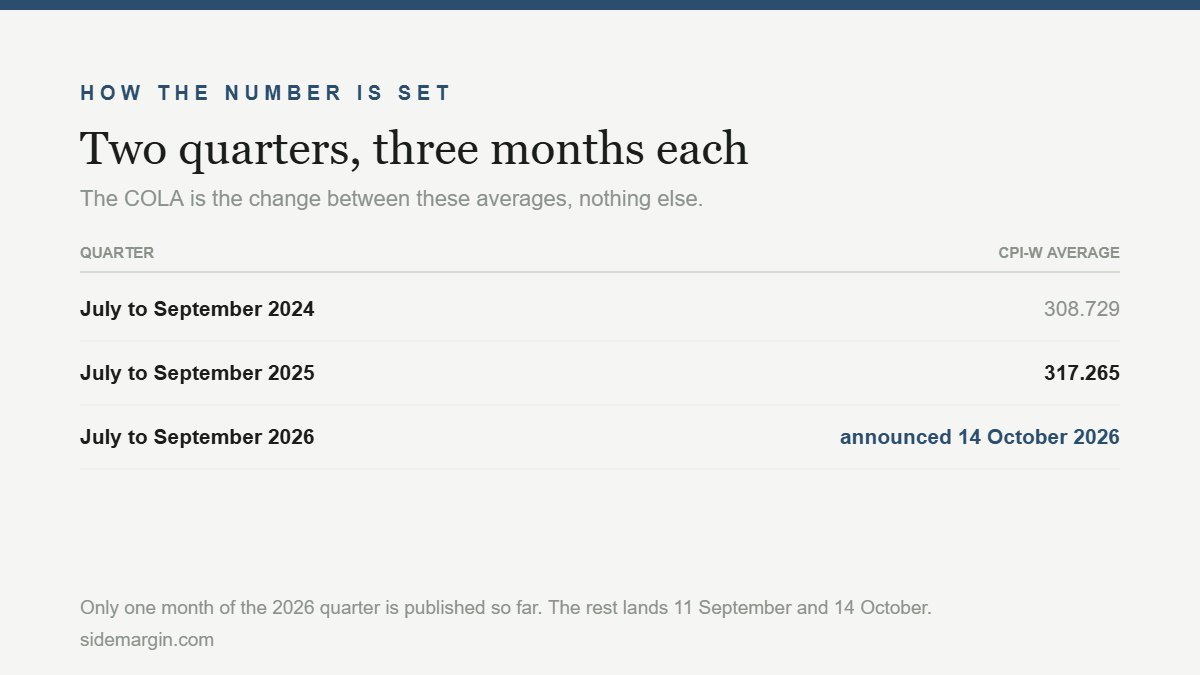
SSA compares one three-month average against another. It takes July, August and September of this year, averages them, and compares that to the same three months of the last year a COLA took effect. The index used is the CPI-W, which measures prices for urban wage earners and clerical workers.
The result is rounded to the nearest 0.1 percent. If it comes out at zero or below, there is no COLA that year.
Here is the 2026 calculation, using SSA’s own published figures.
| Quarter | Average CPI-W |
|---|---|
| July to September 2024 | 308.729 |
| July to September 2025 | 317.265 |
| Difference | 2.8 percent |
For 2027 the base is that same 317.265. As of September 1, only July 2026 is published, at 327.104. August lands on September 11 and September on October 14, so the answer genuinely is not known yet.
The Medicare catch in the Social Security COLA
The COLA is announced as a percentage. What reaches your bank account is that percentage minus a Medicare premium that also went up.
Part B premiums are normally withheld from the Social Security payment, and the increase comes out after the COLA is applied, which makes the raise you read about a gross figure rather than what lands in your account.
The 2026 numbers show the size of it. The standard Part B premium went from $185.00 to $202.90, an increase of $17.90 a month. The average retired worker’s COLA increase was about $56.
The Part B deductible also rose, from $257 to $283 for the year.
Roughly a third of the average raise went straight back out. The average aged widow or widower went from $1,867 to $1,919, a $52 raise, so the premium took about 34 percent of it. And on a $1,000 monthly benefit, where 2.8 percent is $28, the premium increase takes about 64 percent.
Work out your own net raise
Three steps, using the 2026 figures as the worked example. Swap in the 2027 numbers when both are announced.
| Step | Worked example | Yours |
|---|---|---|
| 1. Your monthly benefit × the COLA | $2,015 × 2.8% = $56 | |
| 2. Subtract the Part B premium increase | $56 − $17.90 = $38.10 | |
| 3. Net raise as a share of the headline | $38.10 ÷ $56 = 68% |
The smaller your benefit, the worse step 3 looks. The premium increase is a flat dollar amount, so it takes a bigger bite out of a small raise than a large one.
Hold harmless, and its limits
There is a protection in the law for people whose COLA is smaller than their premium increase. SSA describes it plainly: the hold harmless provision “protects your Social Security benefit payment from decreasing due to an increase in the Medicare Part B premium.”
Read that carefully. It stops your payment falling. It does not give you your raise. A protected person keeps the same check as last year, which is better than less, but it is not an increase.
Four groups get no protection at all:
- People enrolling in Part B for the first time that year
- People paying the income-related surcharge, IRMAA
- People whose premium is paid by a state Medicaid agency
- People who pay Medicare directly rather than having the premium withheld
One more piece of timing. The COLA and the Part B premium are announced separately, and the gap between them moves. CMS published the 2024 premiums on the same day SSA announced that year’s COLA. For 2026 it came about three weeks later, in mid-November 2025. Until CMS publishes, the COLA figure you have is a gross number with no cost attached to it.
Social Security COLA 2027 forecasts, and what they are worth
Two estimates are worth the time. They disagree, and both are forecasts rather than figures.
| Source | Estimate | Dated | Based on |
|---|---|---|---|
| Social Security Trustees | 2.7 percent | June 2026 | Intermediate economic assumptions |
| The Senior Citizens League | 3.6 percent | August 2026 | July inflation data |
The Trustees figure comes from federal actuaries, but it was set in June, before any of the three months that decide the answer. The Senior Citizens League number is more current and built on actual inflation prints, but it comes from an advocacy group and it is revised monthly.
Treat both as a range rather than an answer. The August inflation figure lands on September 11 and will move them again.
What else changes on the same day
The COLA announcement carries a set of other annual figures with it. Here is what they did for 2026.
| Item | 2025 | 2026 |
|---|---|---|
| Taxable maximum | $176,100 | $184,500 |
| Earnings limit, under full retirement age | $23,400 | $24,480 |
| Earnings limit, year you reach it | $62,160 | $65,160 |
| SSI payment standard, individual | $967 | $994 |
| Maximum benefit at full retirement age | $4,018 | $4,152 |
The taxable maximum and the earnings limits are not set by the COLA. They follow average wage growth instead. They change on the same day for a different reason.
Four things people get wrong
That Congress votes on it. It does not. President Nixon signed automatic increases into law in July 1972, and the first one took effect in June 1975. The formula has run on Labor Department data since. Congress can still legislate over the top of it, and has: Public Law 106-554 set the 1999 COLA at 2.5 percent instead of the 2.4 percent the formula produced. That is the exception, not the annual process.
That everyone gets the same dollar increase. The percentage is uniform, but the dollars are not. The COLA is applied to your primary insurance amount and truncated to the next lower dime, then adjusted for when you claimed and truncated again, then reduced by any premium and truncated to a whole dollar. SSA warns that the result “may differ somewhat from the COLA.” The $56 figure is an average, not a promise.
That it uses the inflation rate on the news. Headline inflation is CPI-U, which covers over 90 percent of the population. The COLA uses CPI-W, which covers about 30 percent, all of them working households. A December price spike is irrelevant to it, because only July through September count.
That a bigger COLA changes how benefits are taxed. It does not change the rules, but it does move you against them. The income thresholds for taxing benefits are $25,000 for single filers and $32,000 for joint filers, and they are fixed in law with no inflation adjustment. Benefits rise every year while the thresholds sit still, so each COLA pushes a few more retirees over them.
Recent COLAs, for context
These are labeled by the year the money arrives, which is how most people talk about them.
| Payments from January | COLA |
|---|---|
| 2022 | 5.9% |
| 2023 | 8.7% |
| 2024 | 3.2% |
| 2025 | 2.5% |
| 2026 | 2.8% |
The record high was 14.3 percent in 1980. The lowest increase that was not zero was 0.3 percent. And there have been three years with no COLA at all, most recently affecting January 2016 payments.
Frequently asked questions
When will the 2027 Social Security COLA be announced?
On or about October 14, 2026, when September inflation data is published. The date can move if that release moves.
When will I see the increase?
In your January 2027 payment. SSI recipients see it earlier: because January 1 is a holiday, SSA always makes the January SSI payment at the end of the previous December, so December 31, 2026.
Can the COLA be zero?
Yes. It has happened three times. If prices do not rise between the two comparison quarters, there is no increase. Benefits are never cut, though.
Why is my raise smaller than the COLA?
Usually the Medicare Part B premium, which is deducted after the increase is applied. Rounding at three separate steps takes a little more.
Is Social Security tax-free for seniors now?
No. A separate deduction of $6,000 for people 65 and over, or $12,000 for a married couple where both qualify, runs from 2025 through 2028. It phases out above $75,000 of modified adjusted gross income, or $150,000 for joint filers. That deduction does not repeal tax on benefits.
The bottom line
Put October 14 in the calendar and ignore the forecasts until then. When the number comes, remember it is a gross figure. The rest arrives when CMS publishes the Part B premium, which has landed anywhere from the same day to three weeks later. Last year that premium took about a third of the average increase.
This is general information, not financial advice.
More from Side Margin
- LIHEAP Application: How to Get Help With Your Heating Bill
- How to Cancel Subscriptions You Forgot You Had
Sources
- SSA, latest cost-of-living adjustment
- SSA, how the COLA is applied to a benefit
- SSA press release, 2026 COLA announcement
- SSA, 2026 COLA fact sheet
- SSA, historical COLA series
- SSA, on the hold harmless provision
- SSA press release, the 2026 Trustees Report
- BLS, September 2025 CPI release rescheduled
- BLS, 2025 federal government shutdown impact on the CPI
- CMS, 2024 Medicare Part B premiums and deductibles
- SSA, Social Security COLAs and the Consumer Price Index
- SSA, Trustees Report assumptions and COLA projections
- BLS, 2026 release schedule
- BLS, CPI questions and answers, on CPI-U versus CPI-W
- CMS, 2026 Medicare Part B premiums and deductibles
- IRS Publication 915, taxation of Social Security benefits
- IRS, the enhanced deduction for seniors
- The Senior Citizens League, August 2026 COLA projection