
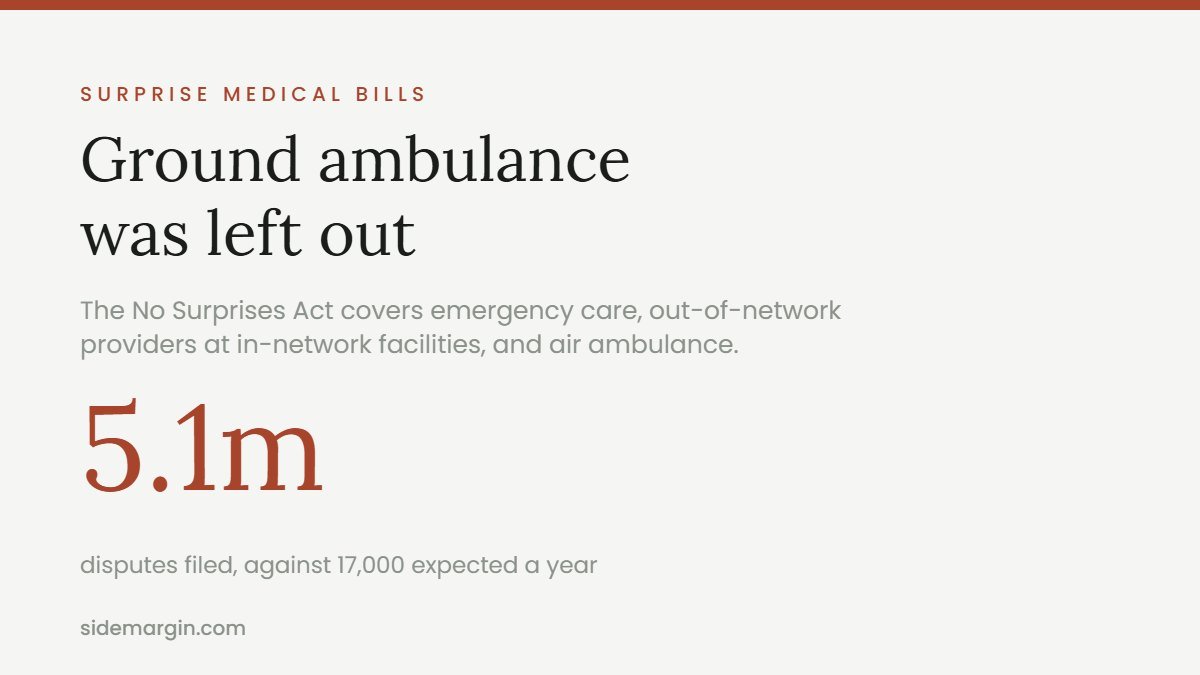
Federal law has protected you from most surprise medical bills since 1 January 2022. It covers emergency care, out-of-network providers working inside in-network facilities, and air ambulances. It does not cover the ambulance that drove you there on the ground, which is the single most common surprise bill of all. About 85% of emergency ground ambulance transports are delivered by out-of-network providers.
Understanding exactly where the protection stops is the whole game, because inside the line you often owe nothing beyond your in-network cost sharing, and outside it you are on your own.
Key takeaways
- Covered: emergency services, non-emergency care from out-of-network providers at in-network facilities, and air ambulance.
- Not covered: ground ambulance. Congress left it out pending further study. The study reported in 2024 and nothing has happened since.
- 22 states have stepped in on ground ambulance. Federal action has stalled.
- Some protections cannot be waived at all. Emergency medicine, anaesthesiology, neonatology, pathology, radiology, diagnostics and assistant surgeons are on a list where a signed consent form is not valid.
- If you are uninsured or self-paying, you get a Good Faith Estimate, and you can dispute a bill that beats it by $400 or more, for a $25 fee.
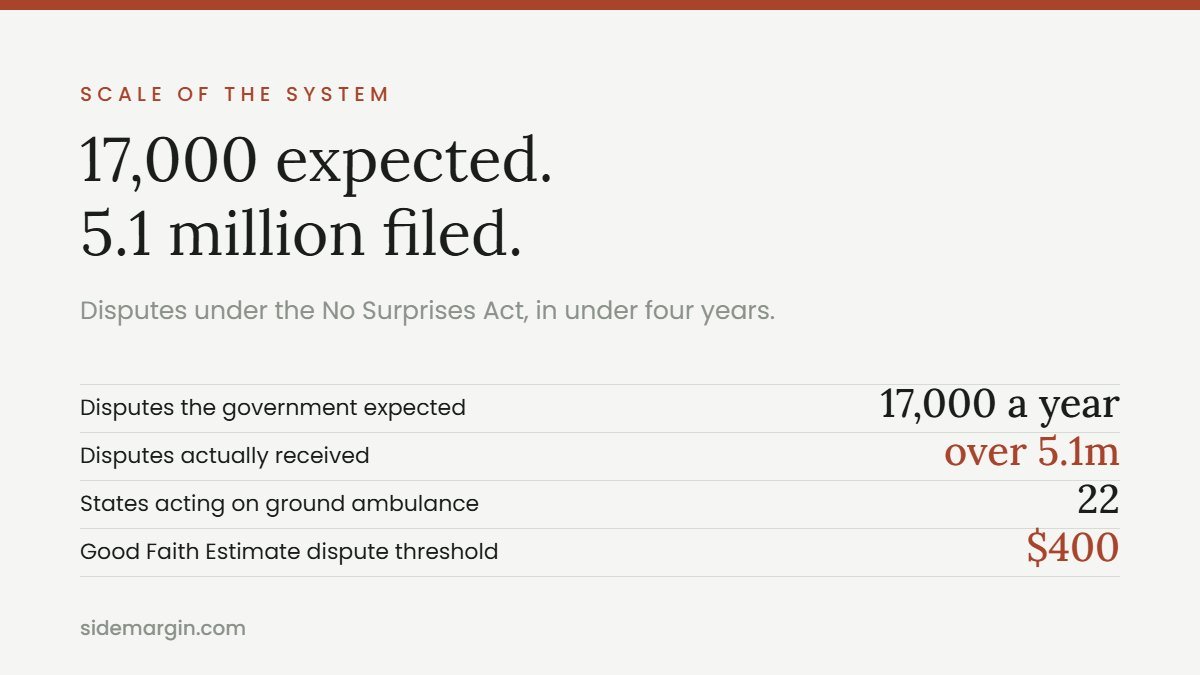
- The system is being used at enormous scale. The government expected roughly 17,000 disputes a year. It has received over 5.1 million in under four years.
- Complaints go to 1-800-985-3059. That is a different process from the $25 dispute, and people mix them up constantly.
What the No Surprises Act actually covers
Three situations, in CMS’s own words. You are protected from unexpected out-of-network bills for “Emergency room visits, Non-emergency care related to a visit to an in-network hospital, hospital outpatient department, or ambulatory surgical center, Air ambulance services.”
The second one is the most valuable and the least understood. If you check into an in-network hospital for a planned procedure and the anaesthetist, the radiologist or the assistant surgeon turns out to be out of network, that is precisely the scenario the law was written for. You pay your normal in-network cost sharing. The provider and the insurer fight about the rest without you.
Before the law, this was routine. Analysis of 2017 claims found that 18% of all emergency visits and 16% of in-network hospital stays included at least one out-of-network charge. Four in ten insured adults said they had received an unexpected medical bill in the previous year.
The ground ambulance hole
CMS states it directly in its consumer protections document: the surprise billing protections “generally do not apply … To ground ambulance services. However, other remedies may be available.”
That exclusion was deliberate. Congress left ground ambulance out pending further study. The numbers explain why it matters so much.
| Finding | Figure |
|---|---|
| Emergency ground ambulance transports delivered out of network | 85% |
| Non-emergency transports out of network | About 57% |
| 911 calls that produce a response without transport | About 30% |
| Privately insured ambulance trips resulting in a surprise bill | More than one in four |
| Average ground ambulance bill, commercially insured, 2021 | $1,093 |
The study Congress ordered was done. The Ground Ambulance and Patient Billing Advisory Committee delivered its report to the Secretaries on 28 August 2024, with twelve recommendations. Recommendation 12 was to “Prohibit balance billing and guarantee reasonable payment for ground ambulance emergency medical services”. Recommendation 8 would cap patient cost sharing at “the lesser of $100 (adjusted by the CPI-U annually) or 10% of the rate”. The Committee stressed the recommendations were an interconnected system and should not be adopted piecemeal.
Two years later Congress has not acted, and the committee is listed as inactive. As the Commonwealth Fund put it in February 2026, “federal action has stalled”.
States have moved instead. People in 22 states now have some protection from surprise ground ambulance bills, with North Dakota, Utah, New Hampshire and Oregon acting in 2025, Illinois revamping existing protections and Texas extending its own through September 2027. If you want to know whether you are covered, your state insurance department is the place to ask, not the federal help desk.
Four surprise medical bills people wrongly think are covered
The law is narrower than its name suggests. It protects you from being billed the balance when an out-of-network provider was effectively forced on you. It is not a general rule that medical bills must not surprise you. These four situations feel identical to a patient and are handled completely differently.
- A service your plan simply does not cover. If your policy excludes something, the No Surprises Act does not make it covered. That is an appeal, not a surprise billing complaint.
- A denial for lack of prior authorisation. Also an appeal. The internal and external review process is the route, and the deadlines are 180 days and four months.
- Your own deductible and coinsurance. The law caps what you owe at the in-network level. It does not make the in-network level zero. On a plan with a $3,000 deductible, a protected emergency visit can still produce a $3,000 bill and that bill is correct.
- Choosing an out-of-network provider on purpose. If you sought out a specialist who is not in your network, you made that decision and the balance is yours.
One clarification that comes up constantly. The protections do apply to self-funded employer plans, which cover a large share of US workers and are exempt from most state insurance law. That is exactly why a federal statute was needed. If your employer self-insures, you are covered by the federal rules even where your state’s own surprise billing law would not reach you.
It is also worth knowing what counts as an emergency, because it is broader than people assume. The standard is what a prudent layperson would consider an emergency at the time, based on the symptoms, not what the diagnosis turned out to be. Chest pain that proves to be indigestion was still an emergency when you went in, and a claim denied on the grounds that it turned out to be nothing is worth appealing.
The consent form you can refuse to sign
There is a notice and consent exception. In limited circumstances a provider may ask you to waive your protections in writing, and this is where people get caught.
It can only be offered for post-stabilisation services, and only if you can safely travel by non-medical transport to nearby in-network care, or for non-emergency services that are not urgent and where in-network alternatives exist.
And there is a list of services where the protections cannot be waived at all, whatever you sign. CMS names them: “Emergency medicine, Anesthesiology, Neonatology, Pathology, Radiology”, plus “Diagnostic services, including radiology and laboratory services” and “Items and services provided by assistant surgeons, hospitalists, intensivists”.
The practical takeaway is worth repeating to anyone about to have a procedure. If a form is put in front of you at anaesthesia pre-op, or in an emergency department, covering any of the specialties on that list, a signature does not make it valid. You are entitled to decline, and you should.
If you are uninsured or paying cash
A separate and genuinely useful right applies here, and hardly anyone exercises it.
CMS: “Usually, if you don’t have or use health insurance, providers must give you a good faith estimate of what your care will cost. You get the estimate when you schedule care in advance or if you ask for one. You may be able to dispute your bill if it’s at least $400 more than the estimate.”
To use the patient-provider dispute resolution process, all six of these must be true:
- You did not have or did not use health insurance to pay for the care.
- You told the provider before treatment that you were not using insurance.
- The care was on or after 1 January 2022.
- You have a Good Faith Estimate received three days before the scheduled appointment.
- You have an initial bill dated within the last 120 calendar days.
- A provider charged at least $400 more than their Good Faith Estimate.
The filing fee is a “$25 non-refundable administrative fee”, and if your dispute succeeds “the $25 will be deducted from the amount you owe your provider”. You file online through the CMS dispute portal or by post.
The 120 day window is the trap. If a bill sits in a pile for four months, this door closes, and it is the only route that forces an independent look at whether a self-pay charge was reasonable.
What has actually happened since 2022
Behind the scenes, an arbitration system decides what the insurer pays the out-of-network provider once you are taken out of the middle. It is called Independent Dispute Resolution, and the numbers are extraordinary.
| Measure | Figure |
|---|---|
| Disputes submitted since the programme began, to 31 January 2026 | Over 5.1 million |
| Disputes initiated, July to December 2025 | 1,372,563 |
| Disputes closed, July to December 2025 | 1,449,900 |
| Resolved or under 30 business days old, end of 2025 | 98% |
| Payment determinations won by providers | About 85% |
| Payment determinations won by health plans | About 14% |
| Ineligibility rate, second half of 2025 | 19%, down from about 69% in early 2022 |
The government projected roughly 17,000 disputes a year when the law was written. It has received over five million in under four years, which is a forecasting error of a scale rarely seen. The backlog that produced is finally under control, and the agencies responded with a rule published on 4 June 2026 aimed at the causes: standardised claim adjustment codes, a codified definition of bundled payments, expanded disclosure of the qualifying payment amount, formal open negotiation procedures, and conflict of interest review for arbitrator selection.
Being straight about a gap: I could not find a study measuring how much consumer-facing surprise billing has actually fallen since 2022. Five million arbitration cases proves the law is being used. It does not by itself prove how many bills stopped reaching patients.
What to do when surprise medical bills arrive
- Work out which category it is. Emergency, out-of-network provider at an in-network facility, air ambulance: protected. Ground ambulance: check your state. Something else: it is an ordinary billing dispute.
- Do not pay it. Paying a bill that should never have been sent makes recovering the money much harder than declining to pay it.
- Get the Explanation of Benefits and compare it with the bill. If the EOB shows the claim was processed at the in-network rate and the provider is billing you the balance anyway, that is the violation, plainly stated.
- Call the provider’s billing office and say the words. “This is a surprise bill covered by the No Surprises Act and I am not liable for the balance.” A meaningful share get withdrawn at this step, because the billing system generated it automatically.
- Call your insurer and ask them to reprocess at in-network cost sharing.
- File a complaint if that fails. The No Surprises Help Desk is 1-800-985-3059, open seven days a week, weekdays 8am to 8pm Eastern and weekends 10am to 6pm, with support in over 350 languages. CMS will “Review your complaint to make sure your health insurance company, health care provider, or health care facility followed surprise billing rules”.
- Keep everything in writing. Dates, names, reference numbers.
Keep the two federal routes straight, because they are constantly confused. The complaint line is for a provider breaking the rules. The $25 dispute is for a self-pay bill that beat its Good Faith Estimate by $400 or more. Different processes, different portals, different eligibility.
If the bill turns out not to be covered, you are back to ordinary tools, and they are stronger than most people think. Start with how to dispute a medical bill, particularly the 240 day charity care window at nonprofit hospitals and the published discounted cash price that every hospital is required to post.
And the cheapest prevention, before any of this: know your out-of-pocket maximum before you need it, and confirm your facility and your providers are in network for the coming plan year rather than the last one, which is one line on the open enrollment checklist.
Rules and figures current as of 17 September 2026. IDR data is from CMS reporting covering July to December 2025 and a June 2026 final rule. State ground ambulance protections change frequently. This is general information, not legal advice.
Sources
- CMS, No Surprises Act overview of key consumer protections
- CMS, No Surprises Act protections for consumers
- CMS, understand your rights against surprise medical bills
- CMS, patient-provider dispute resolution and the $25 fee
- CMS, Good Faith Estimates and the $400 threshold
- CMS, No Surprises Help Desk
- CMS, submit a No Surprises complaint
- CMS, Ground Ambulance and Patient Billing Advisory Committee
- GAPB Advisory Committee, report on preventing out-of-network ground ambulance balance billing
- Commonwealth Fund, states acting on surprise ground ambulance bills, February 2026
- CMS, Federal IDR supplemental background, second half of 2025
- Federal Independent Dispute Resolution Operations final rule, 4 June 2026
- CMS, No Surprises reports index
- Peterson-KFF, ground ambulance rides and the potential for surprise billing
- Peterson-KFF, the pre-2022 baseline on surprise medical bills