
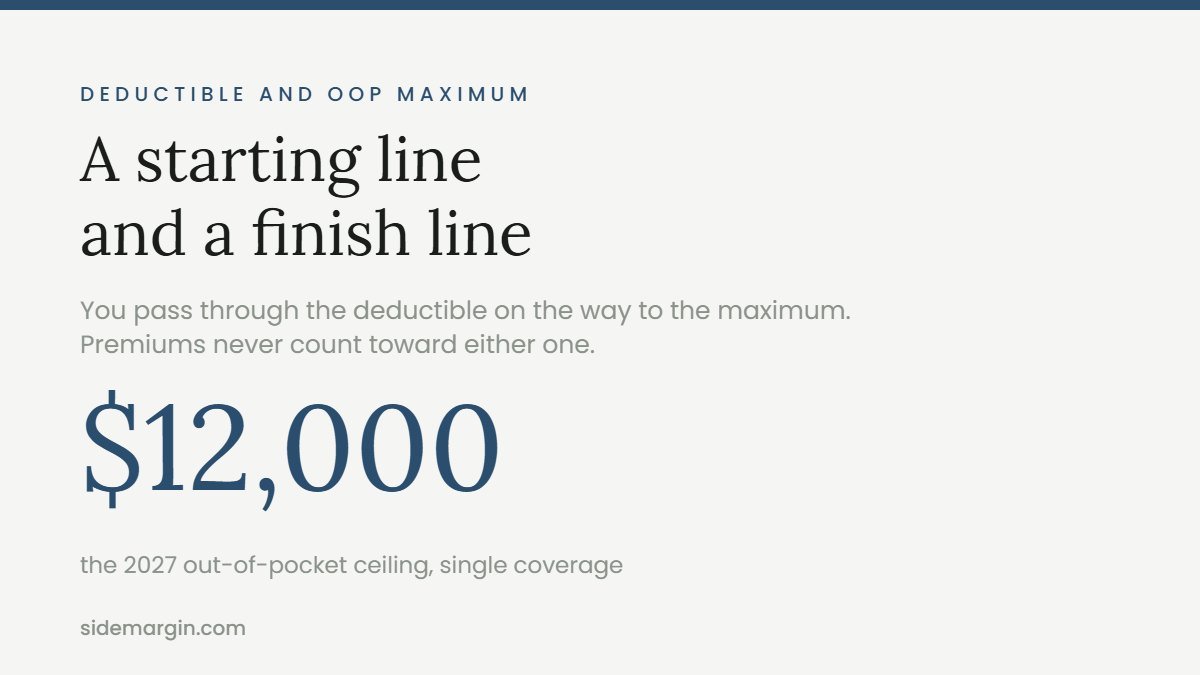
Deductible vs out-of-pocket maximum is the pair of numbers that decides what a bad year actually costs you, and most explanations of them are vague in exactly the place where the money is. The deductible is not the most you will pay. The out-of-pocket maximum is, and for 2027 the legal ceiling on it moved to $12,000 for one person.
Here is the order your money moves in, what stops counting when, and why the plan with the smaller deductible is frequently the more expensive one.
Key takeaways
- The deductible is a starting line. The out-of-pocket maximum is a finish line. You pass through the first on your way to the second.
- Premiums never count toward either. They are a separate, guaranteed cost that continues after you have hit your maximum.
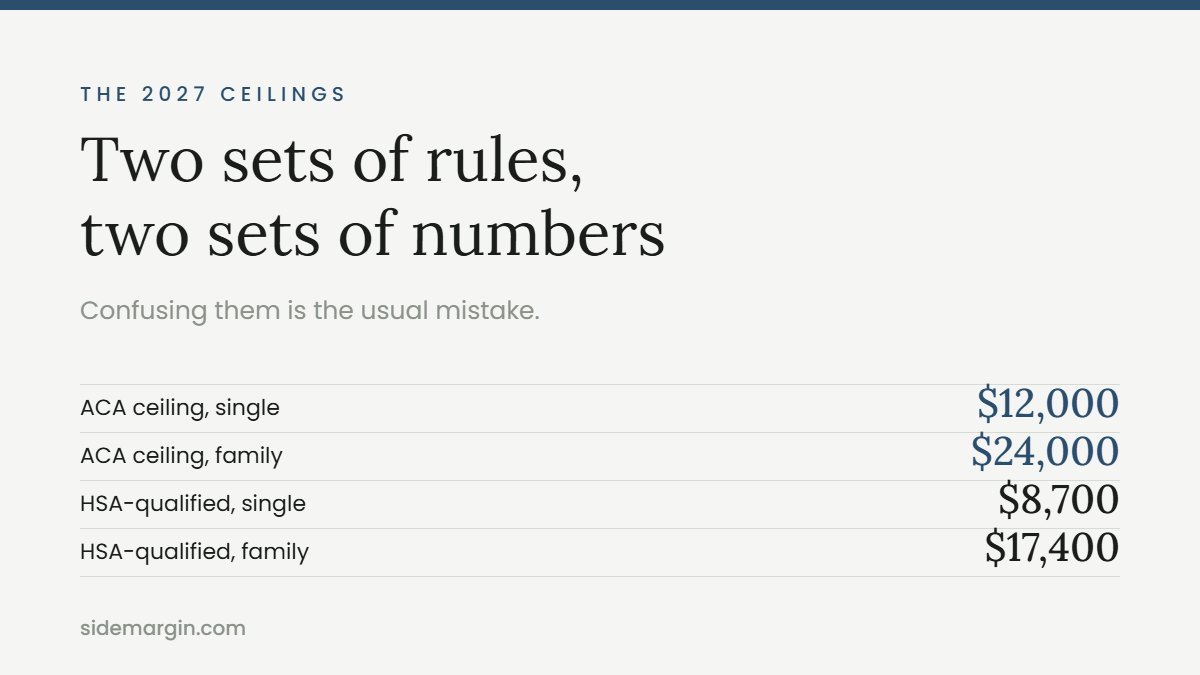
- The 2027 ceiling is $12,000 single and $24,000 family, up from $10,600 and $21,200 in 2026.
- The HSA-qualified limits are different and lower: $8,700 and $17,400 for 2027. Two sets of rules, two sets of numbers, and confusing them is the usual mistake.
- No one person can be made to pay more than the single limit, even on a family plan with a much larger family maximum.
Deductible vs out-of-pocket maximum: the five words defined
These are the official definitions, because the differences between them are precise:
- Premium: “The amount you pay for your health insurance every month.”
- Deductible: “The amount you pay for covered health care services before your insurance plan starts to pay.”
- Copayment: “A fixed amount ($20, for example) you pay for a covered health care service after you’ve paid your deductible.”
- Coinsurance: “The percentage of costs of a covered health care service you pay (20%, for example) after you’ve paid your deductible.”
- Out-of-pocket maximum: “The most you have to pay for covered services in a plan year. After you spend this amount on deductibles, copayments, and coinsurance for in-network care and services, your health plan pays 100% of the costs of covered benefits.”
One caveat the official definition glosses over. It describes copays as applying after the deductible, and plenty of plans work that way. Plenty of others charge a flat copay for a doctor visit from day one while the deductible still applies to scans, procedures and hospital care. Your Summary of Benefits and Coverage is what governs, and it is the document to check rather than the glossary.
The order your money actually moves
Take a plan with a $2,000 deductible, 20% coinsurance, a $6,000 out-of-pocket maximum and a $400 monthly premium. Illustrative numbers, real mechanics.
| Stage | What happens | Running total |
|---|---|---|
| January to March | $2,000 of care. You pay all of it. Deductible met. | $2,000 |
| April | $20,000 surgery. You pay 20%, which is $4,000. | $6,000 |
| May to December | Maximum reached. Plan pays 100% of covered in-network care. | $6,000 |
Three things to take from that table.
The deductible is inside the maximum, not on top of it. The $2,000 counted toward the $6,000. People frequently add them together and frighten themselves with a number that does not exist.
Coinsurance stops. That is the whole function of the maximum. Without it, 20% of a catastrophic bill is unbounded.
The premium is not in the table at all. That is $4,800 over the year, paid in every month including the ones where the plan is paying everything. Total outlay in this example is $10,800, and only $6,000 of it is what insurance people mean by “out of pocket”.
The two limit tables people mix up
There are two different federal ceilings and they do different jobs.
The ACA limit is the outer boundary. No non-grandfathered plan may set an out-of-pocket maximum above it.
| Plan year | Single | Family |
|---|---|---|
| 2026 | $10,600 | $21,200 |
| 2027 | $12,000 | $24,000 |
The HSA limit is stricter, and it is a qualification test rather than a ceiling. A plan only counts as a high deductible health plan, and only lets you contribute to a health savings account, if it sits inside these:
| 2027, HSA qualified | Single | Family |
|---|---|---|
| Minimum deductible | $1,750 | $3,500 |
| Maximum out of pocket | $8,700 | $17,400 |
| Contribution limit | $4,500 | $9,000 |
The IRS wording is worth having exactly, because the deductible has a minimum and the out-of-pocket has a maximum, which is counter-intuitive: a high deductible plan is defined as “a health plan with an annual deductible that is not less than $1,750 for self-only coverage or $3,500 for family coverage, and for which the annual out-of-pocket expenses (deductibles, co-payments, and other amounts, but not premiums) do not exceed $8,700 for self-only coverage or $17,400 for family coverage.”
So the HSA-qualified ceiling for 2027 is $3,300 lower than the ACA ceiling. A plan can legally sit anywhere between the two, but the moment it goes above $8,700 it stops being HSA eligible. If you are weighing whether an account is worth it, the FSA vs HSA comparison covers the rest of the trade.
Embedded or aggregate: the family plan question
Family plans handle the deductible in one of two ways, and the difference can be thousands of dollars in a year when one person gets ill.
- Embedded: each person has their own individual deductible inside the family one. Once any single member meets theirs, the plan starts paying for that person, even though the family deductible is nowhere near met.
- Aggregate: the entire family deductible must be met in total before the plan pays for anyone. One person’s large claim is the family’s problem.
A family of four on a plan with a $6,000 aggregate deductible, where one member has a $4,000 hospital stay and nobody else uses care, pays the entire $4,000. On an embedded plan with a $3,000 individual deductible inside the same family amount, the plan starts paying after $3,000.
For the out-of-pocket maximum there is no such variation, because federal rules override it. CMS states that “the self-only maximum annual limitation on cost sharing applies to each individual, regardless of whether the individual is enrolled in self-only coverage or in coverage other than self-only.”
In plain terms: on a 2027 family plan with a $24,000 family maximum, no single member can be required to pay more than $12,000. Once they hit the single limit, the plan pays 100% for them regardless of where the family total stands.
What never counts toward the maximum
- Your monthly premiums.
- Anything your plan does not cover. Spending does not count merely because it was medical.
- Out-of-network care, as a general rule, with the important exception below.
- Amounts above the allowed charge, the balance billing that appears when a provider charges more than the plan considers reasonable.
That third one is where big bills go wrong. A plan can pay its share of out-of-network care while none of what you paid moves you toward your maximum, so a year that felt catastrophic leaves you short of the finish line.
The No Surprises Act exception
Since 2022 there are situations where out-of-network care must be priced as if it were in network, and those dollars do count toward your in-network deductible and maximum:
- Emergency care, including air ambulance, from an out-of-network provider or facility.
- Ancillary services at an in-network facility from an out-of-network clinician: anaesthesiology, radiology, pathology, neonatology, assistant surgeons. The people you do not choose.
- Care you received out of network because the provider directory was wrong.
This has a consequence worth planning around: a single emergency admission can carry you to your entire out-of-pocket maximum in one event, because it is priced at in-network terms. If that happens early in the year, every covered in-network thing you have been putting off is free for the rest of it.
This is a carve-out for surprise billing, not a general rule. Choosing to see an out-of-network specialist is still on you.
Where to find your real numbers
Every plan must give you a Summary of Benefits and Coverage, a standardised document in the same format across every insurer so that plans can be compared line by line. It is the document that answers the questions the glossary cannot.
Five things to look up in it before you choose:
- “Are there services covered before you meet your deductible?” This is where you learn whether your doctor visits are a flat copay from day one or full price until the deductible is met.
- Whether the family deductible is embedded or aggregate. If the document shows an individual figure inside the family figure, it is embedded.
- The separate prescription deductible, if there is one. Drug spending does not always share the medical deductible.
- The out-of-network out-of-pocket maximum, which is usually much higher than the in-network one and sometimes unlimited.
- The two coverage examples at the end, which show what the plan would pay for a routine birth and for managing type 2 diabetes. They are the closest thing to a like-for-like comparison anyone publishes.
Why the low deductible plan often loses
Compare two plans:
| Plan A, low deductible | Plan B, high deductible | |
|---|---|---|
| Premium | $600 a month | $400 a month |
| Deductible | $500 | $3,000 |
| Out-of-pocket maximum | $3,000 | $6,000 |
| A quiet year, $500 of care | $7,700 | $5,300 |
| A terrible year, maximum reached | $10,200 | $10,800 |
Plan B wins the quiet year by $2,400 and loses the terrible year by $600. That asymmetry is the whole argument, and it is why the instinct to buy the smallest deductible is usually wrong.
The reason is structural. The premium is guaranteed and the deductible is contingent. You pay the premium gap in every single month whether or not you ever see a doctor. You only pay the deductible gap if you get ill, and even then the difference is bounded by the maximum.
Compare annual premium plus realistic expected care, not worst case against worst case. Then check the worst case separately and ask whether you could survive it. Those are two different questions and most people only ask the second.
If you buy your own coverage, the premium side of this is heavily affected by your subsidy, which is calculated against a silver benchmark regardless of the plan you pick. That mechanism is in the ACA subsidy guide, and if you need coverage before November, the special enrollment period rules are the way in.
Figures current as of 16 September 2026. ACA limits are set annually in the HHS Notice of Benefit and Payment Parameters; HSA limits are set by IRS revenue procedure and are different numbers. The worked examples are illustrative.
Sources
- HealthCare.gov, out-of-pocket maximum
- HealthCare.gov, deductible
- IRS Revenue Procedure 2026-24, HSA and HDHP limits for 2027
- IRS Revenue Procedure 2025-19, HSA and HDHP limits for 2026
- CMS, FAQs on the maximum out-of-pocket limit for individuals
- CMS, No Surprises Act key consumer protections
- Georgetown CHIR, embedded deductibles and how they work