
Open enrollment for 2027 marketplace coverage starts on 1 November 2026. If you need insurance before then, a special enrollment period is the way in, and far more situations qualify than most people realise. Losing a job qualifies. So does turning 26, moving house, getting married, having a baby, and losing Medicaid.
One route that existed until recently no longer does, and the way that change happened is widely reported wrongly. That matters, because the wrong version suggests it might come back.
Key takeaways
- Most special enrollment periods run 60 days. A few let you enrol before the event, which is how you avoid a gap entirely.
- Losing coverage is the big one, and it counts even if you quit voluntarily. It is the loss of coverage that must be involuntary, not the loss of the job.
- The monthly low-income window for people under 150% of the poverty line is gone, for 2026 and 2027. Congress removed the tax credit for it in statute. A court reviving the regulation would not bring it back.
- Cancelling your own plan does not qualify. Neither does losing coverage for not paying the premium.
- You usually have 30 days after enrolling to send documents. Miss that and the enrolment can be undone after you thought it was settled.
What qualifies, and how long you get
| Event | Window | Enrol before? |
|---|---|---|
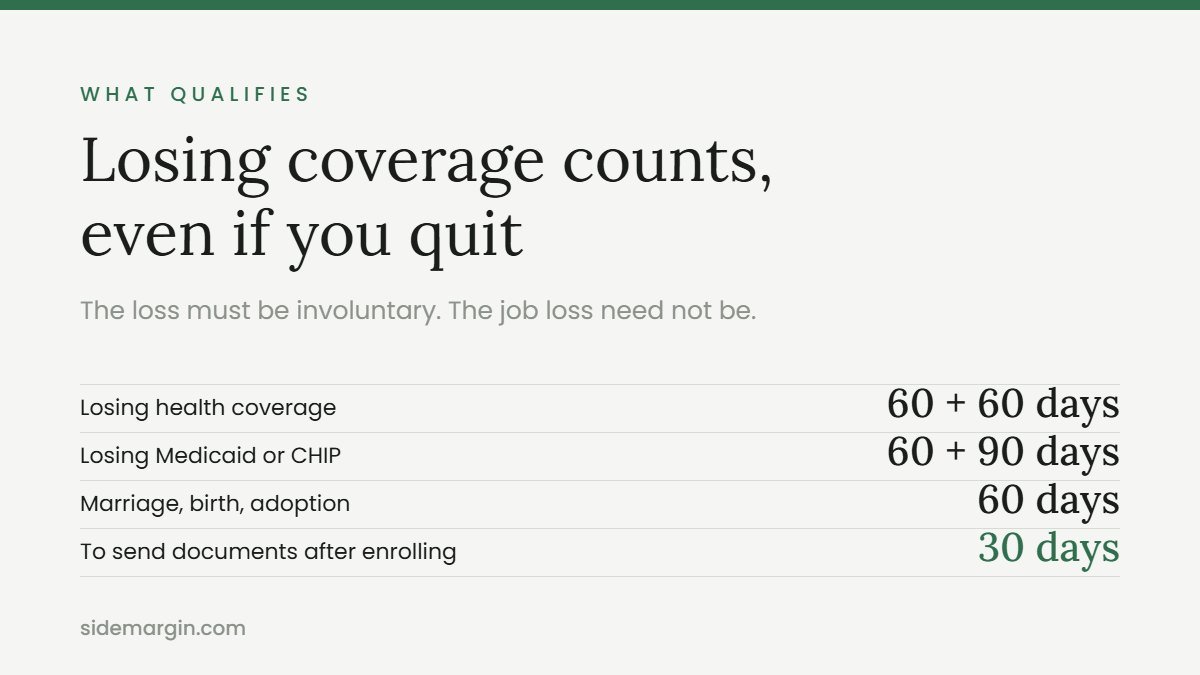
| Losing health coverage | 60 days before and 60 days after | Yes |
| Losing Medicaid or CHIP | 60 days before, up to 90 after | Yes |
| Marriage | 60 days after | No |
| Birth, adoption, foster placement | 60 days after | No, but coverage can backdate |
| Permanent move | 60 days after | Sometimes |
| Employer coverage becomes unaffordable | 60 days before and after | Yes |
| Gaining a health reimbursement arrangement | 60 days before and after | Yes |
| Release from incarceration | 60 days after | No |
| Gaining citizenship or lawful presence | 60 days after | No |
| Federally declared disaster that stopped you enrolling | 60 days from the end of the incident period | No |
| American Indian or Alaska Native status | Any month | Not applicable |
The “before” column is the part worth acting on. If you know in October that your employer coverage ends on 30 November, you can enrol in the first half of November and have marketplace coverage start on 1 December, with no uninsured day in between. Waiting until the coverage actually lapses guarantees a gap of at least a few weeks.
Marriage carries a condition that surprises people: in most cases at least one spouse must have had coverage during the 60 days before the wedding. Two uninsured people marrying do not generally unlock a window.
Losing coverage: what counts and what does not
This is the most used route and the most misunderstood, because of the word “involuntary”.
These count:
- Losing job-based coverage, whether you were dismissed or resigned. The test is the coverage, not the circumstances of leaving.
- Turning 26 and coming off a parent’s plan.
- Losing Medicaid or CHIP eligibility.
- COBRA coverage running out at the end of its term.
- Divorce or legal separation, but only where it actually causes a loss of coverage.
These do not:
- Cancelling your own plan. Dropping coverage voluntarily is the definition of not involuntary.
- Losing coverage because you stopped paying.
- Divorce on its own, if you keep your coverage through it.
- Coverage rescinded, unless the rescission was the insurer’s fault.
The first exclusion traps people who are trying to save money. Cancelling an expensive plan in July and planning to pick up a cheaper marketplace plan in August does not work. You are uninsured until 1 January.
COBRA has a matching subtlety. Letting COBRA run out is a qualifying event. Choosing to stop paying for COBRA part way through is not.
The low-income window is gone, and not for the reason you have read
From 2024 there was a monthly special enrollment period for anyone with expected income at or below 150% of the federal poverty line. It let people in that band enrol at any time of year rather than waiting for November.
It does not exist for 2026 or 2027, and the sequence matters:
- June 2025. CMS paused it by regulation, removing the relevant provision “through PY 2026”.
- The 2025 reconciliation law. Congress then amended the tax code itself. Section 71304 provides that no premium tax credit is allowed where a plan is enrolled in through a special enrollment period “based solely on the relationship of an individual’s expected income to the FPL and not on a change in circumstance”, effective for plan years beginning after 31 December 2025.
- May 2026. CMS finalised the removal for 2027 and beyond, stating it was acting “in alignment with” that statute.
Several consumer sites describe this as CMS deciding to ban the window. That framing is not just imprecise, it is misleading about what could change. Parts of the 2025 rule have been struck down in litigation. Even if a court restored this particular provision, no subsidy could attach to an enrolment made through it, because the bar sits in the tax code rather than the regulation. For almost everyone that makes the enrolment pointless.
If your income is under 150% of the poverty line and you have no qualifying event, the realistic options are Medicaid, if your state’s rules reach you, or waiting for 1 November.
Expect to be asked for proof in 2027
Verification is tightening. For 2027, CMS has finalised a requirement that exchanges on the federal platform run pre-enrolment verification on at least 75% of new special enrollment period enrolments, and has removed the previous restriction that limited such checks to loss of coverage.
There is a legal wrinkle worth knowing. A near-identical requirement from the 2025 rule was stayed in litigation. Rather than rely on that rule, CMS re-proposed and re-finalised the policy through fresh rulemaking for 2027, which makes it considerably more durable than the version that was blocked.
Practically: get your documents ready before you enrol, not after.
The document deadline that quietly undoes enrolments
For a loss of coverage window you generally have 30 days after enrolling to submit documents confirming you qualified. Healthcare.gov describes it as “30 days to confirm eligibility for a loss of coverage Special Enrollment Period.”
People treat picking a plan as the finish line. It is not. Miss the document deadline and the enrolment can be reversed, or your subsidy removed, after you have started using the coverage.
Useful documents: a termination letter from your employer or insurer showing the end date, a COBRA election notice, a Medicaid or CHIP denial or termination notice, or a letter confirming the date your parent’s plan stopped covering you. A pay stub is not proof of losing coverage.
If you do miss it, send them anyway. Healthcare.gov’s own guidance is to “submit documents, even if you miss the deadline.”
When coverage actually starts
- General rule: the first day of the month after you pick a plan. The old cutoff around the 15th of the month no longer applies to these windows, so enrolling on the 28th and the 3rd give the same start date.
- Losing coverage, enrolled in advance: the first of the month after your old coverage ends, with no gap.
- Birth, adoption or foster placement: coverage can be backdated to the date of the event, which means a baby born in the window can be covered from day one.
- State exchanges may differ. If you are in California, New York, Pennsylvania, Colorado, Maryland or another state running its own marketplace, check that site rather than assuming the federal rule.
The backdating rule for birth is the one people leave on the table, usually because they are busy. It is worth a phone call in the first week.
One thing that has expired
The temporary Medicaid unwinding window, created when states resumed eligibility checks after the pandemic, ran from 31 March 2023 to 31 July 2024 and is over.
Losing Medicaid is still a qualifying event under the ordinary rules, with a window that can extend to 90 days. It is the blanket, automatic version that ended.
If nothing qualifies you
Sometimes the honest answer is that no window is open. It is worth knowing what the remaining options actually are, because two of them are worse than they look.
Medicaid and CHIP have no enrolment window at all. They accept applications every day of the year. If your income has fallen, this is the first thing to test rather than the last, and eligibility is assessed on current monthly income rather than what you earned earlier in the year.
Short-term plans are not the same product. They can decline you for pre-existing conditions, exclude them once you are covered, cap what they pay, and they are not required to cover the essential benefits. They are insurance against an accident, not against illness you already have.
Health care sharing ministries are not insurance and carry no legal obligation to pay a claim. Members have discovered this at the worst possible time.
Check whether an event you dismissed actually counts. A move across a county line, a child ageing off a plan, a spouse’s employer changing its contribution enough to make coverage unaffordable, the end of a COBRA term rather than a cancellation. People rule themselves out on a summary rather than the list.
Special enrollment period: what to do
- Work out your event date and count 60 days from it. That is your deadline, not a guideline.
- If the event is in the future, enrol now where the rules allow it.
- Gather the document before you apply.
- Check what the subsidy will be. The rules changed for 2026 and the repayment exposure changed with them, which is covered in the ACA subsidy guide.
- Compare on total cost, not premium. The deductible and out-of-pocket maximum decide what a bad year costs you.
If none of these apply and you are waiting for 1 November, the two numbers that will shape your choice are the subsidy formula and the income thresholds, set out in the 2027 ACA subsidy and Obamacare income limits guides.
Current as of 16 September 2026. Litigation over the 2025 Marketplace Integrity rule continues in the Fourth Circuit, with argument scheduled for late October 2026, so verification rules may move again. The statutory bar on credits for income-based enrolment is not part of that case.
Sources
- HealthCare.gov, list of qualifying life events
- HealthCare.gov, documents and deadlines
- 45 CFR 155.420, special enrollment periods
- Federal Register, HHS Notice of Benefit and Payment Parameters for 2027
- Federal Register, Marketplace Integrity and Affordability final rule
- CMS, Medicaid unwinding special enrollment period FAQ
- Georgetown, City of Columbus v Kennedy litigation tracker