
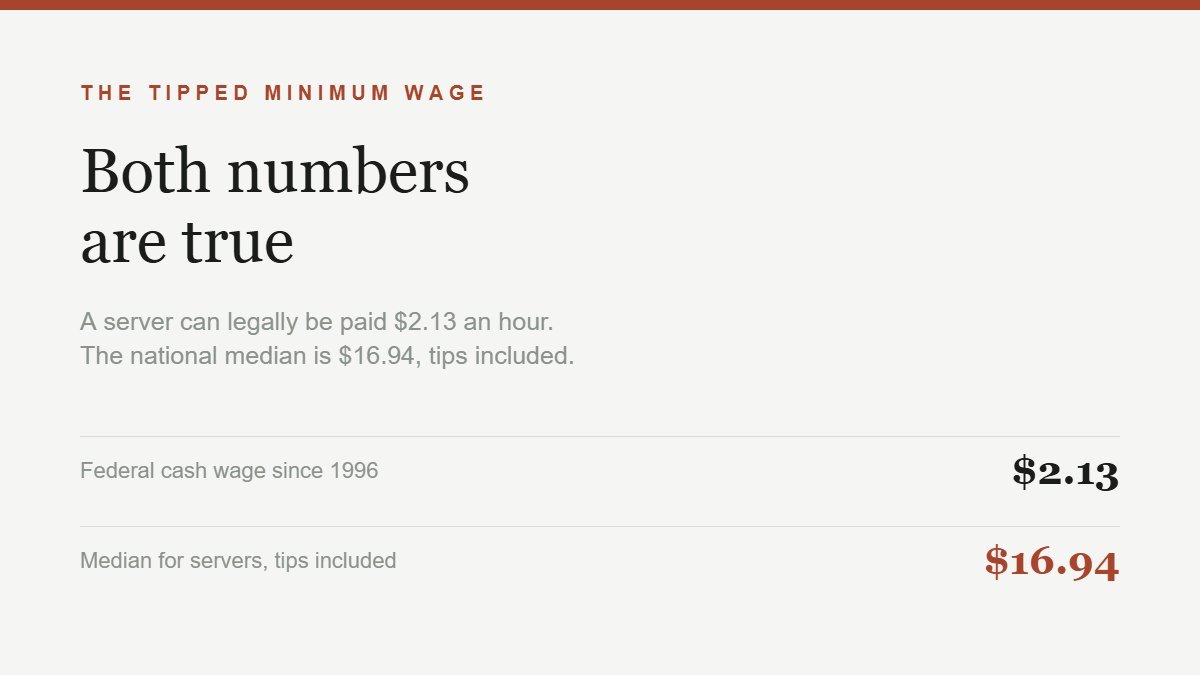
Two numbers are both true at the same time. The federal tipped minimum wage is $2.13 an hour, and a restaurant server in Georgia can legally be paid exactly that. The national median for waiters and waitresses is $16.94 an hour.
Almost every argument about tipping happens because people are holding one of those numbers and not the other. Here is how the tipped minimum wage actually works, what your state changes, and where the pressure you feel at the checkout screen is really coming from.
Key takeaways
- The federal tipped minimum wage is $2.13, and it has not moved since 1996 because the law freezes it to that date rather than indexing it.
- If tips do not bring a worker up to the minimum wage, the employer legally has to pay the difference. Most people on both sides of this argument do not know that.
- Seven states and Guam ban the tip credit entirely, so the tipped minimum wage there is simply the full minimum wage. In California a server gets $16.90 before a cent of tips.
- The $16.94 median from the government already includes tips. It is not a base wage.
- Tip percentages have barely moved in years. What changed is how often you are asked, and that is a software and business decision.
- New York City ran an accidental experiment proving it: when two apps moved the tip prompt, average tips fell from $3.66 to $0.93 per delivery.
The federal tipped minimum wage rule, in three sentences
The Department of Labor states it plainly. First, who counts: “A tipped employee engages in an occupation in which he or she customarily and regularly receives more than $30 per month in tips.”
Second, the tipped minimum wage itself: “An employer of a tipped employee is only required to pay $2.13 per hour in direct wages if that amount combined with the tips received at least equals the federal minimum wage.”
Third, and this is the sentence that changes the whole argument:
“If the employee’s tips combined with the employer’s direct wages of at least $2.13 per hour do not equal the federal minimum hourly wage, the employer must make up the difference.”
So a server whose tables tip nothing all night is not legally taking home $2.13 an hour. The employer owes the top-up to $7.25. The $5.12 gap between $2.13 and $7.25 is called the tip credit, and the employer only gets to claim it if the tips actually arrived.
Two honest caveats. That protection is only as good as enforcement, since it requires the employer to track and pay it. And it guarantees $7.25, which is not a living wage anywhere in the country.
Why the tipped minimum wage never rises
Here is a detail almost nobody reports. The statute does not contain the number $2.13. It sets the cash wage at “the cash wage required to be paid such an employee on August 20, 1996.”
The figure is frozen to a date in 1996. It is not indexed to inflation and it does not rise when the federal minimum wage rises. Changing it takes an act of Congress. That is why it has sat unchanged for three decades while everything else moved.
Your state’s tipped minimum wage changes almost everything
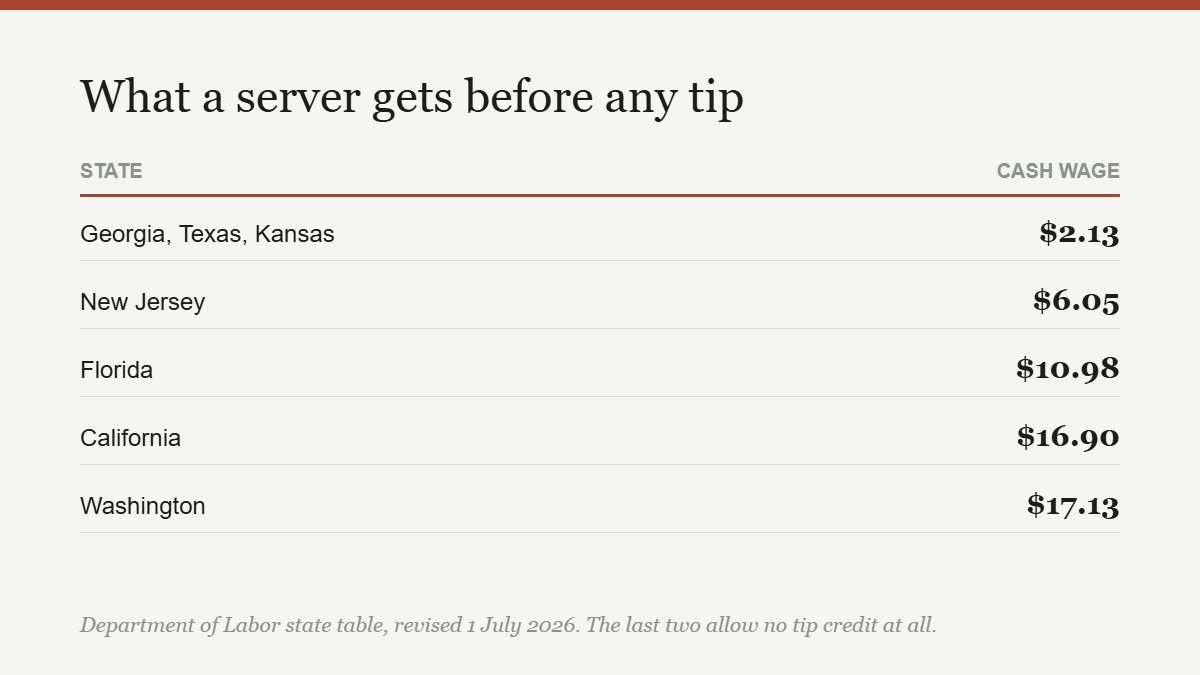
This is the part that makes national arguments about tipping useless. There is no single tipped minimum wage in America. Two servers doing identical work in different states are in completely different systems.
| State | Cash wage before tips | Tip credit |
|---|---|---|
| Georgia, Texas, Kansas, Wyoming | $2.13 | $5.12 |
| New Jersey | $6.05 | $9.87 |
| Florida | $10.98 | $3.02 |
| Nevada | $12.00 | None |
| Alaska | $14.00 | None |
| California | $16.90 | None |
| Washington | $17.13 | None |
The states that require the full minimum wage before tips are Alaska, California, Minnesota, Montana, Nevada, Oregon and Washington, plus Guam. Minnesota and Montana get miscategorised constantly in articles about this, so if you see a list that puts them in the tip-credit column, that list is wrong.
The practical consequence: in those states your tip is genuinely a bonus. In a $2.13 state your tip is doing the work the employer would otherwise have to do.
So what does a server actually earn?
The Bureau of Labor Statistics puts the median for waiters and waitresses at $16.94 an hour in May 2025, which works out to $35,230 a year. That is what the job pays in practice, far above the tipped minimum wage floor.
Before anyone uses that number in an argument, read the methodology note on the same page: “These wage data include tips.”
That single sentence resolves most online fights about server pay. The $16.94 is not a base wage that tips get added to. It is the total, tips already inside it. Anyone putting $16.94 next to $2.13 as if they are alternatives is comparing a total against one of its components.
The spread matters more than the median. BLS reports that “The lowest 10 percent earned less than $8.70, and the highest 10 percent earned more than $31.12.”
That is the same job paying under nine dollars and over thirty. A bartender at a busy city restaurant on a Friday and someone working weekday lunches at a diner in a small town are both in that figure. This is why “servers make good money” and “servers are underpaid” are both things people say sincerely.
The number the industry uses is very different
The National Restaurant Association, the trade body for restaurant owners and an interested party in this debate, puts the figure much higher. Its tip credit policy brief says “Waitstaff at fullservice restaurants earn a median of $27 an hour, with the highest paid tipped employees making $41.50.”
That is roughly sixty percent above the government number. Both cannot be describing the same population.
The likeliest explanation is scope. The Association’s figure appears to cover full-service restaurants only, while the BLS figure includes the whole occupation, casual and family dining included. We could not verify the Association’s underlying methodology, so treat the gap as unexplained rather than assuming either side is wrong.
What that gap should do is make you sceptical of any confident single number, including from people who agree with you.
A tipped minimum wage protection servers had, and lost, in 2024
This got very little coverage and it matters.
There used to be a rule limiting how much non-tipped side work an employer could pay at the tipped rate. Roll silverware, prep garnishes, clean the station: at some point that stops being tipped work. The 2021 rule capped it at 20 percent of the workweek, and at 30 continuous minutes.
The Fifth Circuit struck it down. The Department of Labor then formally removed it, and its own notice describes what happened:
“On October 29, 2024, the United States Court of Appeals for the Fifth Circuit issued a decision in Restaurant Law Center v. U.S. Department of Labor, vacating regulatory text codified at 29 CFR 531.56(e)-(f) from the Department’s 2021 Dual Jobs Rule, with the effect of reinstating the Department’s original dual jobs regulation.”
What governs now is regulatory text written in 1967, which draws the line by occupation rather than by clock. Its own example is a hotel maintenance man who also waits tables: two jobs, no tip credit for the maintenance hours. But it treats “a waitress who spends part of her time cleaning and setting tables, toasting bread, making coffee and occasionally washing dishes or glasses” as doing related duties inside one tipped job.
In practice: there is no longer any percentage cap or time limit on side work paid at the tipped rate. A server who used to be able to say “that was more than 20 percent of my shift” now has to argue that the work amounted to a separate occupation, which is a much harder case to make.
The top-up obligation still applies to all of it. Total pay still has to reach minimum wage.
One rule that is genuinely absolute
If you have ever wondered whether the manager is dipping into the tip pool, the statute is unusually blunt:
“An employer may not keep tips received by its employees for any purposes, including allowing managers or supervisors to keep any portion of employees’ tips, regardless of whether or not the employer takes a tip credit.”
No exceptions for owners, no exceptions for managers, and it does not matter how the business structures its wages. The one narrow carve-out is a manager keeping a tip a customer handed them directly for service they personally and solely provided.
Worth knowing: federal law sets no cap on what percentage of tips can be pooled among eligible staff. And when the employer does not take a tip credit, the pool can include back-of-house workers like cooks and dishwashers.
“No tax on tips” is not what it sounds like
US tax law now includes a deduction for tip income, and it applies to tax years 2025 through 2028, so it is live for the return you file for 2026. It is capped at $25,000 a year and phases out above $150,000 of modified adjusted gross income, or $300,000 filing jointly.
Three things about it are widely misunderstood.
It is a deduction, not an exemption. Tips are still income. Workers still have to report them.
It does not touch payroll tax. The final Treasury and IRS regulations say so directly: “Under section 3121(q), tips are also considered wages for Federal Insurance Contributions Act (FICA) purposes. However, the deduction under section 224 does not apply for FICA purposes and is not taken into account in determining wages subject to FICA tax.”
So Social Security and Medicare still come out of every reported tip dollar. “No tax on tips” reduces federal income tax only.
The benefit is smallest for the lowest earners. A deduction against income tax is worth nothing to a worker who already owes little or no federal income tax, which describes a lot of people in the $8.70 end of that BLS range.
One more detail with teeth: only voluntary tips qualify. A mandatory service charge is not a tip and does not qualify, even if the restaurant passes it to staff.
The tip line and the service charge line are not the same money
This is the most useful thing on this page and almost no diner knows it.
The IRS test for whether something is a tip has four parts: the payment must be free from compulsion, the customer must have the unrestricted right to determine the amount, it must not be dictated by employer policy, and generally the customer decides who receives it.
An automatic 18 percent for a party of six fails that test. The IRS says so with an explicit example, and adds that a mandatory charge stays a service charge even if the employer or employee calls the payment a tip or gratuity. The label does not control. The compulsion does.
Now the part that matters to your wallet. Federal wage regulation says a compulsory service charge is “not a tip” and that such sums “become part of the employer’s gross receipts.”
| Tip | Service charge | |
|---|---|---|
| Who decides the amount | You | The business |
| Whose money is it | The worker’s | The employer’s |
| Must it reach staff | Yes | No federal requirement |
| Qualifies for the tip deduction | Yes | No |
So when a bill arrives with a service charge already applied and a tip line underneath it, those two lines go to different places. The service charge is the house’s revenue. There is no federal rule making the restaurant give any of it to the person who served you.
If you want your money to reach the worker, the tip line is the one that is legally theirs.
Delivery is a completely different system
None of the above applies to a DoorDash or Uber Eats courier, because they are not employees. They are independent contractors, which means no minimum wage floor, no employer top-up, and no employer paying half their payroll tax.
DoorDash describes its pay as base pay plus promotions plus tips, and says of base pay: “This will range from $2-10+ when a Dasher chooses to earn per offer, depending on the estimated time, distance, and desirability of the offer.”
On tips it is explicit: “100% of tips received by DoorDash will go to the Dasher(s) associated with fulfilling the order, on top of base pay and promotions. The amount a Dasher earns in base pay and promotions will never vary based on the tip amount.”
That wording exists because it was not always true. Between 2017 and September 2019 DoorDash operated a model where customer tips offset the company’s own contribution instead of adding to it. Tip more, and DoorDash paid less; the courier ended up at the same guaranteed total either way. It settled with the District of Columbia for $2.5 million in 2020 and with New York for $16.75 million in 2025, covering around 63,000 workers.
Amazon did the same thing with its Flex drivers and paid the Federal Trade Commission $61.7 million, the full amount withheld.
Uber Eats has no comparable US settlement, and says of tips: “There are zero service fees applied to your tips.”
The costs you do not see
Two numbers explain why delivery economics are worse than they look.
The IRS sets a business mileage rate based on an annual study of what running a car actually costs, covering depreciation, fuel, maintenance and insurance. From 1 July 2026 that rate is 76 cents a mile.
A delivery involving five miles of driving therefore costs the courier about $3.80 in real vehicle cost. Against a base pay that starts at $2, the order can be a net loss before their time is valued at anything.
Second, self-employment tax is 15.3 percent. An employee splits that with their employer. A courier pays all of it.
How much do they actually make? Estimates differ by more than an order of magnitude, and the reason is entirely about what gets counted.
| Source | Figure | What it counts |
|---|---|---|
| Analysis commissioned by DoorDash, 2019 | $18.54 per active hour | Engaged time only. No waiting, no expenses. |
| UC Berkeley Labor Center, 2024 | $0.48 to $13.62 per hour | Whole shift including waiting, net of vehicle costs. |
| New York City minimum, 2026 | $22.13 per hour | Statutory floor excluding tips. NYC only. |
Nobody should quote any of those as the answer. The honest summary is that whether delivery pays decently depends almost entirely on whether you count the hours spent waiting and the cost of the car.
The experiment that explains the whole argument
This is the strongest piece of evidence anywhere in this topic, and it is barely known outside New York.
On 13 December 2023, the day New York City’s delivery worker minimum pay law took effect, Uber Eats and DoorDash moved the tip prompt out of checkout and to after the delivery.
According to the city’s Department of Consumer and Worker Protection, average tips fell from $3.66 per delivery to $0.93 within a week, and later to $0.76. Apps that kept tipping at checkout averaged $2.17 over the same period. The department put the total loss to workers at about $554 million over roughly eighteen months.
Then the city required a clear tip option at or before checkout, effective 26 January 2026. Tips nearly doubled, from $1.18 to $2.29 per delivery.
Same city, same customers, same couriers, same orders. Move the button, and tipping collapses. Move it back, and tipping recovers.
DoorDash disputed the report, arguing that moving tipping after checkout is ordinary rather than deceptive, since that is how tipping works in most other settings, and that pressuring people to tip in advance is its own kind of imposition. That is a fair point on its own terms.
But the finding stands regardless of who is right about the ethics: tipping behaviour is mostly a function of interface design. Not generosity. Not guilt. Not how hard anyone worked. Where the button sits.
Is tipping actually getting out of hand?
Partly yes, and not in the way most people assume.
Pew Research Center surveyed 11,945 US adults in August 2023 and found: “72% of U.S. adults say tipping is expected in more places today than it was five years ago.” Only 5 percent said fewer.
The confusion is real too: “Only about a third say it’s extremely or very easy to know whether (34%) or how much (33%) to tip for different types of services.” Notably, higher-income and more-educated respondents reported less confidence, not more. Nobody has figured this out.
And on the thing that annoys people most, 72 percent oppose businesses adding automatic service charges regardless of group size, against 10 percent in favour.
But the percentages have not moved
Here is where the popular story breaks. Toast, which processes payments for around 171,000 restaurant locations, publishes its tipping data every quarter. Quick-service tipping has been flat for six straight quarters.
| Quarter | Full service | Quick service |
|---|---|---|
| Q2 2024 | 19.3% | 15.9% |
| Q4 2024 | 19.3% | 15.8% |
| Q2 2025 | 19.1% | 15.8% |
| Q4 2025 | 19.2% | 15.8% |
| Q1 2026 | 19.3% | 15.8% |
So “tipflation” is real, but it is not inflation in the rate. It is inflation in the number of prompts. The percentage people give has been stable for years. What grew is how many screens ask.
And that growth is a software decision. Payment terminals ship with tipping enabled and defaults preset. The counter worker who turns the screen toward you did not choose those numbers, does not usually control them, and often cannot turn them off.
So are servers and drivers being entitled?
The frustration is legitimate and the evidence mostly points somewhere other than the worker.
The number of prompts grew because point-of-sale companies added them and businesses left them on. The tip on a delivery app moved because the platform moved it, and New York’s data shows what that did. The tip credit exists because federal law lets employers count your money toward their wage bill. A server in Georgia is not choosing to be paid the $2.13 tipped minimum wage.
Where the frustration lands more squarely is on tipping for things that were never tipped, and on service charges dressed up as gratuities. Those are business decisions and you are entitled to dislike them. The 72 percent who oppose automatic service charges are objecting to something the house did, not something a worker asked for.
Two facts are worth carrying into the next awkward checkout screen. In seven states the person serving you already got the full minimum wage and your tip is genuinely extra. In the other forty-three, it is not.
We are not going to tell you what to tip. That is yours to decide, and Pew found most Americans think it depends on the situation anyway.
Frequently asked questions
If I do not tip, does the server just get the $2.13 tipped minimum wage?
No. If tips do not bring them to the minimum wage across the workweek, the employer must pay the difference. What you are affecting is whether they earn above the floor, and how much of their pay the employer covers rather than you.
Does 100 percent of a delivery tip reach the driver?
Both DoorDash and Uber say yes for tips placed through their apps, and DoorDash states that base pay never varies with the tip. That was not true before September 2019, which is what the settlements were about.
Is the 20 percent side-work rule still a thing?
No. It was vacated in October 2024 and formally removed in December 2024. The 1967 occupational test applies instead, with no percentage cap.
Does the automatic gratuity go to my server?
Not necessarily. A mandatory charge legally belongs to the employer and no federal rule requires it be passed on. Some states add their own requirements. If you want to be sure, use the tip line.
Do delivery drivers get the “no tax on tips” deduction?
We could not confirm it. Treasury’s qualifying occupation list includes a transportation and delivery category and names taxi drivers, but we did not find food delivery couriers named in it. Given the deduction is worth up to $25,000, anyone in that position should check the current list rather than assume.
The bottom line
The tipping argument is loud because the two sides are usually holding different facts. One side has $2.13, which is real. The other has $16.94, which is also real and already contains the tips.
Underneath it, three things are true at once. There is a legal floor, the tipped minimum wage, and it is weaker than defenders claim and stronger than critics claim. The number of times you are asked has grown for reasons that have nothing to do with the person asking. And how much people tip turns out to depend less on generosity than on where a software company decided to put a button.
This article explains how the rules work and is not legal or tax advice. Wage rates, tax rules and platform policies change frequently. Check your state labor department and the IRS for your own situation.
Sources
- US Department of Labor — Wages and the Fair Labor Standards Act: Tips
- US Department of Labor — Minimum wages for tipped employees by state
- Bureau of Labor Statistics — Occupational Outlook Handbook: Waiters and Waitresses
- Federal Register — Tip Regulations Under the FLSA: Restoration of Regulatory Language
- eCFR — 29 CFR 531.56, dual jobs
- Cornell Legal Information Institute — 29 CFR 531.55, service charges
- IRS — Tips versus service charges
- IRS — What the no tax on tips deduction means for you
- IRS — Standard mileage rates
- DoorDash — How is Dasher pay calculated
- Uber — How tipping works
- NYC Department of Consumer and Worker Protection — Report on delivery worker pay losses
- New York Attorney General — DoorDash settlement
- Federal Trade Commission — Amazon Flex settlement
- Pew Research Center — Tipping Culture in America
- Toast — Restaurant tipping trends
- National Restaurant Association — Tip credit policy brief
- UC Berkeley Labor Center — Gig Passenger and Delivery Driver Pay in Five Metro Areas
Fact-checked against these sources on 9 September 2026.